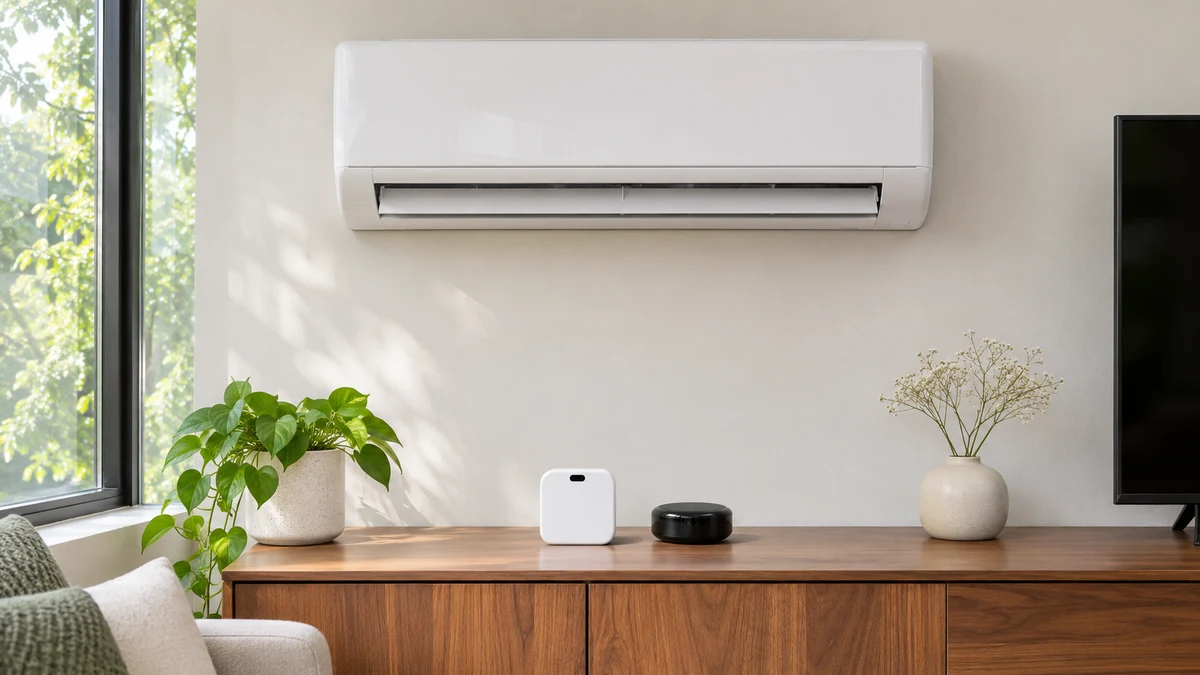
If the air conditioner is the only thing you want to control from your phone, buy a dedicated smart AC controller such as the Sensibo Air, Sensibo Sky, Cielo Breez Max or Mysa. If you also want to run a TV, a fan or a soundbar from the same box, a general-purpose IR hub like the SwitchBot Hub 2 or a BroadLink RM4 does all of them, with fewer climate features. Both kinds work the same way underneath: they copy your AC's handheld infrared remote, so they only fit units that came with one.
Quick picks
| You want | Choose | Why |
|---|---|---|
| The AC to react to heat and humidity on its own | Sensibo Air or Sky | Climate React switches the AC by temperature and humidity thresholds |
| A controller in Apple Home | Sensibo Air | HomeKit certified; shows up in the Home app as a thermostat tile |
| Buttons and a screen on the wall for roommates or guests | Cielo Breez Max or Mysa | Consumer Reports picks with on-device controls and a display |
| A cheap controller for one window unit | Cielo Breez Lite | App control, schedules and geofencing, no screen |
| One box for the AC, the TV and the fan | SwitchBot Hub 2 | IR hub with a built-in thermometer and AC remote status sync |
| Local control in Home Assistant | BroadLink RM4 Mini or RM4 Pro | Long-standing Home Assistant integration; the Pro adds RF |
Check your AC first
Every product on this page talks to the air conditioner over infrared, just like its remote. Consumer Reports' Daniel Wroclawski notes that these controllers work with window and portable units, mini-splits and in-wall heat pumps, as long as the unit uses an infrared remote. If your AC only has buttons on the front, or a wired wall panel, none of them will work.
The controller needs a clear line of sight to the unit. Sensibo lists a range of up to 20 feet for the Air, and Cielo advises placing the Breez Lite within 6 to 12 feet. Plan one device per indoor unit: an IR signal only reaches the head it points at, so a three-zone mini-split needs three controllers.
Wired wall thermostats such as Nest and ecobee rarely fit a ductless head. Sensibo explains that they switch central systems over 24V wires, which a mini-split head doesn't use, so the practical choices are an IR controller or your AC maker's own Wi-Fi module.
What a dedicated AC controller adds
A smart AC controller is built around one appliance, and its app reflects that. You get a thermostat-style screen with mode, fan speed and swing, plus a temperature and humidity sensor in the device. Setup is usually a single step: you point the original remote at the controller and press power, and the app matches the code set. Sensibo says the Air works with more than 10,000 AC models; Cielo lists 300-plus brands and over 20,000 remote models for the Breez Lite.
The bigger difference is automation that understands climate. Sensibo's Climate React and Cielo's Comfy Mode let you set a temperature or humidity range and an action: start cooling when the room gets too warm or too humid, and switch off once it's back in range. Both apps add weekly schedules and geofencing, which turns the AC on as you head home and off when you leave. LinkdHome's David Mead, who ran the Sensibo Sky and Cielo Breez Eco side by side, found Sensibo's geofencing more flexible, with a radius from 300 feet to 5 miles and a last-to-leave mode for households where several people share the app.
The Sensibo Air is the pick for Apple users. It's HomeKit certified, and HomeKit News found it appears in the Home app like any thermostat, with the room temperature on its tile. The older Sensibo Sky has the same Climate React and voice support for Alexa, Google Home and Siri, but no HomeKit. The Sensibo Air Pro adds an air-quality sensor alongside temperature and humidity.
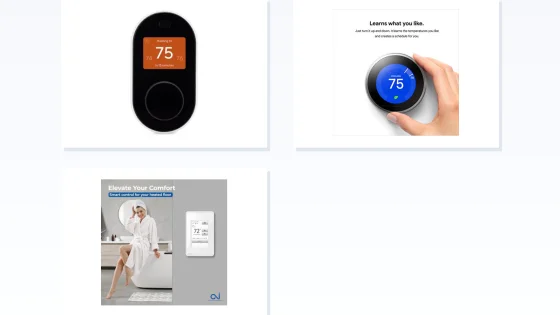
The Cielo Breez Max and Mysa suit homes where not everyone uses the app. Consumer Reports praises the Breez Max's simple LCD and easy controls on the device itself, plus a humidity sensor, geofencing and an automatic Comfy Mode. Mysa has a dot-matrix display, touch buttons, energy monitoring and a humidity sensor, and CR's testers gave its app a high score for setup and ease of use. The Boldr Klima Smart, CR's fourth pick, looks like a Nest Learning Thermostat and adds geofencing with Alexa and Google control.
For a single window unit on a tight budget, the Cielo Breez Lite keeps app control, schedules and geofencing but drops the screen and buttons. It also lets you calibrate its temperature sensor, which helps when the controller sits in a warmer or cooler spot than the rest of the room. TechKith compares the app-first models in Sensibo Air vs Cielo Breez Lite and the wall-style models in Cielo Breez Max vs Honeywell Home D6 Pro.
What a general-purpose IR hub does better
An IR hub learns or looks up the codes for every infrared device in the room: TV, soundbar, projector, fan and air conditioner. That makes scenes possible. LinknLink, which makes its own IR blasters, gives the example of a movie-night scene that turns on the TV, switches the receiver input and lowers the AC temperature together.
The SwitchBot Hub 2 is the most AC-friendly of the general hubs. SwitchBot builds in a temperature and humidity sensor, smart alerts and automations by temperature, humidity and geofencing, and it lists air conditioner remote status sync, which the cheaper Hub Mini doesn't have.
The BroadLink RM4 Mini handles infrared only, while the RM4 Pro adds radio-frequency control for things like RF ceiling fans and shades. LinknLink's comparison credits BroadLink with years of Home Assistant community support and local control once the device is on your network.
The trade-off is depth. An IR hub treats the AC as one more remote, so you won't get Climate React-style rules or a thermostat interface built for heating and cooling. LinknLink puts it plainly: if you mainly care about air conditioning, an AC-focused controller like the Sensibo Sky or Cielo Breez Eco is the better buy. Apple users should also know that HomeKit has no category for general IR remotes, HomeKit News explains, while an AC controller like the Sensibo Air appears as a thermostat.
Cheaper Wi-Fi IR remotes, many of them from Tuya, list Alexa and Google Home support and cover TVs, DVD players and air conditioners from one app. They suit basic on, off and temperature commands from your phone or by voice.
Living with infrared control
Infrared only travels one way. Sensibo explains that if someone uses the original remote, the controller never hears it, and the app keeps showing the last state it sent until the next command. This applies to every brand on this page. A few ways to handle it:
- Put the original remote away and use the app, voice or a schedule as the only way to change settings.
- Use the resync option. The Sensibo app has a Sync AC Power State switch that tells it whether the AC is actually on or off.
- Send a full command. Setting mode and temperature from the app brings the app and the AC back in step. LinknLink notes that many AC remotes send mode, temperature, fan speed and swing in one signal, which is why a full command fixes the mismatch.
- Choose a wired module if exact status matters. Many mini-split brands sell a Wi-Fi adapter that plugs into the indoor unit's board and reads its real state, according to Sensibo, though it only fits certain models and locks you into that brand's app.
Most of these controllers run through the maker's cloud. LinkdHome found the Sensibo Sky and Cielo Breez Eco need an internet connection for app control, so a router outage means falling back on the remote.
Which to choose
Choose a dedicated AC controller if the AC is what you want to automate. The Sensibo Air is the best fit for Apple Home and climate rules, the Cielo Breez Max or Mysa for a screen and buttons on the wall, and the Cielo Breez Lite for the lowest cost.
Choose a general-purpose IR hub if you want one device for the AC, TV and fan, and basic on, off and temperature control is enough. The SwitchBot Hub 2 has the most AC-friendly features, and the BroadLink RM4 suits Home Assistant setups.
FAQ
Is there a smart IR blaster that can control my air conditioner?
Yes. General hubs like the SwitchBot Hub 2 and BroadLink RM4 control an AC alongside the TV and other IR devices. Dedicated controllers like the Sensibo Air and Cielo Breez Max are IR blasters too, built only for air conditioners, with climate automations and thermostat-style apps.
Can I convert any AC to a smart AC?
Almost any AC that came with an infrared remote. That covers most window, portable and mini-split units and in-wall heat pumps. Units controlled only by front-panel buttons or a wired wall controller need another route, such as the manufacturer's own Wi-Fi module.
Do smart thermostats work with mini splits?
Wired thermostats like Nest and ecobee usually don't, because mini-split heads don't use standard 24V thermostat wiring. IR controllers such as the Sensibo Air, Mysa and Cielo Breez Max are designed for mini-splits and need one device per indoor unit.
What is the difference between Sensibo Air and Air Pro?
The Air Pro is the Air with an added air-quality sensor. Both sense temperature and humidity and work with Apple HomeKit; the Pro's air-quality readings help if you're tracking cooking fumes, allergies or a stuffy room.
Is it possible to control an AC without an IR blaster?
Yes, with the manufacturer's Wi-Fi module, if your model supports one. It connects to the indoor unit directly and reports the unit's real state, but it only works with that brand's models and may need a technician to install.