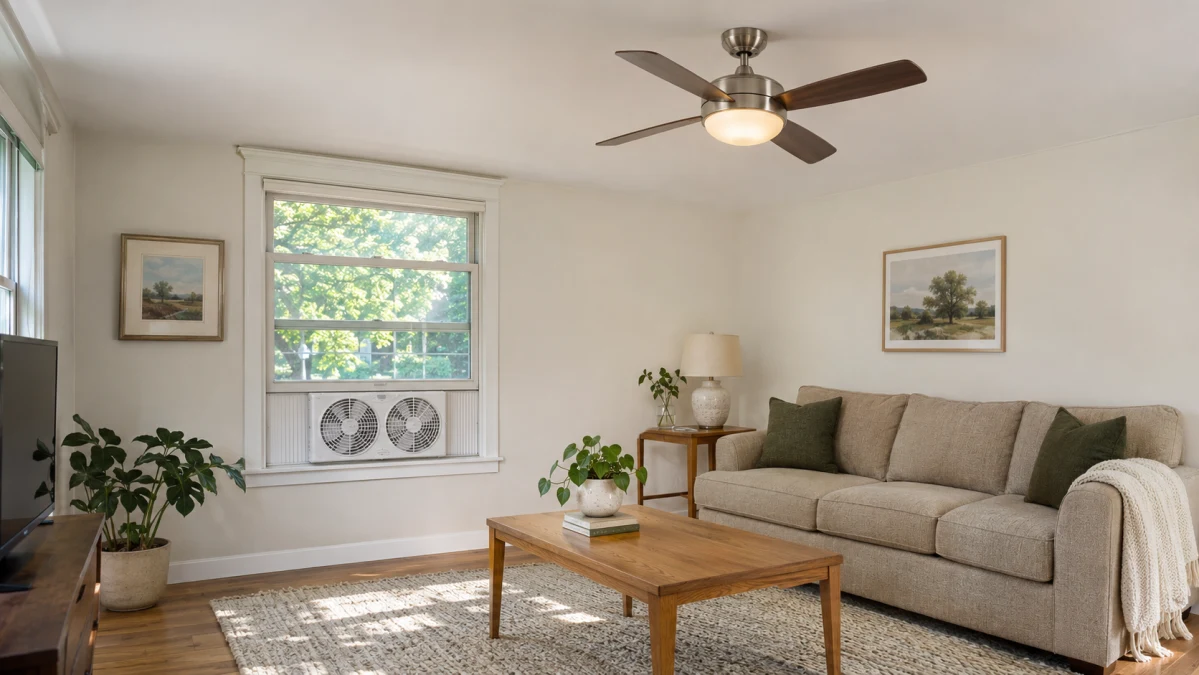
A window fan can help carry heat out of a room when cooler outdoor air is available. A ceiling fan creates a breeze over the people in the room, with the windows closed if you prefer. That difference matters more than an app, a timer or the number of speeds.
Choose a window fan when you want to exchange indoor air with outdoor air. Choose a ceiling fan with a light when you want a breeze and overhead lighting. They can also complement each other: window ventilation on a cool evening, indoor circulation when the windows are closed and the air conditioning is running.
Window fans: useful when the weather gives you something to work with
A house can stay warm long after the temperature outside drops. This is where a window fan earns its place: it can help replace warm indoor air with cooler outdoor air. The Department of Energy describes this approach in its guide to natural ventilation and cooling. Its usefulness depends on the incoming air, so expect more from it on a cool evening than on a hot, muggy afternoon.
Think about where that air will travel. For an exhaust setup, place the fan securely in one window and open another exterior window, keeping interior doors along the route open. CDC describes this arrangement as a way to draw replacement outdoor air through the space. Opening only a bedroom door does not create an outdoor-air inlet if the rest of the home is closed up.
Outdoor conditions can change the decision. EPA recommends avoiding outdoor-air ventilation when pollution or pollen is high, or during extreme temperature and humidity conditions. Check AirNow and local weather and pollen information before opening up. An exhaust setting still draws outside air in elsewhere, so it does not get around a smoke problem.
Humidity deserves a little care, too. A lower relative-humidity percentage outside does not necessarily mean drier air: EPA notes that warmer outdoor air can bring in additional moisture even when its relative humidity is lower. A window fan cannot dehumidify that incoming air.
Check the window before choosing the features
Measure the clear opening’s width and height, identify the window type, and check how the fan will be held in place. Also consider the routine: can the screen stay in place, how will you close and secure the window afterward, and is there a suitable outlet nearby?
A removable fan can still require installation work. Casement windows and sliding windows may need a different mounting arrangement from a double-hung window.
The Twin 9-Inch Window Fan, Lasko model W09560, offers three airflow arrangements. Both fans can bring air in, both can exhaust, or one can draw air in while the other pushes air out. Lasko’s operating manual explains the modes and confirms that the fan has onboard controls as well as Bluetooth control.
That one-in, one-out exchange mode uses the same window for both directions. It offers another arrangement when you have limited openings, but it should not be mistaken for a guaranteed breeze across the room. The location of the fan and other openings still matters.
Lasko’s specification sheet lists a window-opening width of 24–32 inches. The manual adds an important qualification: some sliding-window installations need a plywood filler panel, and casement windows wider than 12 inches require a supporting plywood frame. Check the instructions for your window before assuming the expanding panels make this a drop-in purchase.
For evening use, the adjustable display brightness and timer of up to eight hours are useful conveniences. The room-temperature thermostat can cycle the fan on and off, but it cannot decide whether outdoor air is cooler, drier or clean enough to bring inside. You still make that call.
Phone control uses Lasko Connect’s Bluetooth connection, so think of it as nearby control rather than an internet-connected switch you can operate from anywhere. Check that the app is available for your phone if that feature is part of the reason you are buying.
Availability also warrants a look: Zoro marks its W09560 listing as discontinued. If you find it elsewhere, check that seller’s stock, warranty and return terms.
Ceiling fans: a breeze without opening the windows
A ceiling fan is useful when the room’s air can stay where it is and you want to feel more comfortable in it. That makes it a natural companion to air conditioning. DOE’s Building America guidance explains that the airflow may let you set the AC thermostat a little warmer while maintaining comfort.
The benefit comes from air moving over you. A ceiling fan does not lower the room’s temperature, remove humidity or bring in fresh outdoor air. Running it in an empty room does not prepare a cooler room for your return; ENERGY STAR recommends switching it off when nobody is there.
Because it stays overhead, a ceiling fan also leaves the window and floor space available. The tradeoff is a more involved installation.
Include installation in the budget
An existing ceiling light is a useful starting point, but its mounting box may not be suitable for a fan. ENERGY STAR’s installation guidance calls for an appropriate UL-listed metal electrical box marked for ceiling-fan use. Replacing the box or adding support can become part of the job, so establish the installed cost before comparing purchase prices.
Measure ceiling height and the space around the proposed blades. As general guidance, ENERGY STAR recommends at least 7 feet between the blades and floor and 18 inches between the blades and walls. Follow the selected fan’s instructions for its actual mounting arrangement and clearances, particularly with low or sloped ceilings. Renters should also establish whether they can replace the fixture.
Room size matters, but blade diameter alone is an incomplete buying guide. Look for published airflow in cubic feet per minute, or CFM, when comparing ceiling fans. ENERGY STAR’s product criteria also use airflow per watt to describe efficiency. Those figures are more informative than a motor label by itself.
Give the light its own buying decision
A fan can provide a pleasant breeze and still be a disappointing replacement for your main light. Before choosing a combined fixture, answer three questions:
- Is it bright enough? Ask for light output in lumens. LED wattage describes electricity consumption; it does not tell you how brightly the fixture will illuminate the room. ENERGY STAR’s ceiling-fan lighting guide explains brightness, dimming and light color.
- Can the fan and light run separately? You may want airflow after lights-out or illumination on a cool morning without a breeze.
- What happens if the light fails? With an integrated LED fixture, ask whether the light module is replaceable and whether a replacement part is available.
Dimming and adjustable white color are useful, but they answer different questions. Dimming changes brightness; warm-to-cool settings change the appearance of the light. Neither tells you whether the fixture will adequately light your desk or the far side of the room.
The 45-Inch Ceiling Fan with Light, model W934P387241, is advertised by GobekUSA with an integrated 18W LED, dimming, and warm, neutral and cool white settings. Its “tri-color” description refers to those white-light options; buyers looking for decorative RGB effects should not assume they are included.
The seller also advertises app and Amazon Alexa control, a reversible DC motor, and 1-, 4- and 8-hour timers. However, the listing does not supply light output in lumens, an airflow rating, an app name or a downloadable installation manual for the exact model.
Those omissions affect the purchase more than another control feature would. Ask for the manual, lumen output and app details, along with confirmation that the fan and light operate independently and an explanation of the controls available without a phone. If the seller cannot provide that information, choose a fixture that documents it.
For a bedroom, judge the settings you will actually use
Maximum speed is only part of the story. A bedroom fan needs to provide useful airflow at a setting you are comfortable hearing throughout the night. Display brightness and access to the controls matter, too: a dimmable display or a reachable remote may be more useful at bedtime than voice control.
Treat “quiet,” “silent” and “DC motor” as insufficient evidence of noise performance. If a manufacturer publishes a decibel figure, check the speed and measurement distance before comparing it with another fan. Without comparable measurements, there is no reliable basis for declaring either of these models quieter.
Check return terms before installation, especially for a ceiling fan. Finding that you dislike its sound or lighting after it is mounted can mean additional removal work.
Where a rechargeable hanging fan fits
A small rechargeable fan makes sense when portability and temporary airflow are the priorities. It avoids a hardwired installation, but battery life becomes part of everyday use.
The Portable Camping Ceiling Fan, model FFF-5200mAh-GPCT4923, is a hanging fan with a light. The seller’s listing for the 5,200mAh version advertises USB-C charging, three fan speeds, three light levels and a remote.
Before relying on it overnight, ask about runtime with both the fan and light operating at your intended settings. The seller’s separate fan and lighting estimates do not answer that question. Follow its hanging instructions, and treat it as a portable source of nearby airflow and light—not as a permanent ceiling fixture or a way to ventilate a closed room.
Which fan makes sense for your home?
For a home that holds onto heat after the evening cools down, a securely fitted window fan can help remove that heat. Its usefulness depends on having outdoor air you want to bring inside.
For a bedroom or living room where the windows usually stay closed, a ceiling fan with suitable lighting is the more relevant purchase. Prioritize the installed fit, usable airflow, light output and everyday controls.
If neither installation works and you simply need a breeze, consider a plug-in desk, pedestal or tower fan. If the problem is hot, humid air that needs active cooling and moisture removal, air conditioning addresses that job; either fan can remain a useful companion.