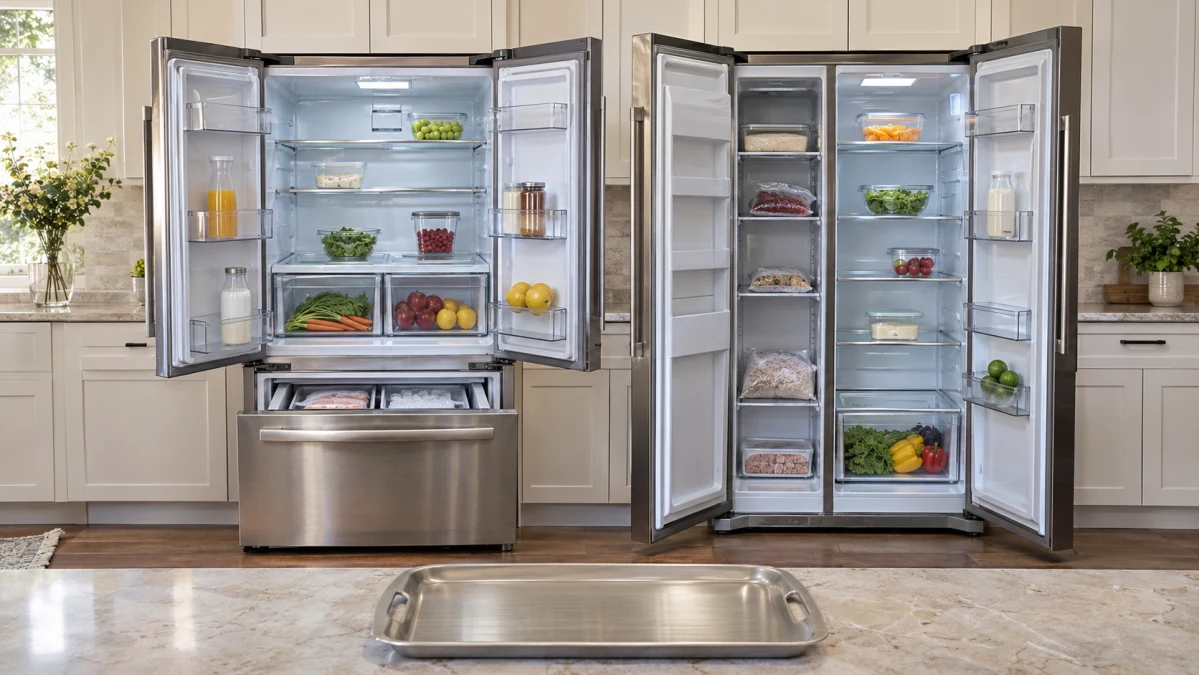
Start with French-door models if wide refrigerated dishes and upper fresh-food access lead your priorities. Investigate side-by-side models if you prefer vertical freezer shelving and access to some fresh and frozen food at eye level. The exact model’s storage geometry and compartment balance can reverse that initial preference.
A refrigerator can have ample listed capacity and fit the cabinet opening yet still frustrate you every day. Choose around your groceries, retrieval habits and operating space—not cubic feet alone. If your needs alternate between refrigerated and frozen storage, changing compartment roles may matter more than either fixed layout.
Start with your groceries, not the capacity total
Whirlpool’s comparison describes French-door configurations with full-width fresh-food shelving, versus tall, narrower refrigerator and freezer compartments in side-by-side units. Wide serving trays and broad leftover containers make that lateral space worth investigating. Narrower packages may suit a shopper who prefers distributing food across vertical shelves. These tendencies do not guarantee the geometry of every model.
Capacity describes volume, not whether a container can pass through the opening, sit entirely on a shelf or fit beneath the shelf above it. A tall package and a broad tray can demand very different storage shapes despite occupying similar volumes. Exterior width and shelf count cannot settle their fit either.
Measure your usual trays, containers and awkward packages, including lids and handles. Compare those measurements with the intended model’s usable shelf width, depth, vertical clearance and access opening, or documented fit information for those items. Allow for the groceries that must sit alongside them: accommodating one large dish is different from storing it with the rest of the week’s food.
Consider French-door storage for wide fresh-food items
Width is only part of the appeal. Whirlpool describes an upper, double-door fresh-food compartment with lower freezer storage. That arrangement may suit a routine dominated by refrigerated groceries, particularly if you prefer retrieving them from the upper compartment.
The same comparison contrasts lower pull-out freezer storage with side-by-side freezer shelves. Think about whether you prefer grouping frozen food in lower pull-out storage or separating packages across vertical shelves. If you want some frozen items at eye level, that preference may outweigh the appeal of upper fresh-food access. Neither arrangement is universally easier to use, and the exact model’s freezer divisions matter more than the layout name.
For the US MRF32I6BST, Midea markets a 32-cu.-ft. French-door refrigerator and lists 31.7 cu. ft. in its specification table: 21.8 refrigerated and 9.9 frozen. That nominal allocation puts substantially more space toward refrigerated food.
The French Door Smart Refrigerator, model MRF32I6BST, is therefore a candidate for a household prioritizing fresh-food storage. Its balance may be the wrong trade for someone whose shopping revolves around frozen meals and bulk freezer purchases. Keep the two decisions separate: the compartment volumes describe allocation, while your container measurements determine usable fit.
Consider side-by-side storage for vertical freezer organization
If you regularly retrieve both refrigerated and frozen food, consider how a vertical arrangement changes that routine. Whirlpool describes side-by-side compartments with some fresh and frozen items accessible at eye level, contrasting them with upper fresh-food and lower freezer storage in French-door configurations. Shelf-based freezer sorting may suit you better than grouping packages in lower pull-out storage; it is a preference, not a promise of faster retrieval or less bending.
The width trade-off can be decisive. Tall, narrower compartments may conflict with broad trays or containers even when the capacity total seems generous. Favor this arrangement for its retrieval and sorting pattern only if your groceries also suit the usable shelf geometry.
Midea’s US MRS26D7AST illustrates both organization and allocation. Midea lists five refrigerator shelves, four freezer shelves and a top-shelf ice maker, with 26.3 cu. ft. total capacity divided into 13.1 refrigerated and 13.2 frozen. The shelves provide places to separate frozen-food categories, while the nearly even listed storage split gives refrigerated and frozen food similar nominal allocations. Those features belong to this model, not every side-by-side refrigerator.
The Stainless Side-by-Side Smart Refrigerator, model MRS26D7AST, is a candidate when vertical freezer sorting and that storage balance match your routine. Compared with the MRF32I6BST, it assigns more listed volume to frozen food and less to refrigerated food despite its smaller total. That may be a useful exchange for a freezer-focused household, but a poor one if wide refrigerated dishes dominate your storage needs.
Check the opening, operating space and delivery route separately
Treat cabinet fit, operating room and delivery access as separate tests. A refrigerator that fits the recess can still have a blocked door or a drawer that cannot extend fully.
- Measure the opening. LG’s general fit guide calls for height from the floor to overhead cabinetry, width at several heights using the smallest result, and depth from the back wall to the counter edge. Account for top hinges when comparing appliance height with the opening.
- Allow for installation space. Compare those measurements with the intended model’s dimension drawing and installation requirements, including required ventilation clearances. The closed appliance’s exterior dimensions are not the whole installed footprint.
- Map doors and drawers in motion. Use the exact model’s specified door-opening and drawer-access requirements, including space for full extension and drawer removal. Plot nearby walls and counters against that movement. LG’s guide also measures from the back wall toward an island or other obstruction and calls for full drawer opening while retaining walking space. Assess the aisle with storage open, not just with the refrigerator closed.
- Measure the delivery route. LG advises measuring the entire route from curb or driveway to kitchen. Identify the narrowest openings and account for turns, stairs, gates, fixtures, handles and furniture—not merely the kitchen doorway.
Neither layout has an automatic space advantage. Base the choice on the particular model’s doors, drawers and installation requirements: fitting between cabinets does not establish that it will work beside a wall, leave useful aisle space or make it through the delivery route.
Consider convertibility when storage roles need to change
Convertibility merits consideration when your additional storage needs alternate between refrigerated groceries and frozen food. That is an allocation problem: you want the same appliance to serve different storage roles, rather than simply a different shelf arrangement.
For the US MRU21C7BST, Midea describes full-refrigerator, full-freezer and split refrigerator/freezer operation, listing 20 cu. ft. total capacity with 10 cu. ft. per compartment. These configurations belong to this model; a “three-way” label does not establish identical choices across other products. Its nominal compartment volumes describe the storage division, not the dimensions of items that fit.
Keep the physical requirements unchanged. Compare grocery dimensions with usable storage space, consider whether the shelves and drawers match your retrieval preferences, and allow for installation clearances, door movement and delivery access. Changing a compartment’s role does not widen a shelf or create more aisle space.
The 3-Way Convertible Smart Refrigerator, model MRU21C7BST, is worth considering when the supported choice among all-refrigerated, all-frozen and split storage addresses your changing demand. If the problem is a broad tray, an awkward reach or a blocked door, choose on physical layout instead.
Favor French-door models when wide refrigerated items and upper fresh-food access matter most; favor side-by-side models when vertical freezer sorting and access to some fresh and frozen food at eye level suit your routine. Consider convertibility when changing refrigerated-versus-frozen allocation is the real need. In every case, let usable item fit, the exact compartment balance, freezer organization, door and drawer movement, and the delivery route override the initial layout preference. If a model fails those practical tests, choose another—even if its capacity total looks ideal.