
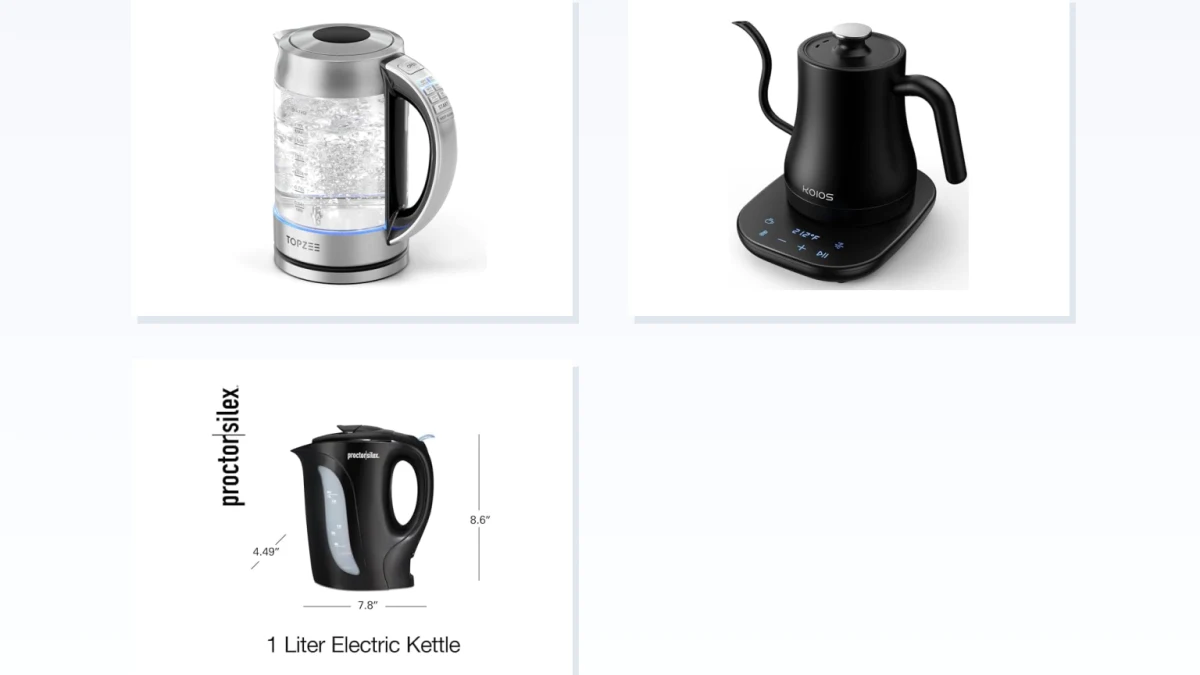
Choosing between a glass and stainless steel electric kettle is mainly a question of construction, visibility, durability, and day-to-day maintenance—not which material is universally "safer" or faster. A glass kettle makes the water level and mineral buildup easy to see, while stainless steel usually tolerates knocks better and is more commonly available in insulated designs. In both cases, the parts that actually contact hot water can include more than the material named on the product page.
This guide compares glass and stainless steel kettles by the details that matter in normal use: water-contact materials, resistance to damage, visibility, exterior temperature, cleaning, and boil performance. The product widgets below separate the two materials, but always verify the individual model's construction because a "glass" or "stainless steel" label may describe only the main body.
Quick Verdict: Glass or Stainless Steel?
- Choose a glass electric kettle if you value an unobstructed view of the water level, want mineral deposits to be easy to spot, and do not mind handling a breakable vessel. Glass is especially convenient when you frequently boil different amounts of water and want to see the interior without opening the lid.
- Choose a stainless steel electric kettle if impact resistance and durability matter more than visibility. Stainless models are also common in double-wall designs, which can reduce exterior heat and slow heat loss after boiling, although construction varies by model.
- Do not choose by material alone if boil speed is your priority. Wattage, the amount of water, starting temperature, heating-element design, and automatic control have more influence on boiling time than whether the vessel is glass or stainless steel.
What This Comparison Covers
This page focuses on the main vessel material of standard electric kettles. It does not rank kettles by gooseneck design, variable-temperature controls, app connectivity, tea presets, or coffee-brewing features.
One distinction matters throughout the comparison: body material is not the same as water-contact construction. A glass kettle may have a plastic lid, filter frame, or level markings near the water path. A stainless steel kettle may use plastic inside the lid, around the spout, or in a water-level window. If minimizing contact between hot water and plastic is important to you, inspect the interior rather than relying on the product title.
Glass Electric Kettles: Best for Visibility
The clearest advantage of a glass kettle is visibility. You can usually see the water level directly through the vessel, watch the boil, and notice mineral deposits without opening the kettle. That makes it easier to avoid overfilling and to recognize when descaling is due.
Many glass kettles use heat-resistant glass, but the exact material should be confirmed from the manufacturer's specifications rather than assumed. Terms such as "borosilicate glass" or other specific construction claims are more useful than a generic "glass kettle" description.
Glass is chemically stable and does not normally retain odors, but a glass kettle is rarely made entirely of glass. The base or heating plate is usually metal, while lids, handles, seals, filters, and other components can use different materials. If water-contact construction matters to you, check those components individually.
The main disadvantage is mechanical durability. Glass can crack or shatter after a fall, a hard impact, or damage to the vessel. A thicker or heat-resistant glass construction does not make a kettle unbreakable. Glass models can also feel heavier than similarly sized plastic kettles, although total weight varies substantially between products.
Use the widget below to compare glass electric kettles. Prioritize the individual specifications for capacity, wattage, lid design, water-contact materials, automatic shutoff, and boil-dry protection rather than assuming these features from the body material.
What to Check on a Glass Kettle
Look closely at the lid and spout in product photos. A kettle with a glass body may still expose boiling water or steam to plastic components. Also check whether the opening is wide enough to reach the bottom and walls during cleaning.
The transparent body makes limescale easier to notice, but it can also make deposits more visually obvious between cleaning cycles. That is primarily a maintenance consideration rather than a reason to avoid glass.
Exterior temperature is another consideration. A single-wall glass vessel can become very hot during boiling. Do not assume that a handle, lid, or body is cool-touch unless the manufacturer specifically describes the relevant construction.
Stainless Steel Electric Kettles: Best for Impact Resistance
Stainless steel is generally the more forgiving choice when a kettle is likely to be bumped, moved frequently, or used in a busy kitchen. It can dent or scratch, but it does not have the same breakage risk as a glass vessel.
Do not assume a particular stainless steel grade unless the manufacturer identifies it. Some listings specify grades such as 304 stainless steel, while others simply say "stainless steel." More important for everyday use is whether the interior water chamber, lid underside, spout, and filter are actually made from the materials you expect.
Stainless steel is opaque, so checking the water level can be less convenient. Some kettles solve this with an external level window, but that window may introduce an additional plastic component into the construction. Other models rely on internal fill marks that require opening the lid.
Mineral deposits can also be less obvious from the outside than they are in a transparent glass kettle. They are still visible when you inspect the interior, particularly around the bottom heating plate, so regular inspection is more useful than waiting for a change in taste or performance.
Use the widget below to compare stainless steel electric kettles by capacity, wattage, interior construction, lid design, insulation, safety features, and ease of cleaning.
Single-Wall vs Double-Wall Stainless Steel
A double-wall kettle can be useful if you want better heat retention or a cooler exterior surface. However, "double-wall" describes the construction, not necessarily the materials used in both layers. Depending on the model, the outer wall may be stainless steel or another material.
Double-wall construction also should not be interpreted as evidence that the kettle boils faster. Boiling performance depends primarily on electrical power, water quantity, starting temperature, control behavior, and overall thermal design.
A double-wall body may reduce exterior temperature, but no kettle should be assumed safe to touch immediately after boiling unless the manufacturer explicitly specifies a cool-touch design.
Does Stainless Steel Boil Water Faster Than Glass?
Not inherently.
Two kettles with similar usable capacity and similar heating power can have similar boiling times even if one is glass and the other stainless steel. Material and insulation can influence heat losses, but they are only part of the system.
For a practical comparison, look at:
- rated wattage;
- tested or manufacturer-stated boil time for a specified amount of water;
- minimum and maximum fill volumes;
- heating-element design;
- automatic shutoff behavior.
Be cautious with statements such as "stainless steel heats faster" unless they refer to measurements from specific models rather than the material category as a whole.
Which Material Is Easier to Clean?
Both glass and stainless steel can be easy to maintain when the kettle has a wide opening and an accessible interior.
Glass has the visibility advantage. Mineral buildup is difficult to miss, so you are more likely to descale before deposits become heavy.
Stainless steel has the cosmetic advantage. Deposits inside the kettle are not visible while it is sitting on the counter, but you need to inspect the interior periodically.
For either material, lid geometry can matter more than the vessel itself. A wide opening or removable lid can make cleaning considerably easier than a narrow hinged design. Follow the manufacturer's descaling instructions because recommended methods can vary by model.
What About Plastic Electric Kettles?
Plastic kettles should not automatically be treated as unsafe or as temporary products. A blanket safety ranking of plastic, glass, and stainless steel is not justified by the body material alone.
Plastic models have their own practical tradeoffs. They are often lighter, and their exterior surfaces may transfer less heat to the hand than exposed single-wall glass or metal. At the same time, buyers who specifically want to minimize plastic in contact with hot water may prefer a kettle with a glass or stainless steel interior.
A "BPA-free" label is useful only for the claim it actually makes. It does not tell you whether the entire water path is plastic-free, what materials are used elsewhere in the kettle, or whether the appliance has been evaluated for electrical safety. Instead of treating one marketing phrase as a complete safety assessment, check the manufacturer's material specifications and the electrical-safety certification or conformity information appropriate to your market.
Glass vs Stainless Steel: The Important Differences
Choose glass when visibility matters most
Glass makes it easy to judge the water level and inspect the inside of the kettle without opening it. It is also the simpler choice if you want the main vessel itself to be non-metallic.
The tradeoff is breakability. If the kettle will be handled roughly, transported frequently, or used where it can easily be knocked from a counter, stainless steel is usually the more practical material.
Choose stainless steel when durability matters most
Stainless steel handles everyday impacts better and is widely available in insulated designs. It is a strong choice for frequent use when you care more about robustness than seeing through the vessel.
The tradeoff is visibility. You may need to open the kettle to check fill marks or mineral buildup, and some models add a separate water-level window.
Compare the actual construction when plastic contact matters
Neither category guarantees a plastic-free water path.
For each kettle, inspect:
- the inside of the lid;
- the spout and filter;
- seals and gaskets;
- the water-level window, if present;
- the interior base or heating plate;
- any components that can contact boiling water or condensed steam.
That information is more useful than simply choosing "glass" or "stainless steel" in a category filter.
Pre-Purchase Checklist
- What materials actually contact the water? Check the interior, lid, spout, filter, seals, and level window rather than only the body description.
- Is the capacity appropriate? A large kettle is unnecessary if you normally boil one or two cups, while an undersized kettle creates repeated boil cycles.
- What is the rated wattage? Compare power and any model-specific boil-time information instead of assuming one body material is faster.
- Does it have automatic shutoff and boil-dry protection? These are more important safety features than many cosmetic differences between materials.
- Can you reach the interior for cleaning? Wide openings and removable lids usually simplify descaling.
- How hot does the exterior become? Look for specific double-wall or cool-touch construction if exterior temperature matters.
- How is the water level indicated? Glass provides direct visibility; stainless steel models may use internal markings or a separate level window.
- Are important construction claims specific? Prefer listings that identify actual materials rather than vague phrases such as "premium metal" or "high-quality glass."
- Is there appropriate electrical-safety certification or conformity information for your market? This is separate from claims such as BPA-free.
- What does the warranty actually cover? For glass models in particular, check the terms rather than assuming vessel breakage is covered.
Final Verdict
There is no universal winner between glass and stainless steel electric kettles.
Choose glass for direct water-level visibility and easier visual monitoring of mineral buildup. Choose stainless steel for greater resistance to everyday impacts and access to a wider range of insulated designs.
Do not pay extra for stainless steel because you expect the material alone to boil water faster, and do not choose glass because you assume every component touching the water is glass. For either type, the better kettle is the model with clearly documented water-contact materials, appropriate capacity and power, effective automatic safety features, and an interior you can clean easily.