
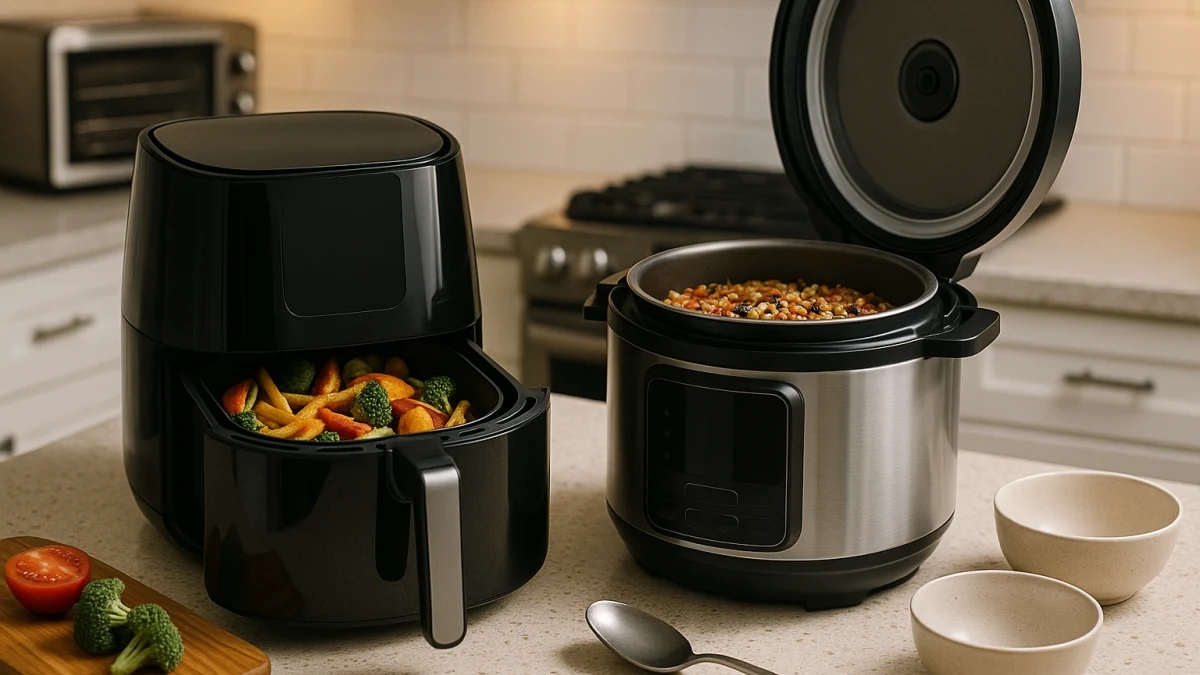
An air fryer and a multicooker can both sit on a countertop, but they solve different dinner problems. This page compares them by the job you want done on a weeknight: dry hot-air crisping and reheating versus covered one-pot cooking for rice, beans, soups, stews, and batch prep.
A normal category page can show plenty of small appliances. It usually will not stop you from buying the wrong kind of convenience. Start with the meal outcome, then compare capacity, cooking layout, active attention, cleanup claims, and the exact modes listed on each product page.
Pick by dinner job, not appliance name
- Crispy leftovers, frozen foods, fries, wings, roasted vegetables, or small-batch dinners: air fryer is the better fit.
- Soups, stews, rice, beans, shredded meats, slow cooking, steaming, or meal prep: multicooker is the better fit.
- Baking, toasting, pizza, racks, trays, or larger countertop oven-style capacity: smart oven is a boundary path, not the main comparison.
- One appliance that claims both air fry and pressure-style cooking: treat an air-fryer multicooker combo as a compromise to inspect carefully.
The most important split is dry heat versus moist one-pot cooking. Air fryers are about crisping, browning, roasting, and reheating in a basket or similar hot-air layout. Multicookers are about contained cooking, often with functions such as slow cook, sauté, steam, rice, yogurt, keep warm, or pressure cook when the exact model supports it. Capacity matters too: air fryer listings here range from compact 2-quart models up to larger 8-quart or dual-basket options, while multicooker-style options include 6-, 7-, and 10-quart batch-cooking sizes.
The weeknight fork: crispy basket food or covered one-pot dinner?
Ask what you want to eat on the nights when you are tired, not what appliance name sounds more versatile.
- Choose the air fryer lane if your usual dinner problem is texture: fries that need crisping, wings, breaded frozen foods, roasted vegetables, or leftovers that should come back hot and browned rather than soft.
- Choose the multicooker lane if your usual dinner problem is containment and batch size: rice, beans, soups, stews, shredded meats, steamed foods, or slow-cooked meals that benefit from a covered pot.
- Be careful with “does everything” language. A combo or oven-style product may cover some overlap, but it can also mean compromises in basket space, pot function, footprint, or the way food is arranged.
The wrong choice is easy to feel after a week. A multicooker is not the natural tool for crisp fries or wings. A basket air fryer is not the natural tool for liquid-heavy dinners such as beans, soups, rice, or stews.
Keep microwaves, stovetop pans, and recipe browsing out of this choice
This comparison stays inside US countertop dinner appliances sold as air fryers or multicookers, with smart ovens handled only as a boundary case. It is not a microwave guide, a stovetop cookware guide, a portable induction burner guide, a commercial-appliance guide, or a recipe collection.
That scope matters because the shopping mistake is not “which appliance has more features?” It is “which appliance matches the food I actually make most often?”
Air fryer: the crisping-and-reheat lane
Use this lane if the decision question is: do you mostly want crisp leftovers, frozen foods, fries, wings, roasted vegetables, or small-batch dinners without turning on a full oven? Basket air fryers and dual-basket air fryers are built around hot circulating air, so they make more sense for dry-heat browning and reheating than for rice, beans, soups, or stews.
Capacity is not filler here. A compact air fryer can be enough for one or two portions, while larger 6-, 6.5-, 6.8-, or 8-quart models can make more sense for bigger portions. A dual-basket layout is worth comparing if you want to cook two foods separately rather than stack everything in one basket. Also look at the footprint, control style, viewing window, and listed modes such as roast, bake, broil, dehydrate, and reheat.
Read the products shown here as different versions of the same basic answer: hot-air crisping and quick reheating. If the listing mentions a nonstick basket, dishwasher-safe basket, or dishwasher-safe parts, treat that as model-specific and check the product page. If your real dinner plan is soup, beans, rice, or a pressure-style meal, move to the multicooker lane instead.
Multicooker: the one-pot and batch-prep lane
Use this lane if the decision question is: do you mostly want soups, stews, rice, beans, shredded meats, slow cooking, steaming, sautéing, or pressure-style meals with less active attention? A programmable multicooker or electric pressure cooker is the stronger fit when dinner belongs in a covered pot instead of a basket.
Look closely at the exact function list. Some products are electric pressure cookers with pressure cook, slow cook, sauté, steam, rice, yogurt, and keep warm modes. Others are multicookers that focus more on slow cooking, steaming, sear/sauté, warming, or related one-pot functions. Do not assume every multicooker pressure cooks just because the category name sounds broad.
Capacity points to a different kind of weeknight planning than an air fryer basket. A 6-quart multicooker can suit many one-pot meals, while 7- and 10-quart listings may be more relevant for larger households or batch prep. Inner-pot material, included accessories, digital controls, and care instructions are also worth checking because lookalike multicookers can differ in the details that affect daily use.
Read the products shown here as the moist-cooking and batch-prep answer. They are useful when you want contained cooking, keep-warm convenience, steaming, sautéing, rice, or pressure-style meals where supported. If your dinner goal is crisp breading, browned edges, fries, wings, or reheated leftovers, the air fryer lane is the cleaner fit.
When the answer is neither basket nor sealed pot
Some products blur the taxonomy. A smart oven with air fry mode is still an oven-style appliance with racks, trays, a cavity, and a larger footprint. An air-fryer multicooker combo may promise both dry heat and pot cooking, but it should be evaluated as a compromise rather than a way to skip the core choice.
Use this check: if you are imagining trays, toast, pizza, baking, or rack positions, you may be shopping for a countertop oven. If you are imagining rice, beans, soup, stew, or pressure-style cooking, the oven-style path will not solve that side of the decision.
Smart oven: a boundary path for trays, toast, and baking
Move here only if your real need is countertop oven-style cooking: bake, toast, broil, roast, pizza, tray cooking, racks, or a larger cavity. Some smart ovens and convection toaster ovens also list air fry, dehydrate, reheat, proof, slow cook, keep warm, Wi-Fi, app control, or voice control, but those details vary by model.
Treat these products as an exit path, not a third equal answer. Compare exterior dimensions, interior capacity, rack positions, included trays or baskets, and the modes you will actually use. A smart oven may overlap with air-fry functions, but it does not replace the multicooker side of rice, beans, soups, stews, or one-pot batch meals.
Model-page checks before you click: quarts, modes, parts
Before choosing, confirm the details that change the dinner fit:
- Quart capacity: compare air fryer basket size against multicooker pot size. A 2-quart air fryer and a 10-quart multicooker are solving very different portion problems.
- Cooking layout: basket, dual-basket, sealed pot, rack, or tray will affect what you can cook together.
- Listed modes: verify air fry, roast, bake, broil, dehydrate, or reheat on air fryers; verify pressure cook, slow cook, sauté, steam, rice, yogurt, and keep warm on multicookers where those functions matter.
- Pressure cooking: check whether the exact multicooker is actually an electric pressure cooker if pressure-style meals are part of your plan.
- Parts and care: do not assume dishwasher-safe baskets, dishwasher-safe parts, ceramic coatings, nonstick materials, PFOA-free language, or inner-pot care instructions unless the product page says so.
- Footprint: compact baskets, dual-basket air fryers, 6- to 10-quart multicookers, and oven-style smart ovens take up counter space differently.
Claims that need a source, not a slogan
Be cautious with claims that sound universal. Oil-reduction percentages, coating safety, pressure-release safety, burn-hazard language, electrical certification, recall status, dishwasher-safe parts, wattage implications, and food-temperature guidance should come from the exact product page, manufacturer materials, or an appropriate official source.
For the practical purchase decision, you do not need a slogan. You need the appliance that matches your usual dinner: air fryer for crisping and reheating, multicooker for one-pot batch meals, and smart oven only when trays, toast, baking, or pizza are the real reason you are shopping.