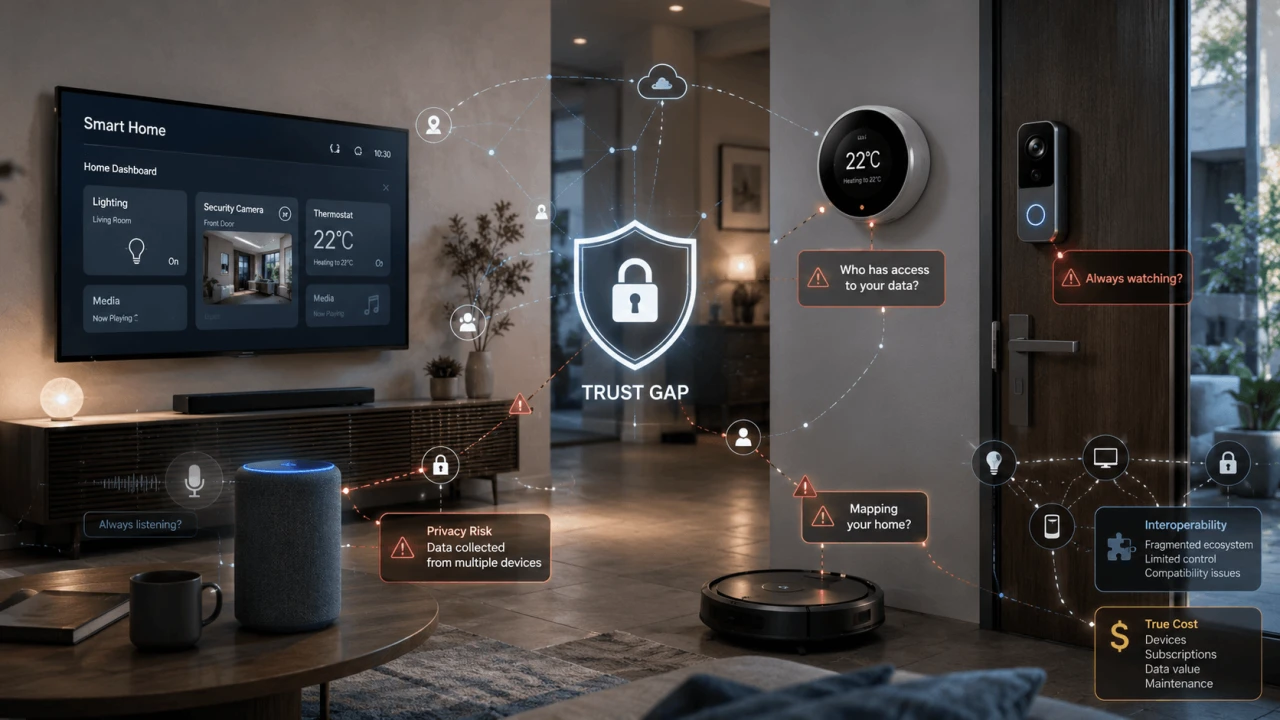
A source-backed statistical review of why smart home adoption is expanding while consumer trust remains constrained by privacy concerns, cybersecurity risk, cost, reliability problems, and ecosystem fragmentation.
Abstract
Smart home technology is moving from early-adopter novelty toward household infrastructure. Public surveys now show broad ownership of smart TVs, smart speakers, doorbell cameras, robot vacuums, locks, and energy-related devices. Yet adoption alone does not imply confidence. The emerging constraint is a trust gap: consumers use connected devices, but many hesitate to expand their smart home because of cost, privacy and security concerns, device glitches, unclear data practices, and fragmented ecosystems.
This report synthesizes consumer survey data, standards-body materials, regulator actions, and academic research published or updated primarily between 2024 and 2026. It separates ownership and adoption metrics from shipment, revenue, and forecast claims; marks vendor-sponsored surveys as directional rather than definitive; and treats market-size forecasts cautiously where public methodology is limited.
Key findings
- A OnePoll survey of 5,000 U.S. homeowners reported that more than eight in ten American homes contained smart technology, but this figure should be treated as homeowner-survey evidence rather than a nationally harmonized adoption statistic.
- In the same survey, smart TVs were the most commonly reported smart device category at 58%, followed by smart speakers at 36%, doorbell cameras at 35%, robot vacuums at 22%, smart locks at 15%, and smart refrigerators at 14%.
- Cost was the leading reported barrier to buying additional smart home devices at 53%, followed by privacy and security concerns at 33%, and concern about glitches at 23%.
- Energy efficiency is becoming a major purchase factor: 64% of respondents in the same survey said they considered energy efficiency and possible financial benefits when evaluating new smart devices.
- Deloitte’s 2023 Connected Consumer Survey reported that 58% of respondents worried their devices were vulnerable to security breaches, and another 58% worried that organizations or individuals could track their movement or behavior through devices.
- Deloitte also reported that 34% of respondents experienced at least one breach or scam in the prior year, while only 34% felt companies were clear about how they use collected data.
- The Connectivity Standards Alliance positions Matter as a reliability, security, and interoperability standard for connected devices, but public reporting on Matter 1.4–1.5 shows that support is still expanding category by category rather than solving all fragmentation at once.
- The EU Cyber Resilience Act entered into force on December 10, 2024, with main obligations applying from December 11, 2027 and reporting obligations from September 11, 2026, making cybersecurity a product-lifecycle issue for connected hardware and software.
- The U.S. Cyber Trust Mark was launched as a voluntary label for consumer IoT security, but public reporting in 2025–2026 indicates that program execution and governance remain politically and operationally sensitive.
- Academic research on video doorbells and smart cameras shows that bystander privacy remains weakly addressed: policies may acknowledge bystanders but often shift responsibility to the device owner.
- Smart TVs deserve separate privacy treatment: recent black-box research on Samsung and LG TVs found that automatic content recognition can operate even when the TV is used as an external display, though opt-out controls affected ACR network traffic in the tested settings.
- Energy savings should not be presented as universal. ENERGY STAR notes that certified smart thermostats are independently certified based on actual field data, while recent sustainable HCI research warns that rebound effects can reduce or offset efficiency gains.
Methodology and source grading
This report is a desk-research synthesis, not a new household survey. It prioritizes official standards bodies, regulators, peer-reviewed or preprint academic research, and large-scale consumer surveys. Vendor-sponsored surveys are included only when sample size and framing are available, and they are labeled as directional.
| Tier | Source type | How it is used | Limitations |
|---|---|---|---|
| Tier 1 | Regulators, standards bodies, government programs, academic research | Definitions, legal context, privacy/security mechanisms, interoperability claims | Often not designed to measure consumer adoption |
| Tier 2 | Reputable consumer surveys and analyst summaries | Consumer concerns, household technology use, market signals | Definitions and sampling frames vary |
| Tier 3 | Vendor-sponsored surveys, media summaries, product announcements | Directional evidence and category examples | Potential sponsor bias; limited raw methodology |
Data separation rule: household ownership, active use, shipments, revenue, installed base, and purchase intent are not interchangeable. This report does not combine them into a single “smart home adoption” number.
1. Smart home adoption: mainstream, but measured inconsistently
Smart home adoption is now visible across multiple consumer device categories. A 2025 OnePoll survey of 5,000 U.S. homeowners, reported by the New York Post and sponsored in connection with Vivint, found that more than eight in ten American homes contained at least one smart technology product. Because the survey focuses on homeowners and was distributed through a media report rather than a full technical methodology, this figure should be treated as a directional homeowner snapshot, not a definitive national penetration rate.
Another directional signal comes from a Verizon Consumer Connections report summarized by Axios, which stated that 42–45% of U.S. internet households owned at least one smart home device and that the average Verizon-connected household had 18 connected devices. The gap between “80%+ of homeowners with smart tech” and “42–45% of U.S. internet households owning a smart home device” illustrates why definitions matter: smart TVs, streaming hubs, connected appliances, and “smart home device” categories may be counted differently by different studies.
Figure 1. Selected smart device ownership reported in a 5,000-homeowner U.S. survey
2. Why consumers buy smart home devices
The strongest purchase drivers cluster around convenience, security, remote control, and energy management. In the OnePoll homeowner survey, respondents highlighted real-time alerts or notifications, battery backup or power-fail safety, and voice or app control as valued smart home features. These are not merely “nice to have” features; they indicate that consumers buy smart home products when the device reduces uncertainty: who is at the door, whether the home is secure, whether a system is still running, or whether energy use can be monitored.
Figure 2. Selected desired smart home features
3. Barriers: cost, privacy/security, and glitches
The adoption story becomes more interesting when purchase drivers are compared with barriers. The same U.S. homeowner survey reported cost as the largest barrier to buying smart home devices, followed by privacy/security concerns and susceptibility to glitches. This pattern suggests that consumers are not rejecting smart home technology as a concept. They are rejecting friction: high up-front prices, subscriptions, uncertainty about privacy, and doubt that products will work reliably over time.
Figure 3. Top reported barriers to acquiring smart home devices
This is the first measurable layer of the smart home trust gap: consumers may want convenience and security, but they also worry about whether the device is worth the price, whether it can be trusted with household data, and whether it will remain functional.
4. Privacy and security: the central trust bottleneck
Deloitte’s 2023 Connected Consumer Survey, summarized in a 2024 Deloitte/WSJ article, provides a broad consumer-trust baseline. It reported that 58% of respondents worried their devices were vulnerable to security breaches, and the same share worried that organizations or individuals could track movement or behavior through devices. The survey also reported that 34% had experienced at least one breach or scam in the prior year, while only 34% felt companies were clear about how they use collected data.
Figure 4. Consumer trust indicators from Deloitte’s Connected Consumer Survey
Smart home privacy risk is not evenly distributed across device categories. A smart plug and an indoor camera are both connected devices, but they do not collect the same kind of data. The more a device can see, hear, map, unlock, recognize, infer, or automate, the greater its trust burden becomes.
| Device category | Primary sensitive data | Trust concern | Evidence maturity |
|---|---|---|---|
| Indoor cameras | Video, audio, household activity | Surveillance, cloud storage, unauthorized access, family/guest privacy | High |
| Video doorbells | Video, audio, faces, visitors, public-facing activity | Bystander privacy, neighbors, delivery workers, law-enforcement access concerns | High |
| Voice assistants | Voice commands, household audio, routines | Always-listening perception, data retention, youth privacy, third-party skills | High |
| Robot vacuums | Floor maps, room layout, occupancy patterns, sometimes images | Household mapping and cloud processing | Medium |
| Smart locks | Access events, user identity, remote unlock controls | Authentication, account takeover, physical security | Medium |
| Smart TVs | Viewing behavior, ACR fingerprints, ad identifiers | Profiling, opt-out clarity, second-party tracking | High |
| Smart thermostats | Temperature settings, occupancy signals, energy patterns | Occupancy inference and utility data sensitivity | Medium |
| Smart lighting/plugs | Usage events, schedules, network identifiers | Presence inference and weak device security | Medium |
5. Bystander privacy: the trust gap beyond the device owner
Bystander privacy is one of the strongest research angles for smart cameras and video doorbells because it expands the privacy question beyond the purchaser. A 2025 arXiv paper analyzing privacy policies for 20 video doorbell and smart camera products found that vendors may acknowledge bystanders but often treat the issue through disclaimers, shifting responsibility to the device owner. A 2026 arXiv study of 49 Chinese smart home apps similarly reported that bystander privacy was largely absent from policy documents and interface design.
This matters because smart home data collection can affect people who never bought, installed, or configured the device: family members, guests, tenants, caregivers, neighbors, delivery workers, and passers-by. A trust framework that focuses only on the device owner misses a large part of the social privacy problem.
6. Smart TVs: the overlooked smart home privacy device
Smart TVs are often treated as entertainment devices rather than smart home sensors, but recent research suggests they deserve a separate privacy category. A 2024 arXiv study on automatic content recognition (ACR) in Samsung and LG smart TVs found that ACR tracking can operate across viewing contexts, including when the TV is used as an external display, while opt-out controls stopped ACR network traffic in the tested cases. This makes smart TVs an important example of “ambient” data collection in the home: the device does not need to look like a security product to become a profiling surface.
7. Interoperability: the hidden adoption bottleneck
Interoperability is not only a technical issue; it is a consumer trust issue. A user who does not know whether a device will work with Apple Home, Google Home, Amazon Alexa, Samsung SmartThings, Matter, Thread, Wi-Fi, Zigbee, or a proprietary app experiences compatibility as risk. The Connectivity Standards Alliance describes Matter as an IP-based standard intended to improve reliable, secure connectivity and compatibility across brands. That promise directly addresses a core weakness in the smart home market: fragmentation.
However, Matter is still expanding in stages. Public reporting on Matter 1.4, 1.4.1, and 1.5 shows progress on energy management, routers, Thread improvements, easier onboarding, and cameras, but not a complete end to ecosystem complexity. The practical consumer question is not “Does Matter exist?” but “Does this device category support the features I need across the platforms I use?”
| Layer | Examples | Consumer problem | Trust implication |
|---|---|---|---|
| Radio/network | Wi-Fi, Thread, Zigbee, Bluetooth, Ethernet | Device requires specific hubs, routers, or coverage | Reliability feels uncertain |
| Application standard | Matter, proprietary cloud APIs | Feature parity differs across ecosystems | “Works with” claims may disappoint |
| Platform | Apple Home, Google Home, Alexa, SmartThings | User may be locked into a preferred ecosystem | Switching cost increases |
| Automation | Scenes, routines, conditional triggers | Automations can fail or behave unpredictably | Reliability trust declines |
| Data/control | Cloud storage, local control, app permissions | User may not know where data goes or what works offline | Privacy and resilience concerns increase |
8. Cybersecurity regulation and labeling are becoming part of the market
Governments and regulators are increasingly treating connected-device security as a product baseline rather than an optional premium feature. In the European Union, the Cyber Resilience Act introduces mandatory cybersecurity requirements for manufacturers of products with digital elements and requires vulnerability handling across the product lifecycle. The Act entered into force on December 10, 2024; reporting obligations begin September 11, 2026, and the main obligations apply from December 11, 2027.
In the United States, the Cyber Trust Mark was introduced as a voluntary label for consumer IoT cybersecurity, covering categories such as smart thermostats, baby monitors, app-controlled lights, cameras, fitness trackers, and internet-connected appliances. Public reporting in 2025–2026 also shows that governance questions around the program remain active, so it should be discussed as an important trust signal in development rather than a settled market norm.
In the United Kingdom, the Product Security and Telecommunications Infrastructure regime came into force in April 2024. Public reporting described the rules as banning weak default passwords, requiring vulnerability-reporting contact points, and requiring transparency about security update periods for relevant connected products.
9. Energy savings: strong purchase driver, variable evidence
Energy management is a credible growth area for smart home technology, especially as utility bills and electrification concerns rise. ENERGY STAR states that certified smart thermostats are independently certified based on actual field data to deliver energy savings and highlights common features such as learning schedules, remote control, geofencing, usage insight, and periodic software updates.
Still, energy-saving claims should be presented cautiously. Savings vary by climate, building type, HVAC system, household behavior, tariff structure, installation quality, and whether efficiency gains trigger rebound effects. A 2025 sustainable HCI paper argues that rebound effects are under-considered in smart home energy research, meaning efficiency improvements may be reduced or offset when behavior changes.
| Device category | Potential benefit | Evidence strength | Important caveat |
|---|---|---|---|
| Smart thermostats | Heating/cooling optimization, scheduling, remote control | High | Savings depend strongly on climate, HVAC system, and behavior |
| Smart plugs | Control standby loads and schedules | Medium | Savings can be small unless used on meaningful loads |
| Energy monitors | Visibility into household consumption | Medium | Insight does not automatically translate into behavior change |
| Smart lighting | Scheduling, occupancy-based control | Medium | LED baseline already lowers savings ceiling |
| Home batteries / EV chargers | Load shifting and tariff-aware charging | Emerging | Requires compatible hardware, tariffs, and automation stack |
10. Smart Home Trust Gap Index
To make the report reusable, we propose a simple Smart Home Trust Gap Index. This is not a consumer survey result. It is an editorial scoring framework that combines privacy sensitivity, security risk, cost barrier, reliability concern, and interoperability dependency. It should be updated as more empirical data becomes available.
| Device category | Privacy sensitivity | Security risk | Cost barrier | Reliability concern | Interoperability dependency | Overall score / 25 |
|---|---|---|---|---|---|---|
| Indoor camera | 5 | 4 | 3 | 3 | 4 | 19 |
| Video doorbell | 5 | 4 | 3 | 3 | 4 | 19 |
| Smart lock | 4 | 5 | 3 | 4 | 4 | 20 |
| Voice assistant | 5 | 3 | 2 | 3 | 4 | 17 |
| Robot vacuum | 4 | 3 | 4 | 3 | 3 | 17 |
| Smart thermostat | 3 | 3 | 3 | 3 | 4 | 16 |
| Smart TV | 4 | 3 | 2 | 2 | 2 | 13 |
| Smart lighting | 2 | 2 | 2 | 2 | 3 | 11 |
| Smart plug | 2 | 3 | 1 | 2 | 3 | 11 |
Figure 5. Smart Home Trust Gap Index
11. Forecast: three scenarios through 2030
Public market-size forecasts for smart home and AIoT vary widely because reports define the market differently. Some include only consumer smart home hardware; others include platforms, services, appliances, installation, security subscriptions, or broader AIoT infrastructure. For that reason, this report avoids a single headline “market size” claim and instead uses a scenario model.
| Scenario | What happens | Accelerators | Constraints | Most affected categories |
|---|---|---|---|---|
| Conservative | Growth continues but slows as early adopters saturate and consumers resist subscriptions and complex setup. | Security cameras, smart TVs, replacement purchases | Cost, privacy concerns, interoperability confusion, product-support uncertainty | Cameras, locks, subscriptions, hubs |
| Base case | Smart home becomes gradually more normal as energy, security, and platform automation improve. | Matter expansion, smart energy, AI assistants, better onboarding | Fragmented feature support and uneven user trust | Thermostats, cameras, sensors, robot vacuums, smart locks |
| Accelerated | AI-powered automation and standards maturity reduce friction enough to move smart home from device-by-device ownership to system-level adoption. | Reliable local control, privacy-preserving AI, strong labels/regulation, utility incentives | Data misuse scandals, security incidents, high hardware prices | Whole-home energy, cameras, voice assistants, home robotics |
12. Limitations
- Survey statistics are not always comparable because “smart home,” “smart tech,” “connected device,” and “IoT device” are defined differently.
- Homeowner surveys can overstate adoption compared with all-household or all-adult samples.
- Vendor-sponsored surveys may emphasize market-friendly framing even when sample size is disclosed.
- Shipment, revenue, installed base, household ownership, and active use are different metrics.
- Market-size forecasts are difficult to verify when underlying methodology is paywalled.
- Academic testbeds reveal important vulnerabilities, but sample sizes may be small and not representative of all devices.
- Regulatory programs such as labels and security laws may take years to affect actual device quality.
13. Source table
| Source | Type | Statistic or evidence used | Geography | Methodology note | URL |
|---|---|---|---|---|---|
| OnePoll/Vivint survey reported by New York Post, 2025 | Tier 3 consumer survey | 80%+ homes with smart tech; device ownership; barriers; energy-efficiency consideration | United States | 5,000 homeowners; vendor-sponsored context; use directionally | New York Post report |
| Deloitte Connected Consumer Survey summary, 2024 | Tier 2 survey summary | 58% device breach concern; 58% tracking concern; 34% breach/scam; 34% clarity on data use | United States / consumer sample as described by Deloitte | Survey summary; use for broad trust baseline | Deloitte/WSJ summary |
| Connectivity Standards Alliance Matter page | Tier 1 standards body | Matter positioned around secure, reliable, interoperable connected devices | Global | Standards-body claim; not adoption data | CSA Matter |
| European Commission Cyber Resilience Act page | Tier 1 regulator | CRA entered into force Dec. 10, 2024; reporting from Sept. 11, 2026; main obligations from Dec. 11, 2027 | European Union | Legal/regulatory timeline | European Commission CRA |
| ENERGY STAR smart thermostats page | Tier 1 government-backed program | Certified smart thermostats independently certified based on field data to deliver energy savings | United States | Certification statement; not a universal savings guarantee | ENERGY STAR |
| Reuters report on U.S. Cyber Trust Mark, 2025 | Tier 2 news report on government program | Voluntary cybersecurity label for consumer IoT devices; NIST criteria and lab testing | United States | Program status should be checked before publication updates | Reuters |
| Guardian report on UK PSTI regime, 2024 | Tier 2 news report on regulation | Default weak-password ban and security update transparency for smart devices | United Kingdom | Secondary report; use for regulatory context | The Guardian |
| Interdependent Privacy in Smart Homes, arXiv, 2025 | Tier 1 academic preprint | 20 video doorbell/smart camera privacy policies analyzed for bystander privacy | Global product-policy context | Policy analysis; not consumer survey | arXiv:2510.26523 |
| Investigating Bystander Privacy in Chinese Smart Home Apps, arXiv, 2026 | Tier 1 academic preprint | 49 Chinese smart home apps analyzed; bystander privacy gaps in policy and UI | China | Mixed-method app and policy analysis | arXiv:2602.09254 |
| Watching TV with the Second-Party, arXiv, 2024 | Tier 1 academic preprint | ACR tracking behavior on Samsung and LG smart TVs; opt-out affected ACR traffic | United States / United Kingdom test context | Black-box audit of selected platforms | arXiv:2409.06203 |
| Balancing Usability and Compliance in AI Smart Devices, arXiv, 2026 | Tier 1 academic preprint | Privacy-by-design audit of Google Home Mini, Alexa, and Siri with youth-centered usability testing | Canada/legal framework context | Comparative audit; not adoption data | arXiv:2601.04403 |
| The IoT Breaches your Household Again, arXiv, 2024 | Tier 1 academic preprint | Security analysis of TP-Link Tapo bulbs, plug, and camera; credential/network-risk findings | Product testbed | Device-specific testbed; not representative of all brands | arXiv:2407.12159 |
| Matter: IoT Interoperability for Smart Homes, arXiv, 2024 | Tier 1 academic preprint | Matter overview and interoperability analysis | Global standards context | Technical overview and evaluation | arXiv:2405.01618 |
| How Viable are Energy Savings in Smart Homes?, arXiv, 2025 | Tier 1 academic preprint | Rebound effects under-considered in smart home energy research | Research literature context | Literature mapping; use for caveats | arXiv:2506.14653 |
14. Citation and reuse policy
Charts and tables from this report may be reused with attribution and a link to this page. Recommended attribution: “Source: SmartEraShop Research Desk, The Smart Home Trust Gap, 2026.”
Suggested update cycle: review the source table every 90 days; update Matter, Cyber Trust Mark, EU CRA implementation, and market-survey data whenever new official releases appear.
FAQ
What is the smart home trust gap?
It is the gap between smart home ownership and the level of confidence consumers have in expanding their connected homes. It is driven by privacy concerns, cybersecurity risk, cost, reliability, and interoperability problems.
Are smart home devices still growing in 2026?
Yes, but growth should be interpreted category by category. Smart TVs, smart speakers, cameras, robot vacuums, locks, thermostats, and energy-management devices follow different adoption curves and face different trust barriers.
Which smart home devices raise the highest privacy concerns?
Indoor cameras, video doorbells, voice assistants, smart locks, robot vacuums, and smart TVs typically raise the strongest concerns because they can see, hear, map, unlock, profile, or infer household behavior.
Does Matter solve smart home interoperability?
Matter helps address interoperability, but it does not eliminate all fragmentation. Device category support, feature parity, platform implementation, hubs, network setup, and cloud/local behavior still matter.
Do smart home devices really save energy?
Some devices can support energy savings, especially smart thermostats and energy-management systems, but savings depend on context. Claims should be tied to field data, assumptions, and limitations.