Updated: June 20, 2026
Choosing a Xiaomi air purifier looks easy until you compare model names, CADR numbers, room-size claims, filters, noise levels and app features. The right choice is not automatically the biggest model or the cheapest deal. The right Xiaomi air purifier is the one that can clean your actual room fast enough, quietly enough and with replacement filters you can realistically buy later.
This guide explains how to choose between popular Xiaomi air purifier models such as the Xiaomi Smart Air Purifier 4 Compact, 4 Lite, 4, 4 Pro and Elite. It focuses on practical buying decisions: room size, CADR, air changes per hour, particle filtration, activated carbon, odor control, smart features, placement, filter replacement and long-term value.

Quick answer: which Xiaomi air purifier should you choose?
If you want a fast answer, choose by room and use case first:
Small bedroom, nursery, study or desk area
Start with: Xiaomi Smart Air Purifier 4 Compact.
It is the easiest model to place in a smaller room. Do not choose it for a large living room or an open-plan space unless you understand the airflow limits.
Budget bedroom or medium room
Start with: Xiaomi Smart Air Purifier 4 Lite.
This is the value pick for many bedrooms and home offices. It offers more airflow than the Compact while staying relatively space-efficient.
Safest default choice for most homes
Start with: Xiaomi Smart Air Purifier 4.
It gives more CADR headroom than the Lite model and is often the better middle option if you do not want to under-size the purifier.
Large living room or open-plan area
Consider: Xiaomi Smart Air Purifier 4 Pro, where available.
The 4 Pro makes sense when you need higher airflow, more headroom and better practical performance at medium speeds.
Large premium setup or stronger monitoring
Consider: Xiaomi Smart Air Purifier Elite, where available.
This is the high-output option, but US buyers should carefully check seller reliability, voltage, warranty and replacement-filter availability.

Browse the Air Purifier category, or check related Air Quality Monitors, Smart Humidifiers and Dehumidifiers.
How we compare Xiaomi air purifiers
This guide compares Xiaomi air purifiers using three layers:
- Official specifications: CADR, effective coverage area, dimensions, noise level, sensors and filter claims from Xiaomi product pages.
- Independent sizing logic: CADR-to-room-size guidance from EPA and AHAM, including the practical idea that a higher CADR relative to room size improves particle filtration speed.
- Real-use decision factors: room layout, fan speed, noise, filter replacement, app compatibility, pets, cooking odors, smoke, pollen and placement.
This is not a lab test. We do not claim measured performance beyond the manufacturer and standards-based data cited at the end of the article. The goal is to help you avoid buying a model that is too small, too loud in real use or too difficult to maintain.
US availability note
For a US-focused buying guide, availability matters as much as specs. Xiaomi’s US environment-appliance product list currently shows the Xiaomi Smart Air Purifier 4 Compact, Xiaomi Smart Air Purifier 4 Lite and Xiaomi Smart Air Purifier 4, plus filter products. The Xiaomi Smart Air Purifier 4 Pro and Xiaomi Smart Air Purifier Elite have official global product pages, but they may be sold as global/import models depending on retailer and region.
Before buying a global/import model in the US, check:
- whether the seller is reliable;
- whether the voltage and plug are suitable;
- whether the warranty is valid in your country;
- whether replacement filters are available locally;
- whether the model works correctly in your Xiaomi Home app region;
- whether returns are easy if the device arrives damaged or incompatible.
Xiaomi air purifier comparison table
The table below combines official Xiaomi specifications with practical buyer notes. Coverage claims are not always calculated the same way across regions, so treat them as a starting point, not a guarantee.
| Model | Particle CADR | Claimed coverage | Noise rating | Best for | Skip if |
|---|---|---|---|---|---|
| Xiaomi Smart Air Purifier 4 Compact | 135 CFM / 230 m³/h | 172–290 ft² / 16–27 m² | ≤60 dB(A) | Small bedroom, nursery, study, desk area | You need to clean a large living room, open-plan space or heavy-pollution room |
| Xiaomi Smart Air Purifier 4 Lite | 360 m³/h, approximately 212 CFM | 25–43 m² / approximately 269–463 ft² | ≤61 dB(A) | Budget bedroom, medium room, home office | Your room is near the top of the coverage range or has pets, smoke, high ceilings or open doors |
| Xiaomi Smart Air Purifier 4 | 400 m³/h, approximately 235 CFM | 28–48 m² / approximately 301–517 ft² | ≤64 dB(A) | Most bedrooms, regular living rooms, safer default choice | You need strong performance for a large open-plan area |
| Xiaomi Smart Air Purifier 4 Pro | 500 m³/h, approximately 294 CFM | 35–60 m² / approximately 377–646 ft² | Varies by region; check exact SKU | Large rooms, living rooms, pets, stronger practical headroom | You cannot find local warranty or replacement filters |
| Xiaomi Smart Air Purifier Elite | 600 m³/h particle CADR; 592 m³/h pollen CADR | Up to 125 m² based on 2 ACPH, not directly comparable to GB/T effective coverage | Check exact regional specs | Large premium setup, stronger output, PM2.5/PM10 monitoring | You only need a simple purifier for a small room or filters are hard to source |
Editorial shortcut: most buyers should start by comparing the 4 Lite and the standard 4. The Compact is attractive because it is small, but it is also the easiest Xiaomi model to under-size. The 4 Pro and Elite are useful for larger rooms, but only if replacement filters and regional support make sense.
CADR, room size and air changes per hour
The most important performance number is CADR, or Clean Air Delivery Rate. CADR tells you how much clean air the purifier can deliver over time. For Xiaomi air purifiers, CADR is usually listed in cubic meters per hour, written as m³/h. In the US, CADR is often shown in cubic feet per minute, or CFM.
EPA guidance is simple: for particles, choose a portable air cleaner with a CADR large enough for the room or area where you will use it. Higher CADR means the purifier can filter more particles and serve a larger area. EPA also notes that fan speed matters: lower speed filters less air, higher speed filters more air.
AHAM’s practical rule of thumb is that the CADR should be at least two-thirds of the room’s area in square feet. For wildfire smoke, AHAM recommends a smoke CADR closer to the room’s full square-foot area.
Simple room-volume formula

For metric sizing, start with room volume:
Room volume = floor area × ceiling height
Example: a 20 m² bedroom with a 2.4 m ceiling has about 48 m³ of air.
Then estimate one theoretical air change:
Minutes for one theoretical air change = room volume ÷ CADR × 60
Example with a 400 m³/h purifier:
48 ÷ 400 × 60 = about 7.2 minutes
This is a theoretical maximum-speed calculation. Real rooms are messier. Furniture, corners, open doors, curtains, airflow direction, dirty filters, sensor behavior and low fan speed all reduce practical performance. That is why buying some CADR headroom is usually better than buying the minimum possible model.
Why manufacturer coverage can be confusing
Coverage claims may be based on different assumptions. Some Xiaomi pages show an “effective coverage area” based on a regional standard, while other claims show room size based on a fixed number of air changes per hour and a 2.4 m ceiling. These numbers are useful, but they are not the same as saying the purifier will perform equally well in every room up to that size.
For practical use, ask a better question: Can this purifier clean my actual room well at the fan speed I am willing to tolerate?
Room-size examples
Use the examples below as a practical starting point. They assume a typical ceiling height around 2.4 m / 8 ft and normal residential use. Choose more headroom if the room is open-plan, smoky, dusty, pet-heavy or near a busy road.

| Room scenario | Approx. room size | Good starting point | Better headroom choice | Why |
|---|---|---|---|---|
| Small bedroom or nursery | 10–14 m² / 108–151 ft² | 4 Compact | 4 Lite | The Compact can fit the room, but the Lite gives more quiet-operation headroom. |
| Normal bedroom | 15–22 m² / 161–237 ft² | 4 Lite | Smart Air Purifier 4 | The 4 is safer if you want lower fan speed at night or have pets/pollen exposure. |
| Home office | 10–20 m² / 108–215 ft² | 4 Compact or 4 Lite | Smart Air Purifier 4 | Choose based on how quiet you need it and how often doors/windows are open. |
| Regular living room | 22–35 m² / 237–377 ft² | Smart Air Purifier 4 | 4 Pro, where available | Living rooms are harder to clean because people move, doors open and airflow is less controlled. |
| Large living room | 35–50 m² / 377–538 ft² | 4 Pro, where available | Elite or two units | A single small purifier will usually be too slow or too loud at useful speeds. |
| Open-plan apartment | 40–70 m² / 431–753 ft² | 4 Pro or Elite, where available | Two smaller purifiers in separate zones | Open-plan spaces often benefit from multiple air-cleaning points instead of one device hidden in a corner. |
Model-by-model verdicts

Xiaomi Smart Air Purifier 4 Compact
The Xiaomi Smart Air Purifier 4 Compact is the small-room model. Xiaomi US lists it with a particle CADR of 135 CFM / 230 m³/h and an effective coverage area of 172–290 ft² / 16–27 m².
Choose it if: you need a compact purifier for a small bedroom, nursery, study or desk area. It is also a good fit when floor space is limited and you want a purifier that is easy to move.
Be careful if: your room is medium-sized, open-plan, pet-heavy or affected by smoke. The Compact is the most tempting Xiaomi purifier to buy because it looks convenient, but it is also the easiest one to under-size.
Editorial verdict: good for small enclosed rooms; not the default choice for most homes.
Xiaomi Smart Air Purifier 4 Lite
The Xiaomi Smart Air Purifier 4 Lite is the value model for many buyers. Xiaomi US lists it with 360 m³/h PM CADR and 25–43 m² effective coverage. It has app control, PM2.5 display, auto mode, night mode, child lock and filter replacement reminders.
Choose it if: you want a reasonably powerful purifier for a bedroom, office or medium room without jumping to a larger device.
Be careful if: the room is close to the upper end of the coverage range, has high ceilings, is connected to a kitchen, or has pets, smoke or heavy pollen. In those cases, the standard Smart Air Purifier 4 may be the safer choice.
Editorial verdict: the best budget starting point for many enclosed bedrooms and medium rooms.
Xiaomi Smart Air Purifier 4
The Xiaomi Smart Air Purifier 4 is the safer middle option. Xiaomi US lists it with 400 m³/h PM CADR and 28–48 m² effective coverage. It also includes high-efficiency filtration, activated carbon, smart app control and PM2.5 monitoring.
Choose it if: you want one Xiaomi purifier that is less likely to feel weak in a bedroom, regular living room or mixed-use room. It gives more CADR headroom than the Lite model without becoming a large premium appliance.
Be careful if: you need to clean a large open-plan living area or a space with frequent smoke/odor exposure. The 4 is strong enough for many rooms, but it is not a magic whole-home solution.
Editorial verdict: the safest default choice for most Xiaomi air purifier buyers.
Xiaomi Smart Air Purifier 4 Pro
The Xiaomi Smart Air Purifier 4 Pro is the stronger large-room model. Xiaomi’s global page lists a particle CADR of 500 m³/h, clean air output of 8,330 L per minute and an effective coverage area of 35–60 m².
Choose it if: you have a large living room, a larger bedroom, a pet-heavy space or an open area where a smaller purifier would run too loudly to keep up.
Be careful if: you are buying it in a region where it is not officially supported. Check voltage, warranty, filter availability and seller reliability before purchase.
Editorial verdict: useful when you need practical headroom, not just a higher number on the spec sheet.
Xiaomi Smart Air Purifier Elite
The Xiaomi Smart Air Purifier Elite is the high-output premium option. Xiaomi’s global page lists 600 m³/h particle CADR, 592 m³/h pollen CADR and room size up to 125 m² based on 2 air changes per hour with a 2.4 m ceiling.
Choose it if: you want stronger output for a large room, premium monitoring and more headroom than the 4-series models.
Be careful if: you only need a purifier for a small bedroom or cannot easily buy replacement filters. A premium purifier becomes a bad purchase if maintenance is difficult.
Editorial verdict: strong global premium option, but not the most practical first choice for every US buyer.
Filters, PM2.5, odors and VOCs
Air purifier marketing often mixes several problems together: dust, pollen, smoke particles, pet dander, odors, VOCs, formaldehyde, bacteria and viruses. For buying purposes, separate them into two main groups.

Particles: PM2.5, dust, pollen, smoke particles and pet dander
Particle filtration is where CADR matters most. PM2.5, dust, pollen, smoke particles and pet dander are airborne particles. To reduce them effectively, the purifier needs both a capable particle filter and enough airflow for the room.
A high-efficiency filter with low airflow can still be weak in a large room. A powerful purifier with a clogged filter will also underperform. That is why you should evaluate CADR, filter condition and room size together.
Odors and gases: cooking smells, pet odors, VOCs and formaldehyde
Odors and gases are different from particles. EPA notes that CADR is a particle-removal rating, while gases and VOCs require activated carbon or other gas-focused filtration. Activated carbon can help, but it is not unlimited. It becomes saturated over time, and the amount of carbon matters.
Choose a model with stronger activated carbon positioning if your main issue is:
- pet odors;
- cooking smells;
- smoke odor after particles settle;
- VOC concerns from cleaning products or furniture;
- renovation smells.
An air purifier can help reduce some odors, but it should not replace source control. For cooking, use a range hood or ventilation when outdoor air is clean. For mold or musty odor, fix the moisture problem. For heavy renovation VOCs, follow safety guidance and ventilate appropriately.
What Xiaomi’s PM2.5 sensor can and cannot tell you
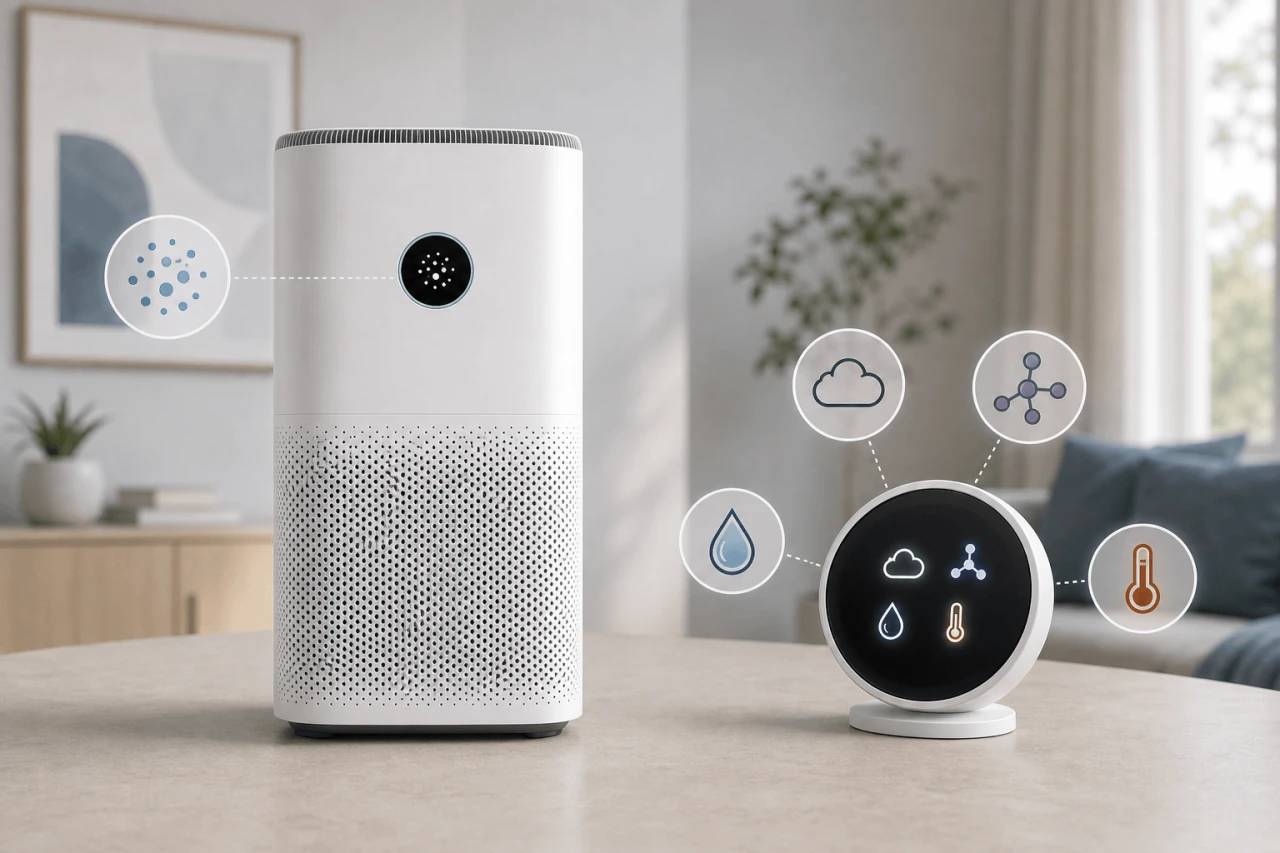
Many Xiaomi air purifiers show PM2.5 readings and use those readings for auto mode. This is useful, but PM2.5 is not the same as complete indoor air quality. A PM2.5 sensor does not fully measure CO2, VOCs, radon, carbon monoxide, humidity balance or every odor problem.
If you want broader monitoring, pair the purifier with a dedicated air quality monitor that can track PM2.5, PM10, CO2, VOCs, humidity and temperature, depending on the model.
Xiaomi Home app and smart features
Smart features make an air purifier easier to live with, but they should come after CADR and filter suitability. A smart purifier that is too small for the room is still the wrong purifier.
Useful Xiaomi smart features include:
- Remote control: start the purifier before arriving home.
- Scheduling: run it before sleep, before work or during high-pollution hours.
- Auto mode: adjust fan speed based on detected particle levels.
- Manual or favorite mode: set stronger airflow when auto mode is too conservative.
- PM2.5 display: get a quick reading of fine particle levels.
- Temperature and humidity display: useful for understanding indoor comfort, depending on model.
- Filter life reminders: avoid running a saturated filter for too long.
- Child lock: useful for nurseries and family rooms.
- Display off: important for bedrooms.
- Voice assistant support: useful where supported by model and region.
For allergy season, smoke events or cooking fumes, do not rely only on quiet auto mode. Auto mode is convenient, but it may not react aggressively enough for your comfort. Running medium or high mode for 20–60 minutes can be more effective after pollution enters the room.
Noise and bedroom use
Noise is where many buyers make the wrong decision. Maximum CADR usually means maximum or high fan speed. High fan speed is almost always audible. Sleep mode is quieter because it moves less air.

For bedrooms, ask these questions:
- Can the purifier clean the room well on low or medium speed?
- Can the display be turned off?
- Is the purifier powerful enough to clean the room before sleep?
- Will auto mode suddenly ramp up during the night?
- Is the filter easy to replace when airflow drops?
A larger purifier can be quieter in practice if it cleans the same room at a lower fan speed. This is one reason the standard Xiaomi Smart Air Purifier 4 can be a better bedroom choice than the 4 Lite for users who are sensitive to noise or live in a dusty area.
Where to place a Xiaomi air purifier
Placement can make a strong purifier feel weak. Air purifiers need open intake and outlet paths. If the device is hidden behind furniture, pressed into a corner or blocked by curtains, performance drops.
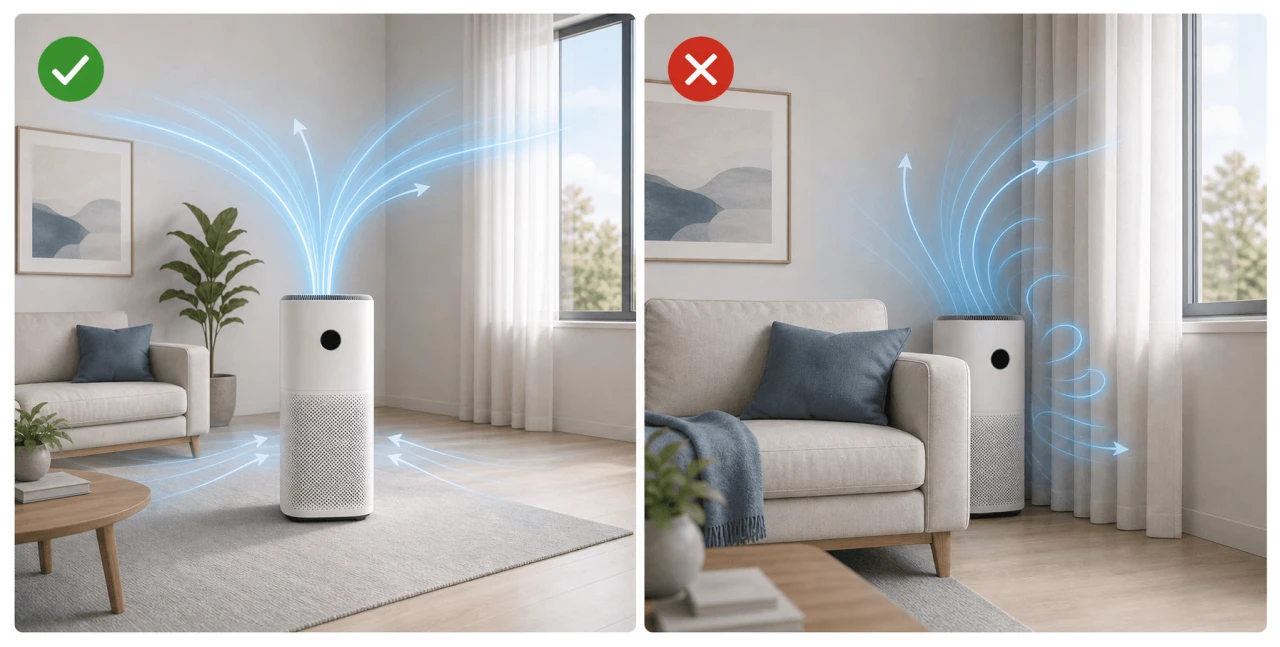
Good placement rules:
- place the purifier in the room where you spend the most time;
- keep air intake and outlet areas clear;
- avoid placing it tightly against a wall;
- avoid hiding it behind a sofa, cabinet or curtains;
- keep doors closed if you want to clean one room efficiently;
- place it closer to the pollution source when practical, but not where airflow is blocked;
- for open-plan layouts, consider two purifiers in different zones instead of one purifier in the wrong corner.
Xiaomi’s own FAQ for the Smart Air Purifier 4 recommends keeping the air inlet at least 20 cm from walls and obstructions and keeping the purifier upright for proper circulation.
Replacement filters and long-term cost
The filter is the hidden cost of an air purifier. A cheap purifier can become expensive if the filter is hard to find or overpriced. A powerful purifier can become useless if you run a saturated filter for months.
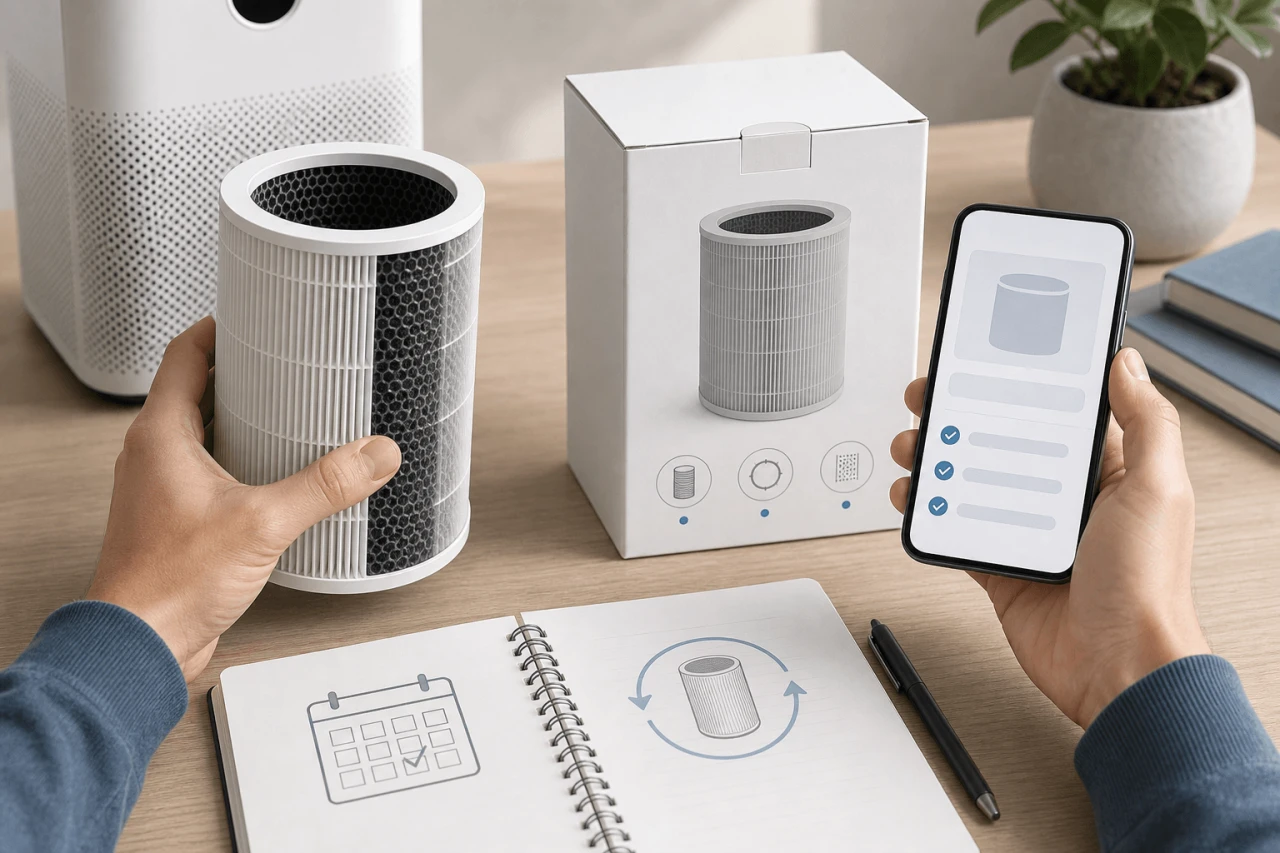
Before buying, check these filter questions:
- Exact compatibility: does the replacement filter match the exact purifier model?
- Local availability: can you buy the filter from at least two reliable sellers?
- Expected lifespan: is the replacement interval realistic for your air quality?
- Carbon capacity: is odor removal important enough to justify a larger carbon filter?
- App reminders: does the purifier track filter life?
- Return policy: can you return an incorrect filter?
Xiaomi commonly positions many filters around a 6–12 month replacement interval, but actual life depends on pollution level, fan speed, runtime, pets, cooking fumes, smoke and dust. If the air quality is poor, the filter will wear out faster.
Xiaomi Air Purifier 4 Lite vs Xiaomi Air Purifier 4
For many buyers, the real decision is between the 4 Lite and the standard 4.
| Decision point | Choose 4 Lite | Choose Smart Air Purifier 4 |
|---|---|---|
| Budget | You want the lower-cost model and your room is not too large. | You can pay more for extra airflow headroom. |
| Room size | Small to medium bedroom or office. | Medium bedroom, regular living room or room with higher pollution load. |
| Noise sensitivity | Acceptable if the room is comfortably within range. | Better if you want stronger cleaning without using high speed as often. |
| Pets | Works for lighter pet dander situations in smaller rooms. | Better if pets spend a lot of time in the room. |
| Pollen or smoke days | Useful if used early and in a closed room. | Safer because stronger CADR gives faster recovery after pollution enters. |
Simple verdict: choose the 4 Lite if the room is clearly within its comfort zone. Choose the standard 4 if the room is medium-sized, you are noise-sensitive, or you want a safer long-term choice.
When a Xiaomi air purifier may not be the best choice
Xiaomi air purifiers are attractive because they combine smart features, clean design and competitive CADR. Still, they are not always the best choice.
Consider another brand or a different setup if:
- you need a verified AHAM CADR label for a specific US room-size requirement;
- you need guaranteed local warranty support;
- replacement filters are hard to find in your country;
- you need specialized gas/VOC filtration with a large carbon bed;
- you need medical-grade or professional indoor-air-quality equipment;
- you need whole-home filtration rather than one-room cleaning.
This does not make Xiaomi a bad choice. It means you should buy it for the right use case: smart one-room air cleaning with decent airflow, app control and manageable maintenance.
Common mistakes to avoid
- Choosing by discount only. A cheap purifier is not a good deal if it is too small.
- Trusting maximum room-size claims too literally. Coverage assumptions vary by standard and fan speed.
- Using sleep mode all day. Sleep mode is quiet because it moves less air.
- Ignoring ceiling height. Higher ceilings mean more air volume.
- Buying one small purifier for an open-plan apartment. Open layouts often need more CADR or multiple units.
- Expecting particle filters to solve all odors. Odors require activated carbon or another gas-focused filter.
- Ignoring filter availability. Always check replacement filters before buying the purifier.
- Blocking the air intake. Corners, furniture and curtains reduce performance.
- Forgetting to remove filter packaging. Many new purifiers ship with the filter wrapped in protective plastic.
- Expecting a purifier to fix mold. Mold requires moisture control and cleanup. A purifier may reduce airborne particles but will not solve the source.
- Confusing purifier, humidifier and dehumidifier. A purifier removes particles; a humidifier adds moisture; a dehumidifier removes moisture.
Final buying checklist
Before choosing a Xiaomi air purifier, go through this checklist:
- Measure your room area.
- Check ceiling height and estimate room volume.
- Choose a CADR with headroom, not the bare minimum.
- Decide the main problem: dust, pollen, PM2.5, pet dander, smoke particles, odors or VOCs.
- Check whether the model has enough activated carbon for odor concerns.
- Check noise ratings and whether the display can be turned off.
- Confirm replacement filter availability for the exact model.
- Check Xiaomi Home app compatibility in your region.
- Check seller reliability, warranty and return policy.
- Make sure the purifier physically fits where you plan to place it.
- Compare current partner offers, but do not buy a model that is too small just because it is discounted.
Browse all Air Purifiers, or explore related Air Quality Monitors.
FAQ
Which Xiaomi air purifier is best for a bedroom?
For many bedrooms, start with the Xiaomi Smart Air Purifier 4 Lite or Xiaomi Smart Air Purifier 4. The Compact can work for a small bedroom, but the 4 or 4 Lite gives more headroom for quiet overnight use.
Is Xiaomi Smart Air Purifier 4 Lite enough for a living room?
It can be enough for a smaller living room, but it is not the safest choice for a large or open-plan space. If the room is near the top of the coverage range, choose the Xiaomi Smart Air Purifier 4 or a higher-CADR model.
Is the Xiaomi Smart Air Purifier 4 better than 4 Lite?
The standard Xiaomi Smart Air Purifier 4 has higher CADR than the 4 Lite, so it gives more airflow headroom. That makes it a better choice for medium rooms, noise-sensitive users, pets, pollen season or rooms with higher pollution load.
What CADR do I need for my room?
As a practical US rule, AHAM suggests CADR should be at least two-thirds of the room area in square feet. For smoke-heavy situations, a CADR closer to the full room area in square feet is better. For metric sizing, compare your room volume with the purifier’s m³/h CADR and choose extra headroom.
Do Xiaomi air purifiers remove smells?
Some Xiaomi air purifiers include activated carbon, which can help reduce certain odors and gases. However, activated carbon becomes saturated over time. For cooking smells, pet odors or VOC concerns, check the amount of carbon, filter replacement cost and filter availability.
Can a Xiaomi air purifier help with allergies?
A properly sized air purifier can help reduce airborne particles such as pollen, dust and pet dander. It is not a medical treatment and will not remove every allergen source, but it can be useful as part of a broader indoor air-quality routine.
Can a Xiaomi air purifier help with wildfire smoke?
It can help reduce smoke particles if the purifier has enough CADR for the room and the room is kept as sealed as practical. During smoke events, use a higher fan speed, check filters more often and follow local public-health guidance.
How often should I replace a Xiaomi air purifier filter?
Many Xiaomi filters are positioned around 6–12 months of use, but real filter life depends on air quality, fan speed, runtime, pets, dust, smoke and cooking fumes. Use app reminders as a guide, but also check airflow and odor performance.
Can I use a Xiaomi air purifier with a humidifier?
Yes, but ultrasonic humidifiers can sometimes affect PM2.5 sensor readings because fine water mist may be detected as particles. If readings jump unexpectedly while a humidifier is running, turn the humidifier off and check whether readings normalize.
Should I buy one large purifier or two smaller ones?
For one closed room, one properly sized purifier is usually simpler. For open-plan layouts or multiple rooms, two smaller purifiers placed in different zones may work better than one purifier hidden in a corner.
Does a Xiaomi air purifier replace ventilation?
No. A purifier can filter particles and, with activated carbon, help with some gases and odors. It does not replace source control or ventilation with clean outdoor air. It also does not solve CO2 buildup, mold sources or carbon monoxide risks.
Does Xiaomi Air Purifier work with Alexa or Google Assistant?
Many Xiaomi smart air purifiers support Xiaomi Home app control and may support voice assistants depending on model, language and region. Always check the exact product page and app region before buying.
Sources and further reading
- EPA: Guide to Air Cleaners in the Home
- AHAM Verifide: Air Filtration Standards
- Xiaomi United States: Environment Appliances
- Xiaomi Smart Air Purifier 4 Compact specifications
- Xiaomi Smart Air Purifier 4 Lite specifications
- Xiaomi Smart Air Purifier 4 specifications
- Xiaomi Smart Air Purifier 4 Pro global product page
- Xiaomi Smart Air Purifier Elite global product page
- Xiaomi Smart Air Purifier 4 FAQ