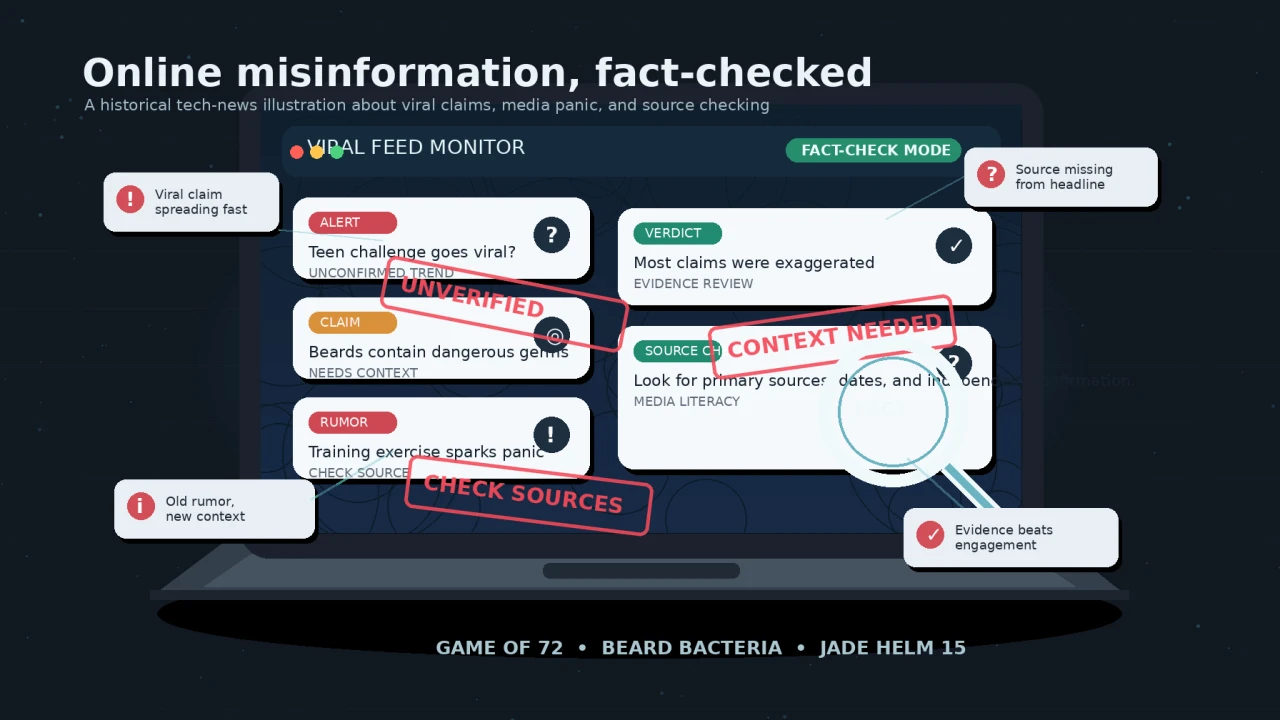
In early May 2015, several very different stories moved through news sites, blogs and social feeds at the same time. One warned parents about a supposed online challenge where teenagers disappeared for 72 hours. Another claimed that men’s beards could contain bacteria associated with fecal matter. A third suggested that a U.S. military training exercise called Jade Helm 15 was secretly linked to martial law or a federal takeover.
These stories had little in common on the surface, but they all showed the same mechanism: a rumor, a limited experiment or an official announcement became much more dramatic after being filtered through headlines, reposts and second-hand summaries.
Quick verdict
| Viral claim | What people were told | What the evidence supported |
|---|---|---|
| Game of 72 | Teenagers were supposedly disappearing for up to 72 hours as part of a dangerous online challenge. | Coverage was widely amplified, but confirmed evidence of a broad trend was weak. |
| Beard bacteria | Headlines implied that beards were unusually dirty or full of fecal bacteria. | The story came from a small media experiment, not a rigorous study proving a serious health risk. |
| Jade Helm 15 | Conspiracy theories framed a military exercise as a cover for martial law or a takeover. | Jade Helm 15 was publicly announced as a U.S. Army Special Operations Command training exercise scheduled for July 15 to September 15, 2015. |
The Game of 72 panic
The so-called Game of 72 was described in some reports as a dangerous social media challenge where teenagers were encouraged to disappear for 12, 24 or 72 hours without contacting their families. The story was highly shareable because it combined several strong triggers at once: missing-person fears, children, social media and the idea of a hidden trend that adults could not see directly.
But once reporters looked for direct evidence, the story became much weaker. Mic reported in May 2015 that the Vancouver Police Department had not issued the kind of warning that later coverage implied. A response to media questions was gradually reframed as if police had confirmed a fast-growing online trend.
That distinction matters. There is a difference between police commenting on a rumor and police confirming a verified social media challenge. As the story spread, those two ideas were treated as if they were the same.
Snopes later reviewed the 72-hour challenge and treated it as another example of a viral scare that received far more attention than confirmed evidence justified.
The beard bacteria headline
The beard story followed a different route. It started with a small media test in which beard samples were examined for bacteria. That was then turned into a much stronger headline claim suggesting that beards were comparable to toilets or packed with dangerous contamination.
That framing went beyond what the underlying material could support. Human skin, hair and many ordinary surfaces can carry bacteria. Finding bacteria is not the same as proving something is unusually dirty, clinically dangerous or broadly unsafe.
Snopes noted that the beard claim came from a small news experiment rather than a broad peer-reviewed study. UPMC later summarized the practical takeaway: there is no strong evidence that beards are generally a major health risk, and ordinary washing remains the sensible conclusion.
The broader lesson is simple: “bacteria were found” is not enough on its own. Sample size, comparison group, methodology and real-world significance all matter.
Jade Helm 15 and conspiracy framing
Jade Helm 15 was the most politically charged of the three stories because it started from a real military event. The U.S. Army announced that U.S. Army Special Operations Command personnel would train with other armed forces units in a multi-state exercise running from July 15 through September 15, 2015.
The conspiracy narrative came later. Maps, labels, training scenarios and the involvement of special operations forces were used by rumor-driven sites and commentators to suggest that the exercise was a disguised domestic operation. Those claims were not supported by evidence.
Jade Helm 15 became a useful case study in how distrust can reshape an ordinary official announcement into a much larger hidden-plot story. Once mainstream outlets respond to a fringe rumor, the rumor itself often gains more visibility even when the goal is debunking.
Why these stories spread
The three stories spread for different reasons, but they shared the same basic mechanics. Each one had a strong emotional hook. Each one was easy to compress into a dramatic headline. And each one started from a real detail that was stretched into a broader conclusion the evidence did not fully support.
That pattern still matters. Viral misinformation often does not begin as a completely invented story. More often, it begins with something partial, ambiguous or context-free that gets amplified faster than it gets checked.
How to check similar claims today
The platforms have changed since 2015, but the checking habits remain the same. Start with the original source. Look for an official statement, direct document, research paper or full interview rather than a recycled summary. Then compare later headlines to that source and see whether the conclusions still hold.
It also helps to look for independent confirmation. If a major trend is real, it should leave more evidence than copied articles pointing back to the same anecdote. When every story depends on the same thin origin, the claim is usually much weaker than it first appears.
The takeaway
The May 2015 roundup still works as a compact lesson in three familiar misinformation styles: youth panic, health exaggeration and political conspiracy. The point is not that every alarming online story is false. The point is that viral attention is not evidence.
Before sharing a claim designed to provoke fear, disgust or outrage, it is worth checking whether the facts actually support the emotion.
Sources
- The Washington Post: What was fake on the Internet this week: Game of 72, beard poop and Jade Helm 15
- U.S. Army: Updated press release: Exercise readies SOF for threats abroad
- Mic: This disturbing teen trend is terrifying parents, but it is probably a hoax
- Snopes: 72-Hour Challenge
- Snopes: Did a study find men’s beards are full of fecal matter?
- UPMC: How dirty is your beard, really?