
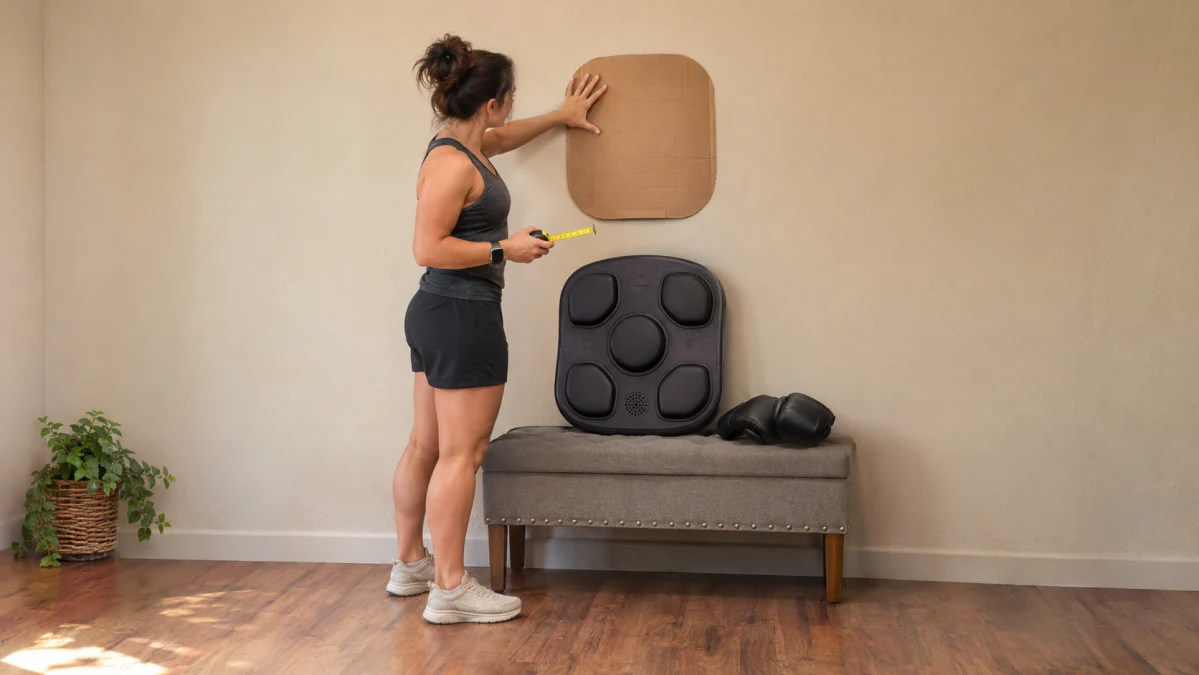
The feature list is the easy part. The wall is the hard part.
A wall-mounted music boxing trainer only makes sense if you can mount it securely at the right height, use it without hitting nearby furniture or doors, and charge it without turning every workout into a setup project. Bluetooth, lights and scoring matter only after those basics work.
Just as important, these electronic targets should not automatically be treated like compact heavy bags. Before buying, check what kinds of strikes the manufacturer actually allows and how the exact model is supposed to be attached.
Start with the wall, not the workout modes
Adhesive mounting sounds ideal for an apartment because it avoids drilling, but "adhesive" is not a universal mounting specification. The wall finish, underlying material, surface preparation, adhesive system and removal procedure all matter.
Screw mounting has its own questions: where the fasteners need to go, whether studs or anchors are required, what hardware is supplied and whether you are allowed to make holes in the wall.
For example, Gear Elevation's wall-mounted trainer supports adhesive hook-and-loop mounting on compatible smooth surfaces or a screw-mounted bracket. WallPunch similarly advertises adhesive pads for smooth walls and screw mounts for studs.
Those descriptions are useful because they show how different the two installation paths can be. They are not proof that either method is appropriate for your wall.
Before ordering, find the instructions for the exact model and answer four questions:
- Will the mounting system work on your actual wall? "Smooth wall" is not enough information if you have textured paint, wallpaper, tile, plaster or another unusual surface.
- What preparation is required? Adhesives may require cleaning or other preparation; brackets may require drilling and wall-specific hardware.
- What comes in the box? Do not assume that brackets, anchors, screws, adhesive pads, tools or a power adapter are included simply because the product is described as easy to install.
- What happens when you remove it? If you rent, also make sure the mounting method and any resulting holes, adhesive residue or surface changes are acceptable.
No-drill installation is convenient, but it should not be treated as automatically secure or damage-free.
Make sure you can actually reach and use the targets
The overall dimensions of the machine tell you whether it fits on a wall. They do not tell you whether the punching zones will be comfortable for you.
Before mounting anything, make a paper or tape mockup using the confirmed dimensions of the exact model. If target positions are shown in the manual or product images, mark those too.
Stand in front of it in your normal fighting stance and check:
- whether you can comfortably reach every target;
- whether shorter or taller people in the household can use the same mounting height;
- whether your hands or elbows can hit a door, shelf, monitor or other obstacle;
- whether you have enough room for the foot movement you actually intend to use.
Avoid relying on a generic "recommended height." The useful height depends on the target layout and the person using it.
Charging deserves the same attention. Confirm where the charging port is, what cable is required and whether the trainer can remain mounted while charging. If you need to remove it regularly, make sure the mounting system is designed for repeated removal and reattachment.
For comparison, Gear Elevation lists its trainer at approximately 40 × 44.5 cm and describes it as rechargeable. WallPunch specifies USB Type-C charging and says a USB cable is included. Those details apply to those products only; visually similar trainers can use different housings, ports and mounting systems.
Decide whether you want reaction drills or power punching
These machines are most convincing when used as illuminated targets for short reaction, rhythm and cardio drills. They are much less straightforward if you expect them to replace a heavy bag.
Gear Elevation explicitly describes its trainer as a light-guided fitness target rather than a heavy bag. Its instructions call for controlled punches and prohibit kicks, knees, elbows and strikes to the casing, speaker or corners.
That restriction should not automatically be applied to every wall-mounted trainer, but it illustrates why the operating instructions matter. Lights, padded targets and included boxing gloves do not tell you how much impact a device can safely absorb.
If you want to work mainly on timing, hand-eye coordination and controlled combinations, an electronic target can make sense. If your workout depends on hard power shots, kicks or heavy-bag-style combinations, verify that the exact product is designed for them before buying it.
"Music boxing" can mean several very different things
Bluetooth is one of the least useful specifications when it appears by itself.
A trainer can have Bluetooth simply to play audio through a speaker. Another model may flash targets according to its own programmed sequence while music plays independently. A third may attempt to link target cues to a beat. App-based scoring and workout history are separate features again.
Gear Elevation says its trainer can play music from a paired phone through its built-in speaker while illuminated targets provide workout cues. That does not by itself establish automatic synchronization between your music and the target sequence.
BEATBOKS takes another approach: it offers downloadable music designed to correspond with machine speeds. That can support rhythm-based workouts without being the same thing as automatically analyzing any song you play.
WallPunch goes further in its marketing, advertising flashing targets that coincide with rhythm and a mobile app that tracks punching performance and progress. If app tracking matters to you, check the app name, supported phones, current availability and exactly what the recorded metrics mean before treating it as a deciding feature.
The practical rule is simple: decide which function you actually want before comparing labels such as "Bluetooth," "smart" or "music boxing."
Which type of trainer makes the most sense?
The three options below emphasize somewhat different features. The important differences are not just how many electronics they advertise, but whether those electronics match the way you plan to exercise.
Bluetooth Boxing Target with Light Music is the most natural place to start if playing music during a light-target workout is the priority. Its supplier lists Bluetooth, lighting and music features for home fitness. Before buying specifically for rhythm training, confirm whether Bluetooth simply carries audio to the speaker or whether any target mode actually responds to that audio.
Smart Boxing Trainer with Music and Light Targets is more interesting if you want reaction-oriented drills. Its supplier describes electronic light targets, music and reaction training. The missing detail that matters most is how those cues behave: look for the number of modes, how speed or difficulty changes and whether the target sequence is programmable or fixed. Also verify the permitted striking intensity rather than assuming "boxing trainer" means heavy-bag use.
Electronic Music Boxing Trainer combines supplier-listed speakers and light effects with a gloves package, which may reduce the number of accessories you need on day one. Check the exact package before ordering, however, because included gloves do not tell you whether mounting hardware, adhesive components or a charging adapter are also supplied. The supplier's "Easy Install" language is not enough to determine whether the mounting system suits your wall.
What to check before you buy
A good wall-mounted boxing trainer should pass three practical tests.
First, the installation has to work: the exact mounting method must suit your wall, the necessary parts must be available, and you must be comfortable with whatever drilling, adhesive or removal consequences come with it.
Second, the physical setup has to work: you need a useful target height, enough movement space and convenient charging access.
Third, the workout has to work: the manufacturer must support the strikes you intend to throw, and the light, music, scoring or app features must actually do the job you are buying the trainer to do.
If any of those three pieces remains unclear, another set of flashing targets or another Bluetooth logo will not fix the problem. A simpler trainer that fits your wall and your workout is a better buy than a more feature-packed one that is awkward to mount, charge or hit.