
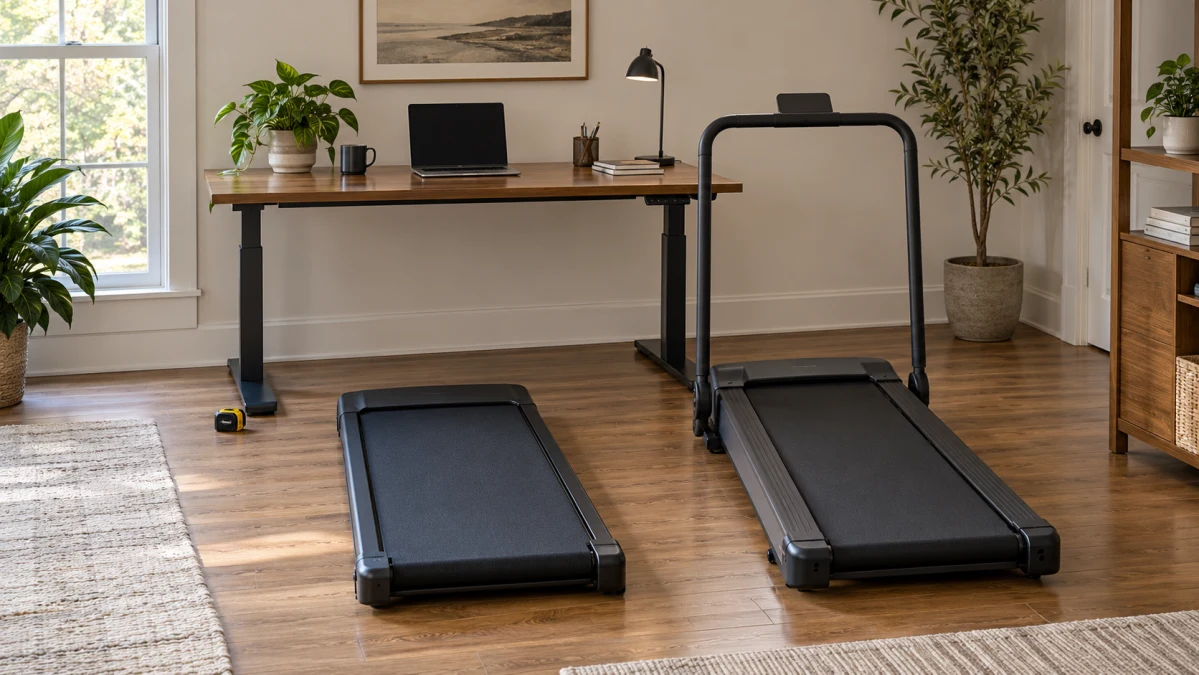
An under-desk treadmill has to fit more than the gap between your desk legs. It has to work with your keyboard height, leave room for your stride and be practical to move when you want your chair back. If you also want to run, you need a machine designed for running—and enough clear space to use it away from the desk.
Walking pads and 2-in-1 folding treadmills overlap. Some machines handle both desk walks and separate workouts. The useful distinction is how much space, weight and setup you are willing to accommodate for that second job.
The differences that matter
The Under-Desk Walking Pad Treadmill is the smaller, lighter option. The 2-in-1 Folding Treadmill, sold in navy under part number NJD374-A24-ANY, adds a running configuration but is a substantially larger machine.
| What to compare | Akluer TW140L specifications | Costway specifications at Newegg |
|---|---|---|
| Advertised speeds | 0.6–4 mph overall; 0.6–2 mph for working | 0.6–3 mph with the upright lowered; 0.6–10.5 mph raised |
| Approximate floor footprint, length × width | 48 × 21 inches | 58 × 31 inches upright; 61 × 31 inches folded flat |
| Published deck or belt dimensions | 39.4 × 15.7 inches, labeled “deck size” | Roughly 49 × 20 inches, labeled running belt |
| Machine weight | 48.5 pounds | 106 pounds |
| Maximum user weight | 330 pounds | 265 pounds |
Check the user-weight limit independently: the heavier machine has the lower stated limit here.
Make sure the desk fits you, too
Start with the height at which you comfortably use your keyboard while standing. A treadmill raises you off the floor, so your desk needs additional adjustment to keep the keyboard at roughly elbow height, as OSHA’s workstation guidance recommends. Ask for the distance from the floor to the top of the moving belt. Overall machine height and folded storage height are different measurements. If your desk is already near its upper limit, this can decide the purchase.
Next, measure between the desk legs and beneath any crossbar. Check that the treadmill can sit far enough forward for you to reach the keyboard without leaning over it. Tape out its footprint on the floor, then leave the operating space required by its instructions around it. Akluer specifies at least 3.28 feet behind the TW140L and 2 feet on each side. A narrow chassis can still require a generous clear area.
Pay attention to the moving surface itself. A wide frame includes stationary edges that do not give your feet more room while walking. When a seller gives only a “deck” measurement, ask whether it describes the usable moving belt. If you have a long stride or intend to run, try a comparable belt size at your intended pace before committing; the machine’s top speed cannot tell you whether you will feel cramped.
Finally, decide where your chair will go. If you expect to alternate between sitting and walking throughout the day, trace the route the treadmill must take each time. Include doorways, thresholds and the space needed to turn it.
Akluer TW140L: walking in a smaller space
Akluer advertises nine automatic incline levels up to 12%, giving you an uphill walking option during breaks. For keyboard work, begin flat and at the lowest speed; increase only while you can walk comfortably and type or use the mouse without reaching or leaning.
Akluer’s usage notes list vertical storage and say to lower the incline to Level 0 after use. Confirm exact dimensions before a tight furniture fit: its text and illustrations disagree. A session lasts up to 99 minutes before a restart.
Costway 2-in-1: room for a separate run
Costway’s appeal is the ability to use one machine for walking at work and running afterward, with the upright raised for the running configuration. Set aside a clear workout area where you can raise and secure the upright and use the handrails and safety key as instructed.
The conversion has a catch: Costway says the two side handles must be unscrewed and removed before folding. They do not simply tuck away. If you plan to walk at your desk each morning and run every evening, account for that assembly step in both directions. It may matter more to your routine than the advertised top speed.
Folding mainly reduces the machine’s height. Costway lists a folded size of approximately 61 × 31 × 6.5 inches—still more than five feet long. Measure the opening beneath a bed or sofa, including internal supports, and leave room to maneuver the treadmill into it. Transport wheels do not eliminate lifting at stairs or high thresholds.
Costway’s manual gives conflicting maximum speeds for walking mode—about 2.5 mph and 3 mph. Ask the seller which limit applies to your unit. Your comfortable working pace may be much slower.
Check the details you will live with every day
Noise during calls
A quiet-motor claim does not tell you what your microphone or a downstairs neighbor will hear. LifeSpan’s treadmill-desk guide explains that both the motor and footsteps contribute noise, and that measurement conditions affect noise figures. For either machine, look for a demonstration with someone walking at the speed you expect to use. Check whether the return policy lets you try your own microphone and room setup.
Controls you can reach
Before starting work, make sure you can slow and stop the belt without bending down or reaching under the desktop. Costway specifically directs users to the remote in walking mode. Keep it within reach, and check how to obtain a replacement.
Attach the Costway’s safety-key clip to your clothing as directed in its manual. Stop the belt before stepping away, and disconnect power before moving the machine.
Daily use, maintenance and support
Ask about the continuous-use limit and cooling requirements for the hours you plan to walk. The Costway manual identifies its 4.75 HP rating as peak motor power; that number does not tell you how long it can run continuously. Follow the model’s belt-lubrication and adjustment schedule, and check whether your floor is suitable: Costway warns against operating this treadmill on carpet because of overheating.
Before ordering, find out who pays return shipping, whether opened equipment can be returned and how repairs are handled. Akluer’s warranty policy excludes unauthorized sales channels and allows some repairs through parts supplied for the customer to install. Check the actual seller’s coverage rather than assuming a warranty includes someone coming to your home.
Which one makes sense for your routine?
For desk walking, start with the Akluer if the belt accommodates your stride and your desk reaches a comfortable working height. Its smaller size and lower weight matter when you need room for a chair.
Choose the Costway if running is a real part of your plan and you can accommodate its floor space, weight and handle-removal routine. Its running capability gives you a reason to accept those compromises.
If daily conversion sounds like a chore, give that concern as much weight as speed or app features. The purchase should fit the way you actually use the room—whether that means leaving a walking pad under a standing desk or giving a running treadmill a more permanent home.