
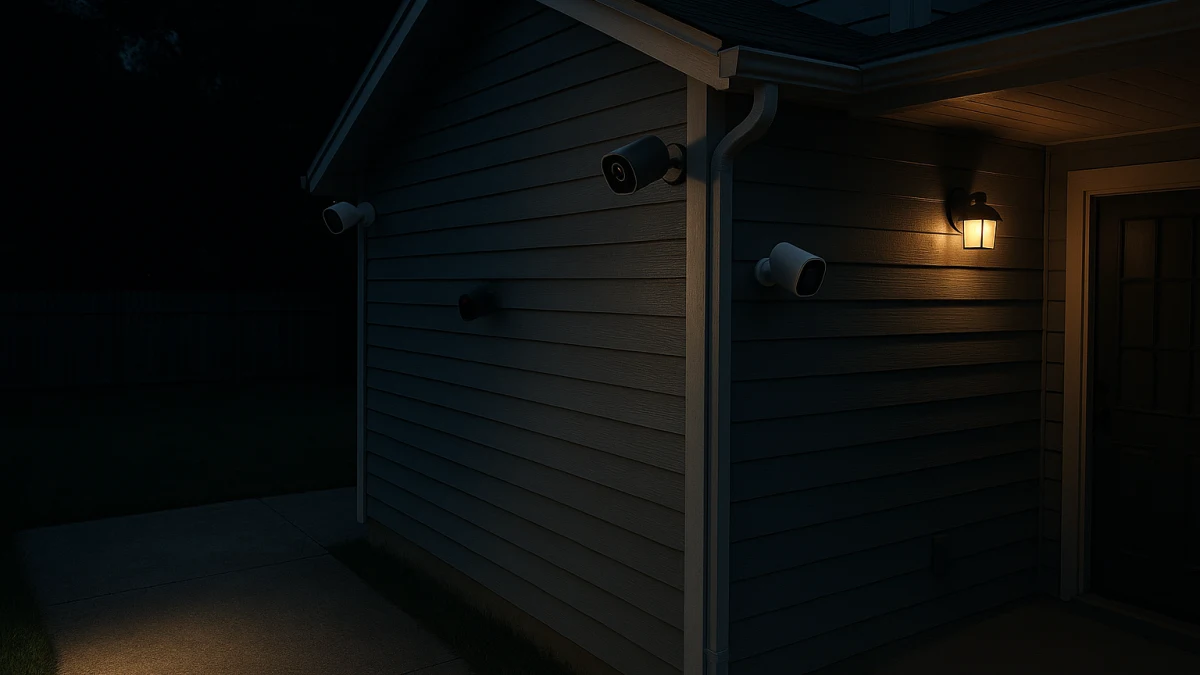
A dark yard does not automatically need the brightest camera you can find. The more important first choice is how the camera should behave at night: turn on a visible light, watch with infrared, or try to preserve color detail when there is already some ambient light.
This collection is organized around that night behavior rather than treating every “night vision” listing the same. Use it to translate terms like spotlight, floodlight, IR, infrared, color night vision, TrueColor, starlight, PIR, and detection distance into a better-fit decision for a yard, driveway, side yard, porch, or alert-only zone.
Light on, light off, or ambient color?
| If you need... | Better fit |
|---|---|
| The camera to draw attention and visibly light a dark yard, driveway, or side area | Spotlight security cameras |
| Night monitoring without a visible light turning on across the yard | Standard infrared night-vision security cameras |
| Color detail where there is already some ambient light | Low-light color night-vision security cameras |
| Coverage only at the front step, porch, or narrow entry point | Video doorbell with night vision |
| Movement awareness without footage or illumination | Motion sensor |
Before choosing, think through six tradeoffs: visible deterrence versus discretion, color detail versus darkness requirements, glare and reflections, listed night-vision range versus usable detail, outdoor suitability, and power tradeoffs when active lighting triggers often.
Match the dark zone to the night behavior
Start with the place, not the feature list. A driveway facing the street may benefit from an obvious spotlight or floodlight cue. A side yard near windows or neighboring property may be better served by IR monitoring. A porch with an existing light may make a low-light color camera or doorbell more realistic than a fully dark corner of the yard.
Also check where the camera will point. Reflective surfaces, glass, shiny vehicles, and tight mounting angles can reduce useful nighttime detail whether the camera uses visible light or infrared.
Not a lighting, storage, or power-source guide
This page compares outdoor security-camera night behavior. It is not a guide to standalone floodlights, landscape lighting, wired-versus-battery systems, solar sizing, storage plans, subscriptions, or local lighting rules.
Those details still matter at checkout, but they need model-specific information. Here, the main decision is whether your dark zone calls for visible light, lower-obtrusion infrared, conditional low-light color, a porch-only doorbell, or an alert-only sensor.
Specs that need model-level confirmation
Treat technical claims as product-page checks. Lumens, LED count, IP65/IP66/IP67-style weather language, operating temperature, lux claims, spotlight triggers, IR behavior, and color night vision are not interchangeable across models.
Listed night-vision distances such as 80 ft or 100 ft can help you compare categories, but they should not be read as guaranteed identification distance in every yard.
Spotlight cameras: deterrence when the yard needs visible light
Choose this lane when you want the camera to make itself known. Listings in this group commonly use terms such as spotlight, floodlight, white-light, warning light, alarm light, built-in LED, motion spotlight, or color night vision.
That visible light can be useful in a dark driveway, gate area, or side yard where deterrence and illumination are part of the goal. The tradeoff is that the light is also noticeable: it may create glare, reflect off windows or vehicles, or shine into places you do not want lit.
Use the products shown here to compare the light behavior, night-vision mode, field of view, outdoor rating, operating temperature, and any listed brightness or light-source details. Skip this lane if your priority is discreet monitoring or if the camera would point toward reflective surfaces or nearby areas where a bright trigger could be a problem.
Brightness claims are not yard-coverage promises
A spotlight, floodlight, built-in LED, or high LED count does not automatically mean the camera will fully light an entire yard. Brightness language is useful for sorting products, but coverage depends on placement, angle, trigger settings, distance to the activity, and the model’s own light behavior.
If a listing mentions full-color or color night vision, confirm whether that depends on the built-in light, ambient light, or a specific night mode.
Infrared cameras: night monitoring without the bright cue
Choose standard infrared when you want nighttime visibility without a visible light switching on across the yard. This is the clearer alternative when a spotlight would be too obvious, too glaring, or poorly aimed near windows, cars, or neighboring property.
Look for infrared, IR, infrared night live view, and night-vision-distance wording. Some products in this kind of lane list distances such as 80 ft or 100 ft, and some include outdoor weather-rating language, but those numbers are comparison cues rather than promises for every real-world setup.
Read these products for IR type, listed night-vision distance, field of view, weather rating, audio, and detection features. If a product also mentions spotlight or color mode, open the details carefully; standard IR should not be assumed to deliver full-color footage unless the model separately supports it.
Low-light color cameras: color detail when some light is already there
This is the middle path: less visibly intrusive than a bright spotlight, but more conditional than standard infrared. It fits areas with some ambient light where color detail matters, such as a porch-adjacent walkway, a driveway with nearby lighting, or a yard edge that is not completely dark.
Look for color night vision, full-color, TrueColor, starlight, or low-light language. Some products may also list 2K or 4K resolution, pan/tilt coverage, weatherproofing, and night-vision range, but the key question is how that specific model produces color at night.
Use the products shown here to compare color-night-vision wording, field of view, listed range, weather rating, resolution, and whether the model appears to rely on ambient light. If the area is truly dark and you need reliable footage, compare this lane against spotlight and standard infrared rather than assuming color mode solves every night scene.
Porch-only and alert-only choices start here
Doorbells and motion sensors often appear near security-camera results, but they answer narrower problems. A video doorbell can make sense when the dark zone is only the front step. A motion sensor can make sense when you only need to know something moved.
Neither should be treated as a full substitute for a yard, driveway, or side-yard camera when you need video coverage, night-vision detail, or illumination.
Doorbells belong only in the porch zone
A night-vision video doorbell is useful when the area you care about is the doorway: visitors, packages, the front step, or a narrow porch. Listings may mention night vision, IR, infrared, color night vision, two-way audio, chimes, motion detection, weather rating, and wide viewing angles.
Compare these as entry-zone devices, not yard cameras. Check field of view, night-vision type, weather rating, power source, and motion-detection details for the doorway. If you need to see farther into a driveway, side yard, or open lawn, go back to one of the three camera lanes above.
Motion sensors are alerts, not night-vision cameras
Choose a motion sensor only when an alert is enough. PIR, detection angle, detection distance, app alerts, battery operation, smart-home compatibility, and outdoor suitability can matter, but these devices do not provide footage, color detail, night vision, or yard lighting.
Use these products for alert-only coverage or as a companion to cameras. Do not treat a motion sensor as a cheaper version of a spotlight, infrared, or low-light color camera if you need recorded video or visual verification.
Dark-yard placement checks before checkout
Before buying, confirm the practical fit for the exact mounting spot:
- Field of view: Make sure the camera sees the actual path, gate, driveway, or porch area you care about.
- Night behavior: Check whether the model uses spotlight, floodlight, IR, color night vision, TrueColor, starlight, or another mode.
- Outdoor rating: Verify the listed weather rating and operating temperature for the planned location.
- Range wording: Treat 80 ft, 100 ft, or other distance claims as model-specific comparison details, not guaranteed usable detail.
- Glare risks: Look for windows, reflective vehicles, shiny siding, glass doors, or tight corners in the camera’s view.
- Neighboring areas: Aim visible-light cameras carefully so the benefit of illumination is worth the added attention.
- Mounting position: Doorbells belong at the entry; sensors need the right detection angle; yard cameras need a view of the whole target zone.
For a dark yard, use visible light only when deterrence and illumination are worth the tradeoffs. Choose infrared when discretion matters more. Choose low-light color when ambient light can support it. Keep doorbells for porch-only viewing and motion sensors for alert-only awareness.