
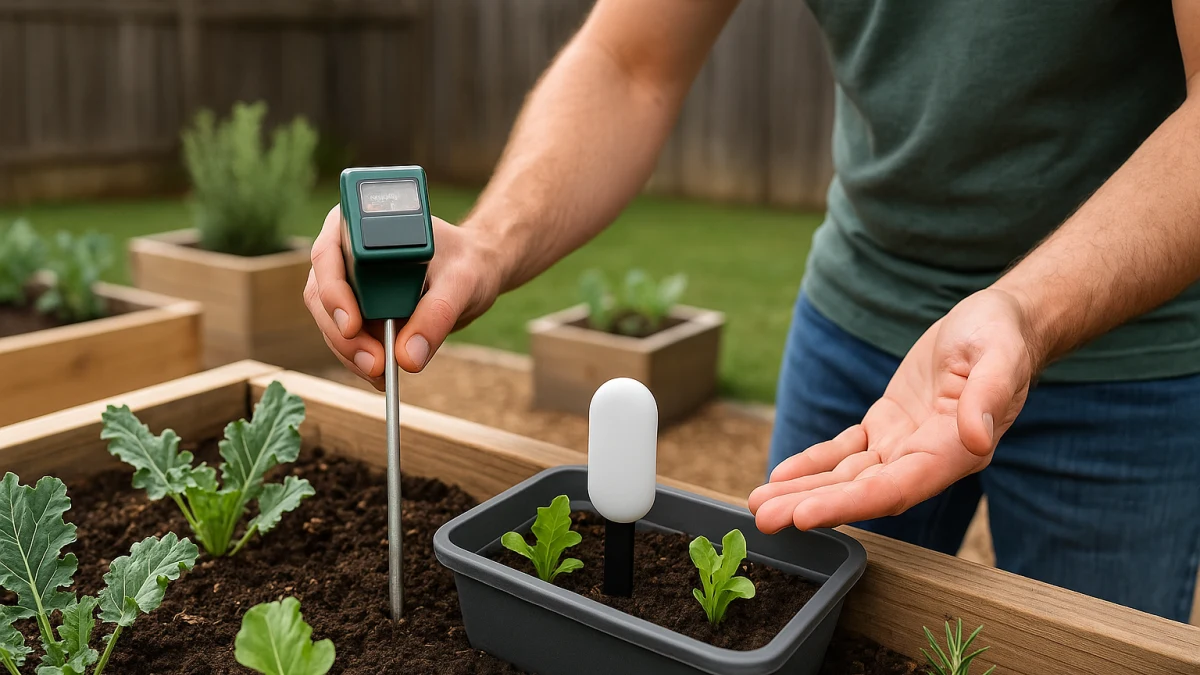
Outdoor planters and raised beds create a different moisture problem than small indoor pots: the top layer can look dry while the root zone still holds water, or a deep box can dry unevenly from sun and wind. This guide separates two buying paths that often get mixed together on a normal category page: manual probes for root-zone spot checks, and fixed or smart sensors for ongoing outdoor monitoring.
Read the products through that contrast. Probe length, insertion depth, display readability, leave-in design, weather exposure, power, wireless setup, and monitoring scale matter more here than a generic list of moisture-meter features.
Choose by root-zone depth and whether the sensor stays outside
| If you need... | Better fit |
|---|---|
| To insert a probe, read it, remove it, and wipe it after checking a planter or raised bed | Long-probe manual moisture meter |
| Custom alerts, data logging, or app dashboards for one outdoor pot, bed, lawn area, or garden zone | Outdoor-ready fixed or smart soil sensor |
| A short indoor-pot meter for a deep planter or raised bed | Use it only as a shallow-container fallback after verifying probe length and outdoor use |
| A product that depends on a gateway, hub, controller, Wi-Fi, Bluetooth, or Zigbee | Treat compatibility, range, app support, and independent operation as purchase gates |
Use five filters before comparing products: whether the probe reaches the soil depth you care about, whether the tool is meant for spot checks or fixed placement, whether the readout is easy to see outside, what power or app setup is required, and whether one sensor is enough for the number of beds, planters, or zones you want to monitor.
Put root depth before app features
The most common wrong turn is buying for the readout instead of the root zone. A color-coded dial, large LCD, mobile app, or alert can all be useful, but only after the sensor can measure the soil location that affects watering.
Look for these decision cues:
- Probe length and insertion depth: deep planters and raised beds may need more reach than a short houseplant probe offers.
- Use routine: manual meters make sense when you walk outside, test a few spots, then remove and clean the probe.
- Fixed placement: smart sensors should be judged by whether the product is designed to remain in soil outdoors.
- Setup burden: no-battery dial tools are simple; app-connected products may bring batteries, hubs, gateways, wireless range, and update behavior into the decision.
- Scale: one patio pot is different from several raised beds, a lawn area, or multiple garden zones.
Keep controllers, drip kits, and houseplant-only gear out
This page is about sensing soil moisture in outdoor containers, planter boxes, raised beds, gardens, lawns, and similar planting areas. It is not a guide to sprinkler controllers, irrigation timers, drip irrigation kits, indoor garden systems, fertilizers, or watering automation.
Some smart sensors may connect to a broader garden ecosystem, but that does not make the controller the main purchase. Start with the sensor: where it sits, what it reads, how it sends data, and whether it can be used the way the product page describes.
Manual long-probe meters for root-zone spot checks
Choose this lane if you only need to check soil by hand in an outdoor container, planter box, lawn edge, garden, or raised bed. The routine is simple: insert the probe, take the reading, remove it, and wipe it after use. That makes these meters better for occasional checks than for continuous monitoring.
Probe length is the first filter. A manual meter with a 7.6-inch single probe is a stronger outdoor-container signal than a very short indoor-pot tool, but it still has to match the actual depth you want to test. For yard use, a color-coded dial, instant reading, or large LCD can also matter because you may be reading it in bright light or while moving between beds.
Power expectations vary. Some simple dial meters advertise no battery requirement, while LCD multi-mode testers may use battery power and list stainless-steel or zinc-alloy probe materials. Extra modes such as pH, fertility, or light should not distract from the main outdoor question: does the moisture probe reach the useful depth, and is the tool meant to be removed after each test?
Use the products shown here to compare probe length, display style, battery needs, and the insert-read-remove workflow. Do not assume a manual meter is weatherproof, safe to store outside, suitable to leave in soil, or accurate for every raised bed unless the product page specifically supports that use. If you want alerts, history, or remote readings, move to the smart-sensor lane instead.
The short indoor-pot meter is only a shallow-container fallback
A small indoor-pot moisture meter can be convenient for herbs, small patio pots, or shallow containers, but it should not be treated as the main answer for deep planters and raised beds. The risk is not that the display is simple; the risk is that the probe may only tell you about a shallow layer while the active root zone is wetter or drier.
Use this fallback only after checking the stated probe length, outdoor-use guidance, and cleaning instructions. If the product copy is built around houseplants and does not address outdoor depth or exposure, keep it out of the raised-bed decision.
Fixed and smart sensors that stay in an outdoor zone
Choose this lane when ongoing readings are more useful than walking outside for every check. Smart or fixed sensors can be a better fit for one outdoor pot, raised bed, lawn area, grow bed, or garden zone when you want app dashboards, custom alerts, data logging, or remote monitoring.
This lane has more purchase gates. A product may rely on Wi-Fi, Bluetooth, Zigbee, a gateway, a hub, a controller, or a specific app before the readings are useful. Some products are best understood as ecosystem add-ons rather than standalone sensors, especially if they require a compatible console, gateway, or hub.
Outdoor suitability also has to be product-specific. Look for clear wording around indoor/outdoor use, leave-in probe design, waterproof housing, corrosion-resistant probes, or stated IP66 or IP67 protection claims. Those labels are not interchangeable, and they should be verified on the product page rather than assumed from the word smart.
Read these products by setup and placement first: what app or hub is required, how the sensor connects, whether it is intended to stay in soil, and how many sensors the system can support. Update intervals and sensor-count limits matter if you are monitoring several raised beds, planters, garden zones, farms, lawns, or grow beds. This lane adds alerts and history, but it is not automatically better than a manual probe if the wireless setup, battery plan, or compatibility requirements do not fit your routine.
Weatherproof, IP, hub, and range claims need documentation
Treat outdoor durability and wireless claims as model-specific. Words like waterproof, weatherproof, leave-in, IP66, IP67, app-compatible, gateway-based, or hub-required should be confirmed in the product documentation before you buy.
Do not generalize from one listing to another. One sensor may be built around a Wi-Fi gateway, another around Zigbee and a hub, another around Bluetooth, and another around a brand-specific console or app. Range, update intervals, battery expectations, and maximum sensor counts can change the whole purchase, especially for multiple beds or yard zones.
Checkout checks for beds, planters, and outdoor pots
Before buying, check:
- Probe reach: Is the probe long enough for the root-zone depth you actually need to test?
- Use style: Is the product meant for manual spot checks, or is it designed to stay in soil?
- Outdoor wording: Does the product page clearly support outdoor use, waterproof housing, IP protection, corrosion resistance, or leave-in placement where relevant?
- Readout: Will a dial, large LCD, or app dashboard be easier for the way you check plants?
- Power: Does it require no battery, AAA batteries, another battery type, charging, or a powered gateway?
- Connectivity: Does it need Wi-Fi, Bluetooth, Zigbee, a hub, gateway, controller, console, or specific app?
- Scale: If you have multiple planters or raised beds, does the system support enough sensors and useful update behavior?
- Independence: If the item is an accessory sensor, can it work alone, or only inside a larger ecosystem?
Match the purchase to your watering-check routine: choose a long-probe manual meter for occasional root-zone checks, or a documented outdoor-ready smart sensor when alerts, history, and fixed placement justify the extra setup.