
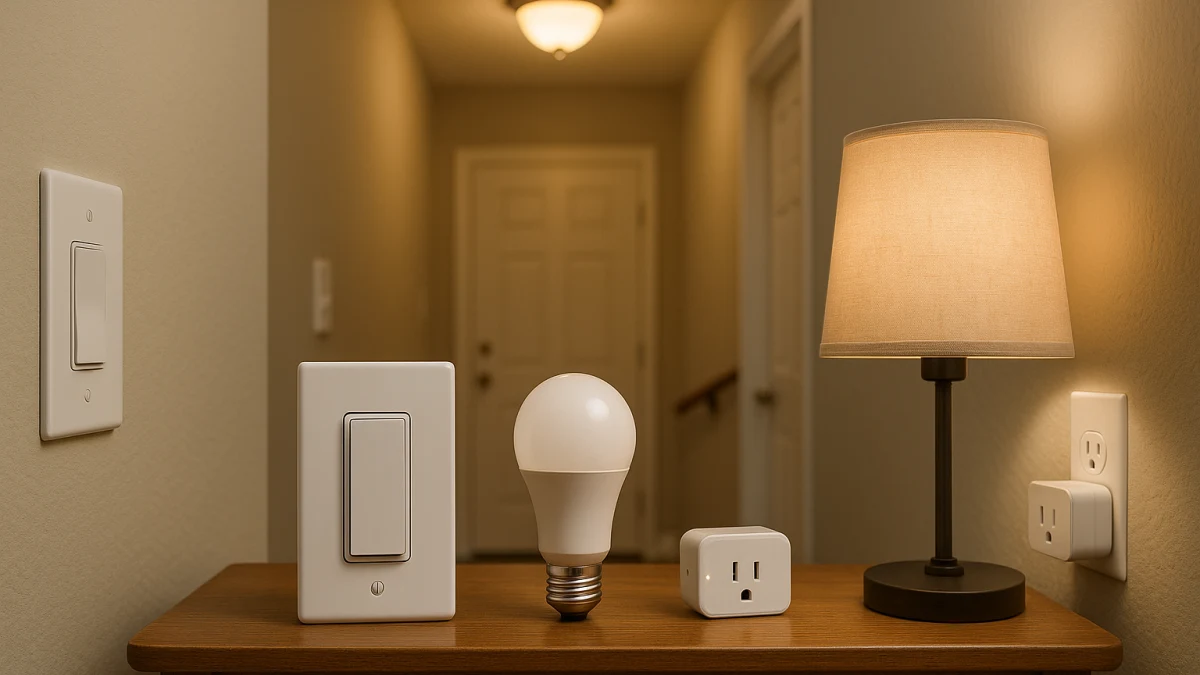
A hallway, stairway, entry, or landing light controlled from two wall locations is a different smart-lighting problem from a bedroom lamp or a single-switch ceiling fixture. The first question is not which app or voice assistant you prefer, but whether the product is actually designed for multi-location control.
In North American product listings, a circuit where two wall switches control the same light is usually called 3-way. In other markets, the equivalent function may be described as 2-way or two-way switching. Do not assume that an ordinary smart switch works in this wiring arrangement just because it controls the same type of bulb.
Use this collection as a compatibility-first comparison. Start with a smart switch when both wall locations need to remain normal physical controls. Consider smart bulbs only when the fixture can remain continuously powered. Treat a smart plug as a separate solution for a plug-in lamp, not as a way to make the existing hardwired two-location circuit smart.
Which option fits a two-location hallway?
| If you need... | Better starting point |
|---|---|
| Both wall locations to remain usable for family members and guests | 3-way or multi-location-compatible smart switch |
| Normal wall control plus app, schedules, or voice control | 3-way or multi-location-compatible smart switch |
| Color or tunable-white lighting without replacing the mains switches | Smart bulbs, but only if the fixture can remain continuously powered |
| A separate console, table, or landing lamp instead of the hardwired fixture | Smart plug |
| Smart bulbs while retaining convenient physical controls | Smart bulbs plus a compatible wireless control or smart-bulb wall module |
The important comparison points are multi-location compatibility, the required wiring topology, neutral-wire requirements, companion or add-on controls, dimming compatibility, fixture power behavior, load limits, and platform requirements. App support alone does not answer the hallway question.
First identify what the existing switches actually do
A conventional 3-way circuit does not have one permanent “on” position for each wall switch. The light state depends on the combination of the two switch positions, and operating either switch can change the light from on to off or from off to on.
That distinction matters for smart bulbs. Simply telling everyone to “leave both switches on” is not a reliable description of a conventional 3-way setup. What the bulbs actually need is continuous power to the fixture, with the mains switching arrangement left in a state that supplies that power and no longer used routinely to disconnect it.
For smart switches, the opposite priority usually applies: preserve useful physical control at both locations while adding smart control to the circuit.
Treat multi-location compatibility as a manufacturer claim
Do not infer compatibility from the words “smart switch,” “Wi-Fi switch,” or “smart dimmer.”
Look for explicit product or installation documentation describing terms such as:
- 3-way or three-way;
- multi-location or multi-way;
- 3-way kit;
- companion switch;
- add-on switch;
- satellite or accessory switch;
- operation with an existing mechanical 3-way switch.
Products implement multi-location control differently. One system may replace both existing switches. Another may use one smart master plus a dedicated companion. Some products allow a conventional mechanical switch at the second location. Others use a wireless companion instead of the original traveler arrangement.
Neutral-wire requirements are also product-specific. Some smart switches require a neutral in a particular wall box, some require one in both locations, and some product families offer no-neutral designs.
Do not determine compatibility from wire colors alone. Line, load, neutral, ground, and traveler arrangements vary, especially in older installations. Use the wiring diagram for the exact product and hardware revision, and use a qualified electrician when the existing circuit cannot be positively identified.
Start with smart switches when both wall locations matter
For a hardwired hallway or stair light, a multi-location-compatible smart switch is usually the strongest starting point when people should continue using whichever wall control is nearest.
The useful distinction is not simply “smart switch versus dimmer.” Check whether the product supports your exact arrangement:
- one smart switch plus an existing mechanical 3-way switch;
- a matched smart-switch pair;
- a master plus wired companion;
- a master plus wireless companion;
- 3-way dimming rather than on/off control only.
A product advertised as a single-pole smart switch should not be assumed to work in a 3-way circuit. Likewise, a product supporting 3-way on/off operation does not automatically support dimming from both locations.
After a product passes the multi-location screen, verify its installation requirements. Check neutral and ground requirements, line/load placement, traveler or companion requirements, supported voltage, maximum load, switch versus dimmer behavior, LED compatibility, required hub or bridge, and the manufacturer's wiring diagrams.
If the existing light is controlled from more than two wall locations, you may have a 4-way or broader multi-location circuit rather than a simple 3-way arrangement. Confirm that the chosen system explicitly supports that topology.
Smart bulbs work only while the fixture remains powered
Smart bulbs are useful when color, tunable white, scenes, individual-bulb control, or simple bulb replacement matters more than preserving the existing mains-switch behavior.
Their limitation in a hallway is straightforward: when a wall switch disconnects power from the fixture, the bulb cannot remain available to its app, hub, automations, or voice assistant while power is off.
Some bulbs have configurable behavior after power is restored, but that does not eliminate the underlying issue. A bulb with no mains power is not remotely controllable.
For a conventional two-location circuit, therefore, the real requirement is not “both switches must be on.” The requirement is that the fixture remain continuously energized and that household members stop using either mains switch to cut power.
Use smart bulbs only when continuous power is practical
This route makes the most sense when you specifically want features the switch lane may not provide, such as RGB color, tunable-white lighting, scenes, or control of individual bulbs in a multi-bulb fixture.
Before choosing a bulb, check:
- base type such as E26, E27, E12, or GU10;
- bulb shape and physical dimensions;
- lumen output;
- indoor or damp-location rating where relevant;
- color, tunable-white, or white-only capability;
- Wi-Fi, Bluetooth, Zigbee, Thread, or Matter requirements;
- hub or bridge requirements;
- compatibility with enclosed fixtures;
- compatibility with any existing dimmer.
Do not put a smart bulb behind a conventional wall dimmer unless the bulb manufacturer explicitly supports that arrangement. Many smart bulbs expect normal full-voltage power rather than an upstream phase-cut dimmer.
If you want smart bulbs while keeping convenient physical controls at both ends of the hallway, investigate controls specifically designed to command smart bulbs without removing their mains power, such as compatible wireless remotes or in-wall smart-bulb modules. Those systems are different from an ordinary mains dimmer.
A smart plug controls a lamp, not the 3-way circuit
A smart plug does not modify the existing hardwired hallway light or its wall switches. It only controls the device connected to the outlet.
That can still be useful when a console lamp, table lamp, or landing lamp is an appropriate separate light source. In that scenario, the smart plug can add schedules, automations, app control, or voice control without changing the hardwired circuit.
Check the plug's indoor-use rating, physical size, outlet orientation, supported load, wireless protocol, hub requirements, and platform support. Also make sure the lamp itself returns to an illuminated state when power is supplied; some lamps with electronic touch controls or their own smart electronics do not behave like a simple mechanical-switch lamp.
Treat this as a lamp-control option, not as an equivalent replacement for multi-location control of the ceiling fixture. For stairs, landings, entrances, or egress routes where fixed lighting or wall controls may be required, verify applicable local electrical and building requirements before substituting a plug-in lamp for the existing hardwired lighting arrangement.
What to verify before buying
For a smart switch, verify explicit 3-way, two-way, or multi-location support appropriate to your market and wiring system. Then confirm whether the second location uses a normal mechanical switch, another smart switch, a wired companion, or a wireless companion. Check neutral, ground, line/load, traveler, voltage, load, dimming, hub, and bulb-compatibility requirements.
For smart bulbs, verify that the fixture can stay continuously powered. Match the correct base, bulb size, lumen output, fixture rating, color or tunable-white capability, and smart-home platform. Do not assume compatibility with an existing wall dimmer.
For a smart plug, verify that a separate plug-in lamp is genuinely the light you intend to automate. Check the plug's load rating and the lamp's power-restoration behavior.
For uncertain wiring, do not rely on a product category, wire color, or generic wiring diagram. Multi-location circuits can differ substantially between homes. Follow the installation documentation for the exact product and use a qualified electrician when the circuit cannot be identified confidently.
If both existing wall locations must continue behaving like ordinary light controls, begin with the multi-location smart-switch lane. Choose smart bulbs when continuous fixture power is realistic and bulb-level features justify changing how the wall controls are used. Choose a smart plug only when a separate plug-in lamp is the actual lighting solution.