
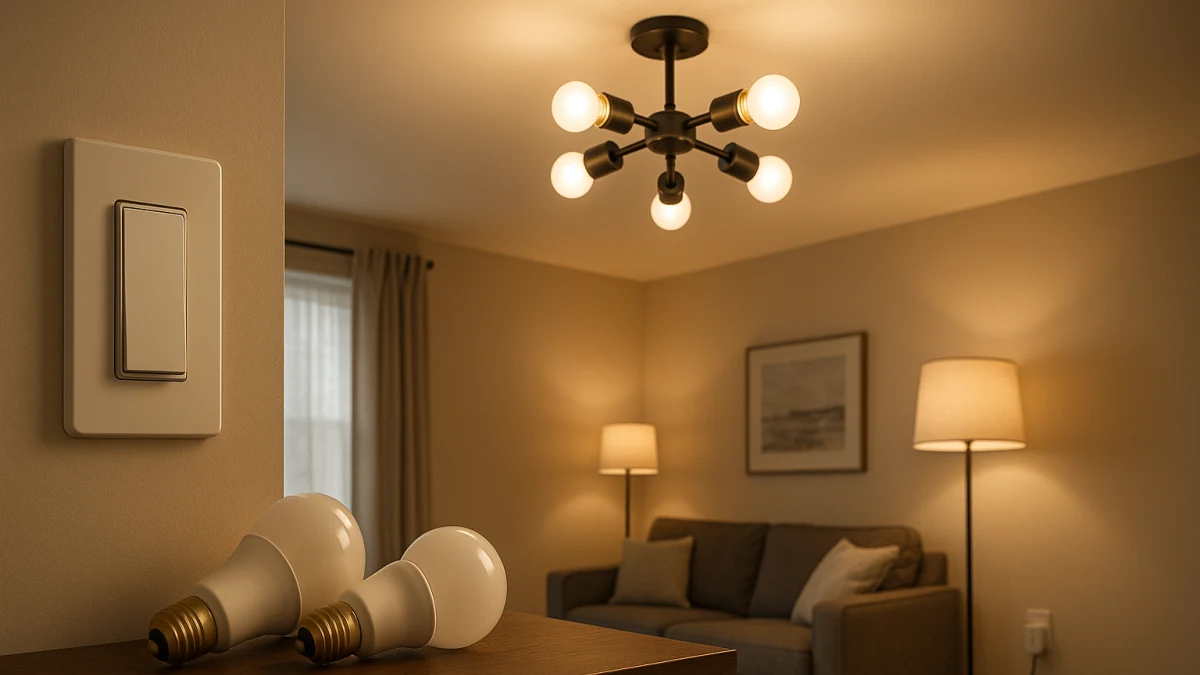
A multi-bulb ceiling light can be made smart in two very different ways: control the whole hardwired fixture at the wall, or replace every bulb in the fixture with a smart bulb. The right answer depends less on the word “smart” and more on the constraint you cannot change: wall-switch behavior, socket count, color features, wiring limits, dimming, or ecosystem support.
This collection is meant to do what a normal smart switch or smart bulb listing cannot: make the tradeoff visible before you buy. Smart switches belong to the fixture circuit, smart bulbs belong to each socket, and smart plugs belong only to plug-in lamps in the same room.
Decide by wall control, color, and socket count
| If your main need is... | Better fit |
|---|---|
| One wall switch already controls the whole ceiling fixture, and you want familiar wall-switch behavior | Smart switch for the fixture circuit |
| The fixture has several bulbs, and replacing every socket is less appealing than one circuit-level device | Smart switch for the fixture circuit |
| You want color, tunable white, or per-bulb scenes and can keep the wall switch powered on | Smart bulbs in each fixture socket |
| You want a no-wiring or more rental-friendly route and can verify bulb base, shape, voltage, and wall-switch behavior | Smart bulbs in each fixture socket |
| You only need smart control for a plug-in lamp elsewhere in the room | Smart plug for plug-in lamps in the same room |
Use this table together with the practical comparison points: everyday wall control, multi-bulb replacement cost, color or tunable-white features, installation difficulty, dimming compatibility, wireless protocol, and what the device can actually control.
Wall switch, color, or socket count: choose the constraint first
Start with the room, not the product category:
- Choose the switch path when the ceiling fixture already works well from one wall control and you want the whole fixture to stay intuitive for guests and daily use.
- Choose the bulb path when the feature you are paying for lives inside the bulb: multicolor scenes, RGBWW or RGBCCT color, tunable white, or per-bulb control.
- Count sockets before comparing prices. A five-socket fixture needs five compatible smart bulbs, while one compatible smart switch may control the whole fixture circuit.
- Treat dimming as a compatibility question, not a bonus assumption. Switch dimming, smart-bulb dimming, existing wall dimmers, and LED bulb behavior are not interchangeable.
- Keep plugs in their lane. A smart plug can automate a table lamp, but it does not control a hardwired ceiling circuit.
Neutral wire, load limit, and 3-way claims need product documentation
Smart switch listings may mention AC voltage, load or current rating, neutral wire, single-live-wire support, 1- to 4-gang options, dimming, 3-way or multi-way use, Wi-Fi, Zigbee, Matter, app control, and voice control. Those terms are screening clues, not universal promises.
Before buying a switch or dimmer, check the manufacturer’s product page for the exact wall-box and load requirements. Do not assume any model works with every LED bulb, no-neutral box, existing dimmable fixture, 3-way layout, or US installation. If the wiring or load details are uncertain, treat that uncertainty as a reason to pause rather than guess.
One wall switch, one fixture: the whole-circuit upgrade
If a single wall switch already controls the ceiling light, a smart switch is often the cleaner upgrade because it keeps the fixture working as one fixture. That matters most in kitchens, bedrooms, hallways, and living rooms where people still expect a wall control to work normally.
The products shown here are useful to compare when you want a switch, dimmer, or switch module for hardwired light control. Look for buyer-checkable details such as neutral wire or single-live-wire language, AC voltage, load rating, gang count, dimming support, 3-way or multi-way claims, protocol support such as Wi-Fi, Zigbee, or Matter, and app or voice-control compatibility.
Read this lane as the fixture-level option, not the color-effects option. For a multi-bulb ceiling fixture, one compatible smart switch can avoid replacing every socket with a smart bulb, but it still has to match the wall box, circuit, load, bulbs, and control layout. If color scenes, tunable white, or per-bulb control are the main goal, move to the bulb lane instead.
One smart bulb per socket: buy the features you actually need
Smart bulbs make sense when the features you want are inside each bulb: multicolor output, RGBWW or RGBCCT color, tunable white, app control, voice assistant support, grouping, or bulb-level scenes. They are also the no-wiring route for shoppers who do not want to replace a wall switch.
The tradeoff is socket count and constant power. In a multi-bulb ceiling fixture, each socket needs a compatible bulb, so check the fixture before comparing packs. Product pages may show shape and base terms such as A19, BR30, E26, or E27, plus brightness, wattage, 110 V or 120 V, Wi-Fi, Bluetooth, Zigbee, app support, and voice control.
Read this lane socket by socket. A 2-pack may be enough for a small fixture and not enough for a chandelier-style fixture, and the bulb shape still has to physically fit. Also check manufacturer guidance on wall-switch behavior: if the wall switch cuts power to the sockets, smart bulbs may not remain available for app or voice control unless the product specifically supports a suitable bypass, detached, or smart-bulb mode. If normal wall control for the whole fixture matters more than color, the switch lane is usually the better starting point.
Smart plugs stop at the outlet, not the ceiling circuit
A smart plug is a common false friend in this decision. It can make a plug-in lamp smart, but it does not replace a wall switch, control a hardwired ceiling fixture, or fix the problem of smart bulbs losing power when someone turns off the wall switch.
Use smart plugs only as an add-on for room lighting. For example, you might pair a ceiling-light upgrade with a smart plug on a side-table lamp so the room’s lighting can be coordinated. Keep the ceiling decision between the switch path and the bulb path.
Outlet-only lighting help: keep smart plugs out of the ceiling decision
This is the secondary lane. Compare these products only if you also have a plug-in lamp or other plug-in lighting load in the same room.
For smart plugs, check plug format, indoor-use suitability, 120 V or 125 V labeling, current or wattage rating, Wi-Fi or app support, voice assistant compatibility, and whether the body blocks adjacent outlets. Skip this lane if the only problem you are solving is a hardwired ceiling fixture.
Final ceiling-fixture checks before checkout
Before you buy, match the device to the fixed constraint in the room:
For a smart switch or dimmer
- Confirm whether the product requires a neutral wire or supports the wiring style described by the manufacturer.
- Check AC voltage, load or current rating, and whether the switch is intended for lighting loads.
- Verify gang count, wall-box fit, and any 3-way or multi-way claims against your actual switch layout.
- If dimming matters, look for manufacturer guidance on LED and dimmer compatibility.
- Confirm the control ecosystem: Wi-Fi, Zigbee, Matter, app control, and voice assistant support.
For smart bulbs
- Count every socket in the fixture before choosing pack size.
- Match base and shape, such as E26 or E27 and A19 or BR30, to the fixture.
- Check voltage terms such as 110 V or 120 V, plus brightness and wattage details.
- Decide whether multicolor, RGBWW, RGBCCT, or tunable white is actually worth buying one smart bulb per socket.
- Check how the bulbs behave when the wall switch is turned off, especially if app or voice control matters.
For smart plugs
- Use them only for plug-in lamps, not the ceiling circuit.
- Check 120 V or 125 V suitability, current or wattage rating, app support, voice support, and outlet clearance.
Choose the device that matches the room’s real constraint: a smart switch for familiar whole-fixture wall control, smart bulbs when color or no-wiring setup is worth one bulb per socket, and smart plugs only for plug-in lamps.