
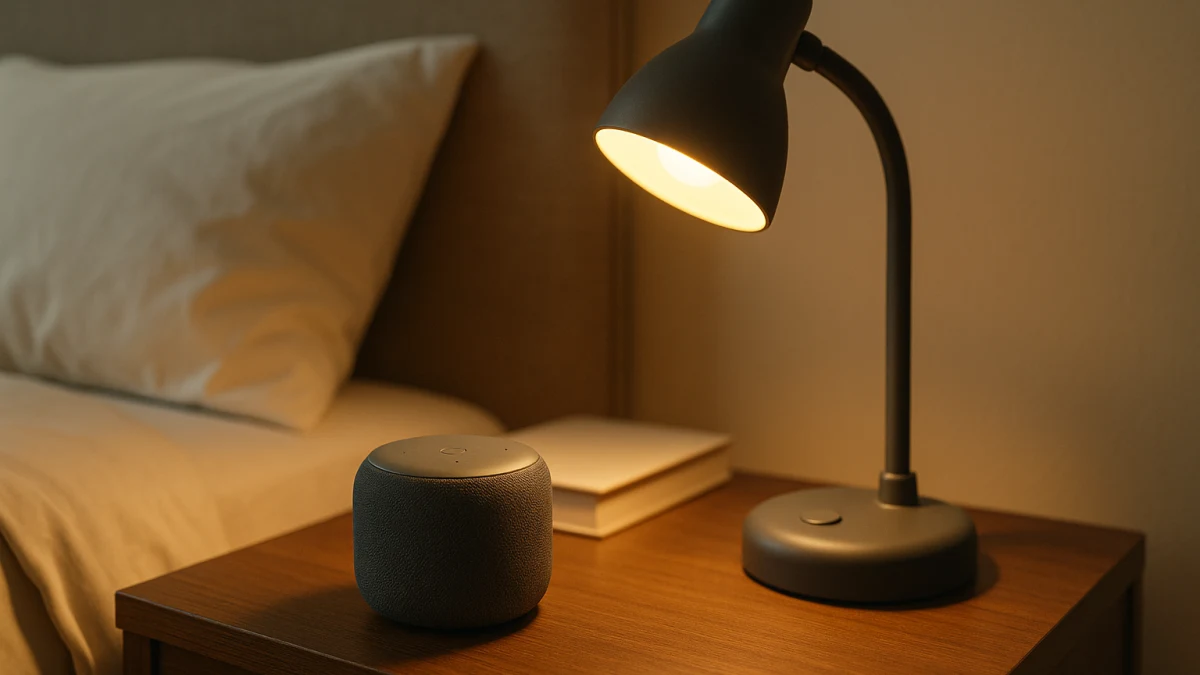
Your nightstand has limited space, so the first decision is not which gadget looks most advanced. It is whether that spot should go to voice and audio convenience or to a reachable, controlled bedside light. A normal category page can list smart speakers and lamps side by side, but it will not force the more useful question: what job do you actually need at bedtime?
Use the products shown here as narrowed candidate sets, not as generic smart speaker or office lamp results. Smart displays, standalone alarm clocks, sunrise lights, charger gadgets, smart bulbs, sound bars, TVs, sleep trackers, and decor-only lighting belong outside this comparison because they solve different problems.
Spend the nightstand spot on voice—or on light?
| If your main need is... | Better fit |
|---|---|
| Voice commands, alarms, timers, music, reminders, or smart-home control within reach of the bed | Bedside smart speaker |
| A reachable light for reading, winding down, or quick nighttime tasks | Bedside desk lamp |
| Less microphone presence, less audio playback, or less service setup in a shared bedroom | Bedside desk lamp, unless the exact speaker's mic mute and privacy controls are acceptable |
| Better bedroom TV audio rather than a nightstand routine | Leave this collection and compare bedroom sound bars instead |
Before you compare individual products, check the decision points that search filters often hide: footprint, cord or battery setup, controls you can use from bed, shared-bedroom impact, microphone behavior, light quality, compatibility, and false-friend products that look adjacent but do a different job.
The nightstand-space test: commands, sound, or reachable light
Use this test before opening product pages:
- Choose the speaker path if you will regularly ask for alarms, timers, reminders, music, streaming audio, or smart-home commands from bed.
- Choose the lamp path if your most common action is turning on a soft light, reading, finding something at night, or winding down without relying on a phone screen.
- If both sound useful, prioritize the action you do most often. A speaker does not replace proper reading light, and a lamp does not provide audio or voice-assistant convenience.
- Check the practical fit early: tabletop dimensions, base size, outlet location, cord route, battery expectations, physical buttons, touch controls, and whether another sleeper will be bothered by voice replies, music, or brightness.
Do not let alarm clocks, smart displays, or TV audio hijack the choice
Several products can look close to this decision but change the buying problem:
- Smart displays add screens and visual content; they are not the same as a compact bedside speaker.
- Standalone alarm clocks and sunrise wake-up lights focus on wake routines, not the speaker-versus-lamp tradeoff here.
- Sound bars, TV speakers, receivers, and home-theater gear are for room audio or TV audio, not a nightstand routine.
- Smart bulbs may control a lamp you already own, but they do not solve the question of whether to spend nightstand space on a device.
- Charger lamps, speaker lamps, FM-radio devices, and alarm-clock lamps combine jobs in ways that can obscure the choice. Skip them unless you intentionally want a multifunction product rather than a clean comparison.
- Floor lamps and decor-only lamps may help a bedroom look finished, but they are not compact bedside task lights.
Use the smart-speaker lane for alarms, audio, and hands-free routines
Choose this lane if voice commands, music, timers, reminders, or smart-home control will be more useful at your bedside than a dedicated reading light. Look for visible language around voice command, Alexa or other assistant support where listed, Wi-Fi or Bluetooth connectivity, streaming-service support, smart-home control, microphone presence, and a compact design that actually fits beside the bed.
The speaker products shown here are useful to compare for bedside routine signals, but speaker cards can be broad. Screen out anything that reads more like a large home-audio speaker, receiver, sound bar, or general Bluetooth speaker if it lacks the smart controls, compact footprint, or easy physical access you need from bed. In a shared bedroom, pay special attention to mic-off language, mute controls, indicator behavior, volume controls, and whether there are buttons you can use without speaking.
Read this widget as a shortlist for voice-and-audio convenience, not as proof that every product supports the same assistant, alarm behavior, sleep sounds, music services, or privacy controls. If your real need is reading, dimming, warm light, or a reliable glow for nighttime tasks, move to the lamp lane instead.
Bedroom microphone and service claims need product-level proof
Smart-speaker features vary by exact model, generation, account setup, and connected services. Do not assume that a speaker supports the assistant, music service, alarm behavior, sleep-sound feature, smart-home platform, or intercom-style function you want unless the product page or manufacturer information says so.
Treat microphone controls the same way. Check whether the listing describes a mic mute or mic-off control, how the device indicates microphone status, and whether there are usable physical controls for volume and playback. For a bedroom, those details matter as much as audio quality because the device sits close to where you sleep.
Use the bedside desk-lamp lane when light control is the job
Choose this lane when the main need is compact, reachable light for reading, winding down, or quick nighttime tasks. Look for LED lighting, dimming, adjustable brightness, adjustable color temperature, warm-light options, touch controls, app or voice controls where offered, and tabletop dimensions that suit a nightstand rather than a full desk.
For reading use, do not assume every lamp is bright enough or comfortable for your routine. Verify lumens, color-temperature range, dimming behavior, and whether the controls are easy to reach from bed. Also check base size, height, cord or battery setup, and whether the lamp will leave room for the other things you keep on the nightstand.
Use these products as bedside-light candidates, not as a generic office-lamp ranking. They are most relevant when dedicated light control matters more than audio, reminders, or streaming. If you mainly want hands-free commands or music at bedtime, the smart-speaker lane is the better comparison set.
Final nightstand checks: footprint, cords, controls, lumens
Before buying, make the final check product by product:
- Footprint: measure the available nightstand space and compare it with the product's width, depth, height, and base size.
- Power setup: confirm corded power, battery operation, charging needs, outlet location, and whether the cord route will be awkward beside the bed.
- Reachable controls: check for buttons, touch controls, app control, voice control, dimming controls, volume controls, and any physical fallback you can use without sitting up.
- For smart speakers: verify supported voice assistant, Wi-Fi or Bluetooth connectivity, streaming-service support, alarm and timer behavior, reminder support, smart-home compatibility, microphone controls, and status indicators.
- For bedside lamps: verify lumens, adjustable brightness, dimming range, adjustable color temperature, warm-light options, LED details, and whether the controls are practical from bed.
- For shared bedrooms: consider whether voice responses, music playback, microphone presence, or lamp brightness will bother another sleeper.
- For false friends: if the real goal is TV audio, a wake-up light, an alarm-clock replacement, a charger hub, or whole-room decor, compare that category directly instead.
The right choice is the device that solves your most frequent bedside job first. Pick voice and audio if commands, reminders, alarms, and music drive the routine; pick the lamp if controlled light is the job you will use every night.