
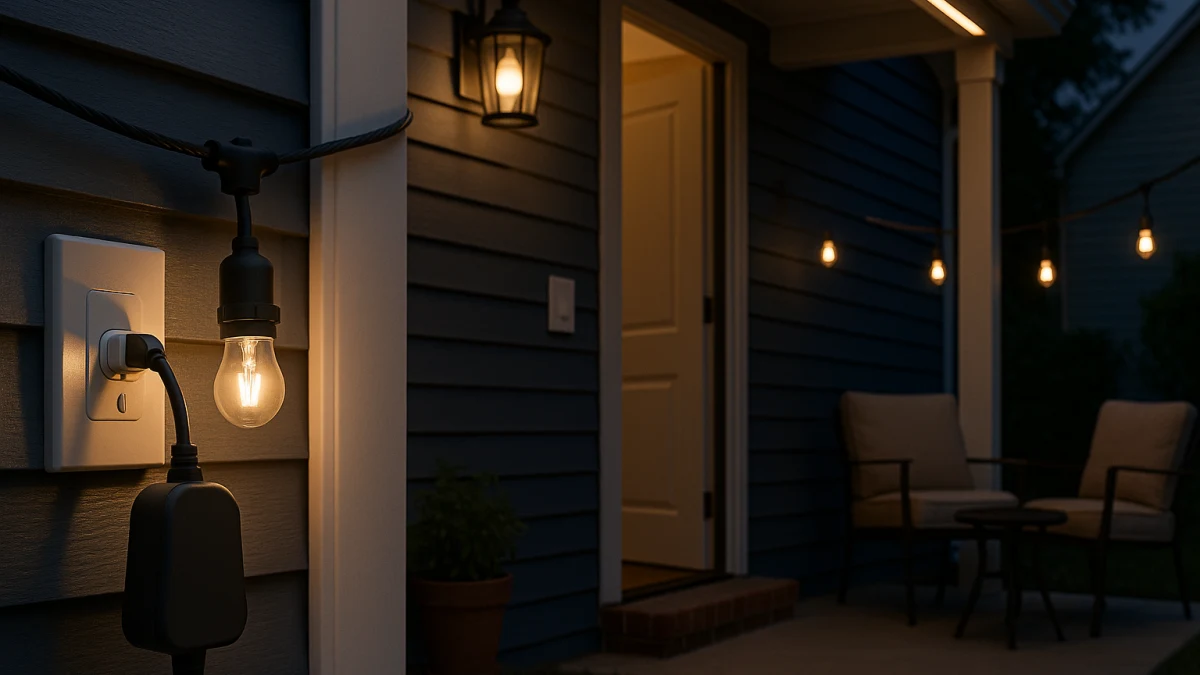
Porch lights, patio string lights, and outdoor accent runs can all become “smart,” but they do not start from the same product choice. This collection is organized by the control point you actually have: a plug-in outlet, a replaceable porch or flood bulb, an indoor wall box that controls exterior fixtures, or a new weather-rated accent strip.
That separation matters because a normal smart-lighting category can mix indoor plugs, generic bulbs, wall switches, strips, and unrelated outdoor lights. Here, the useful question is narrower: does the product match the outlet, fixture, wiring, load, and exposure before you think about apps, voice control, colors, or schedules?
Pick the control point before you pick the smart device
| Your setup | Better fit |
|---|---|
| The light set already plugs into an outdoor receptacle, such as patio string lights or seasonal lights. | Outdoor-rated smart plugs for plug-in lights |
| A porch or flood fixture accepts a compatible bulb, and the bulb text supports outdoor, wet, damp, weatherproof, or all-weather use. | Smart bulbs for compatible porch or flood fixtures |
| Several exterior fixtures are hardwired and already controlled by one indoor wall box. | Smart switches for hardwired exterior light circuits |
| The goal is to add a new color or accent run under a patio, deck, gazebo, eave, or covered zone. | Weather-rated LED strip lights as a supporting accent option |
Use these checks to narrow the widget results: control point first, then exposure language, then load or dimming compatibility. For bulbs, check PAR38 shape, E26 base when required, fixture enclosure limits, brightness, and operating-temperature language. For switches, check neutral-wire needs, single-pole versus 3-way wiring, box fit, hub requirements, 2.4GHz Wi-Fi or Zigbee details, and the listed load type. For LED strips, remember that the strip’s IP rating may not apply to the adapter, controller, connectors, or plug.
Start with outlet, bulb socket, or indoor wall box
If the lights plug into an outdoor receptacle, a weather-rated smart plug is usually the cleanest lane because it adds schedules or app control without changing the fixture. If the porch fixture takes a compatible outdoor smart bulb, replacing the bulb may be simpler than touching the switch. If the exterior lights are hardwired and already controlled from inside, a smart wall switch can automate the whole circuit from the indoor control point.
The common mistake is choosing by feature label alone. “Works with Alexa,” “color changing,” or “app control” does not answer whether the product belongs outdoors, fits the fixture, supports the connected load, or matches the wall-box wiring.
Weather-rated is a gate, not a style feature
Outdoor photos are not enough. Look for product-page language such as outdoor-rated, weatherproof, waterproof, wet location, damp location, IP44, IP65, IP66, ETL, UL, maximum load, and operating-temperature range where the manufacturer provides it.
Also check what part of the product the rating covers. A plug body, bulb, strip, adapter, controller, and connector may not share the same exposure limits. For US outdoor outlets, also verify GFCI protection and whether a weatherproof in-use cover or protected mounting location is needed for your setup.
Not a landscape transformer, camera light, or wiring project guide
This page is not for low-voltage landscape lighting transformers, permanent outdoor lighting systems, security floodlight cameras, or step-by-step electrical installation. It is for choosing among smart control products for plug-in lights, compatible outdoor bulbs, indoor wall switches that control exterior circuits, and a short supporting lane for weather-rated LED accent strips.
If your project requires new outdoor wiring, fixture relocation, buried cable, or code interpretation, treat that as an electrical project rather than a product-filtering decision.
Outdoor smart plugs for patio, porch, and string-light outlets
Use this lane when the lights already plug into an outdoor receptacle: patio string lights, plug-in porch accents, or seasonal light sets. The products shown here are meant to be compared on outdoor-use language first, then on outlet count, load rating, scheduling, app or voice support, and whether a hub is required.
Product pages in this lane may show details such as IP44, IP65, IP66, ETL listing, 15A or 1800W load language, dual outlets, individual outlet control, operating-temperature ranges, and sunset or sunrise routines. Those details are more important than generic smart-home claims because the connected light set and outdoor outlet conditions decide whether the plug is a reasonable fit.
Read these products as control add-ons for receptacle-powered lights, not as replacements for a wall switch. If the light is hardwired to an indoor switch, move to the switch section. If the job is one porch fixture with a compatible replaceable bulb, the bulb lane may be simpler.
The dimmer-plug exception for string lights
Outdoor smart dimmer plugs are a narrower case than outdoor on/off plugs. Use one only when the plug is listed for dimming and the connected string lights or bulbs are also dimmer-compatible and within the plug’s stated load limit.
Be especially cautious with mixed loads, motors, non-dimmable LEDs, or older light strings. A dimming feature on the plug does not automatically make every connected light set dimmable.
Outdoor-compatible smart bulbs for porch and flood fixtures
A smart bulb can be the shortcut when one exterior fixture accepts the right bulb and the bulb itself is described for outdoor, wet, all-weather, or weatherproof use. This lane is strongest for smart PAR38 flood bulbs and similar outdoor-capable bulbs rather than generic indoor smart bulbs.
Check the fixture before comparing color effects. Bulb shape, E26 base where required, brightness, tunable white or color output, enclosed-fixture limits, and operating-temperature language all matter. Connectivity choices such as Wi-Fi, Bluetooth, Zigbee, Alexa, Google Home, or Apple HomeKit should come after the outdoor and fixture-fit checks.
The products shown here help when replacing a bulb is enough to make one porch or flood fixture smart. For several hardwired fixtures on the same circuit, a smart switch may be cleaner. Also remember that app or voice dimming belongs to bulbs that support it; standard wall dimmers may not be compatible with smart bulbs.
Indoor smart switches for hardwired exterior light circuits
Choose this lane when exterior lights are controlled from an indoor wall box and you want one schedule, app command, or voice routine for the whole circuit. The switch is indoors; do not treat it as an outdoor-rated device unless the product page specifically says so.
Compare neutral-wire requirements, neutral-optional designs, single-pole versus 3-way wiring, switch-box fit, dimmer versus on/off control, and hub requirements before comparing app features. Load details matter too: LED, CFL, incandescent, halogen, maximum wattage, and dimming ranges can decide whether the switch works with the actual fixtures.
These products are useful when one indoor control should automate multiple hardwired porch lights, sconces, or exterior fixtures. They are not competing with outdoor smart plugs for receptacle-powered string lights, and they should not be assumed compatible with smart bulbs, non-dimmable LEDs, or every existing 3-way arrangement.
LED strips stay in the accent-light lane
LED strips are included only for adding a new accent run, not for controlling an existing porch fixture or string-light plug. If your real goal is to schedule porch lights, automate a flood fixture, or control patio string lights, stay with the plug, bulb, or switch lanes above.
For strips, the main risk is component mismatch: the strip may be IP65 or IP67 while the adapter, controller, connectors, adhesive, or plug has different limits.
Weather-rated LED strips for adding covered outdoor accent light
Use this supporting lane for accent lighting under a patio, deck, gazebo, eave, or other suitable covered zone. Compare IP65, IP67, or IP68 language, strip length, RGB or RGBIC effects, app or remote control, mounting clips or adhesive, cuttable versus non-cuttable designs, adapter rating, and plug type.
Read these as decorative add-ons, not porch-light controls. Before buying, check whether the power supply, controller, and connectors can be placed where you intend to install them; some strips may have non-waterproof adapters or plug-type caveats such as an EU 2-pin plug.
Final US fit check: GFCI, cover, enclosure, and load
Before you choose a product, verify the basics against the product page and your actual installation:
- The outlet or circuit is appropriate for outdoor use and GFCI protection is addressed for the location.
- Any outdoor plug can fit under the needed weatherproof cover without forcing the cord, cap, or receptacle into an unsafe position.
- The connected load stays within the listed amp or watt rating, such as 15A or 1800W when the product specifies it.
- Dimming is supported by both the smart device and the connected bulbs or string lights.
- A smart bulb matches the fixture’s shape, base, enclosure limits, wet or damp language, and operating-temperature range.
- A smart switch matches the indoor wall box, neutral-wire situation, single-pole or 3-way wiring, load type, and dimming needs.
- LED strip adapters, controllers, connectors, adhesive, and plugs are rated or protected for the planned location.
The simplest good choice is the one that matches the real control point first: outdoor plug for plug-in lights, compatible bulb for a single suitable fixture, indoor smart switch for hardwired exterior circuits, and LED strips only when you are adding a separate accent run.