
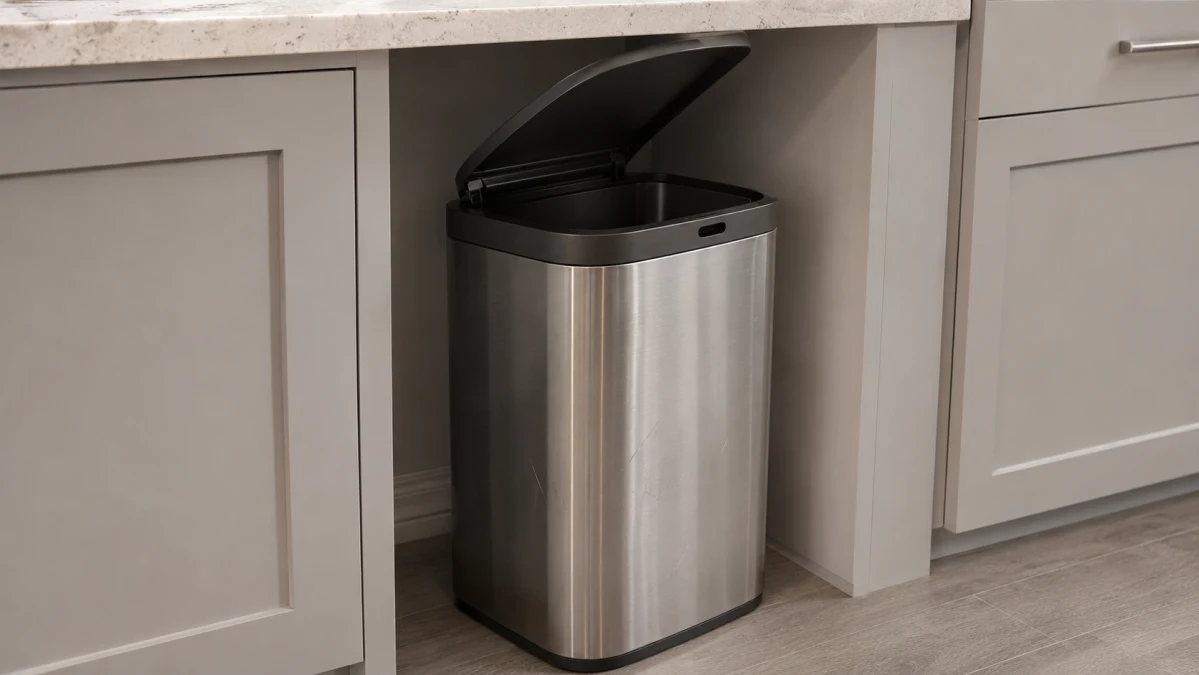
A sensor trash can should make it easy to scrape a plate or drop a handful of wrappers into the opening. In a tight kitchen, that convenience depends on where the lid moves, how you reach the sensor and whether you can get a full bag out.
A can that slides neatly under a counter may still be awkward to use there. Before buying, measure the space and think through those everyday movements. Capacity matters, too: saving a few inches is a poor trade if the bin fills much faster than you want to empty it.
Measure for everyday use
Start with the exact spot where the can will stand.
- Check the usable footprint. Measure the available width and depth, allowing for baseboards, pipes, cabinet hinges and doors that need to swing past. Compare those measurements with the product’s dimension drawing. Manufacturers do not always label length and width in the orientation you expect.
- Measure to the lowest overhead obstruction. Start at the surface supporting the can and measure up to the underside of the counter, shelf or projecting trim. Compare that with the total height when the lid is open. If a listing gives “clearance,” check whether it means total open height or additional space above the closed lid.
- Watch the lid move. A manufacturer’s demonstration can show whether it rises, folds or projects behind the body. Check nearby edges throughout that movement. For a close fit, ask the seller for the specific measurement that is missing.
- Leave room to put trash inside. Picture holding a plate or cutting board over the opening. A lid can clear a shelf while the shelf still gets in the way of your hand or the items you are trying to throw away.
Use the assembled dimensions, including any legs or wheels. Marking the footprint on the floor with masking tape can also help you judge how far the can will project into a walkway.
Similar capacity, different opening height
Two iTouchless models illustrate why the capacity label cannot tell you whether a can will work under a counter. Both hold roughly 13 gallons, but their published open heights differ by 5.3 inches.
- iTouchless WS13RSL: The manufacturer lists a wings-opening lid and closed dimensions of 16.3 inches L × 10.4 inches W × 22.6 inches H. Its published total height with the lid open is 27.2 inches.
- iTouchless SP13WW Prime White: The manufacturer lists closed dimensions of 10.7 inches L × 15.8 inches W × 24.7 inches H. Its published total height with the lid open is 32.5 inches.
Imagine a shelf covering the opening area, with 30 inches between its underside and the surface the can stands on. The WS13RSL’s published open height leaves 2.8 inches above the lid. The SP13WW is 2.5 inches too tall to open fully beneath that shelf, despite fitting there when closed.
The WS13RSL is the more promising option for that height restriction. Its footprint, opening movement and sensor position still need to suit the space. In a taller location, the SP13WW’s extra opening height might be irrelevant.
Give the sensor room to work
Locate the sensor in the product photos or manual before deciding which way the can will face. You need to be able to make the intended gesture comfortably. An overhang can make reaching above a sensor awkward, while a knee-operated feature is useful only if your knee can reach its sensing area.
There is specific placement guidance for the two iTouchless models. The manufacturer’s WS13RSL manual and SP13WW manual both specify at least 10 inches between the sensor and a wall, and instruct owners to keep the sensor out of direct sunlight. Their diagrams show horizontal clearance toward a wall facing the sensor.
That makes orientation part of the decision. Rotating a can to squeeze it into a gap may leave its sensor facing a nearby cabinet side. Follow the instructions for the exact model you are buying; another can’s sensor may be positioned or operated differently.
Think through the bag change and power supply
Check how the lid assembly or bag-retaining rim comes off. You will need room to reach the bag, lift it free and fit a replacement. A can that opens comfortably under a counter may still need to be pulled forward for emptying.
That can be an acceptable compromise, provided there is a clear route out. Check that you can grip the can and move it without catching its legs, lid or power cable on the surrounding furniture.
Power affects that routine. The WS13RSL uses four C batteries or an optional AC adapter; the batteries are not included, and the adapter is sold separately. The SP13WW uses four AA batteries, also not included.
Battery power avoids a cord when moving the can, but you will need access to replace the batteries. An adapter requires a reachable outlet and a cable route that accommodates any movement needed for bag changes. Check the contents of the particular seller’s package before ordering.
Match the smaller cans to your routine
A 12-liter capacity is about 3.2 US gallons—roughly a quarter of a 50-liter kitchen can. That may suit tissues and wrappers beside a desk, while kitchen packaging and food preparation waste can demand more frequent emptying. Compare the advertised capacity with the bin you already use and how quickly you fill it.
For a narrow gap, compare the actual width and depth alongside capacity. For a spot beneath furniture, pay particular attention to assembled height, sensor access and the opening mechanism.
12L Sensor Trash Can. The supplier advertises a plastic 12-liter bin with hand and knee activation and an adjustable sensing range. If knee activation appeals because your hands are often full, check where that gesture needs to happen. A counter edge or surrounding furniture could make the movement awkward. Ask how the range adjustment works, too; an adjustable setting alone does not establish that the can will ignore people walking nearby.
Automatic Sensor Trash Can. The supplier describes a slim bin with legs and soft-close operation. Check its assembled height and the space occupied by the legs before choosing it for a low or narrow opening. Confirm the capacity as well, so you can compare how much it holds with the 12-liter option. Soft closing describes how the lid shuts; you still need to see how it opens and how much room that movement takes.
Moving a can occasionally to change the bag is a different commitment from pulling it out every time you throw something away. If everyday use requires repositioning it, consider a more accessible location before paying for the convenience of a sensor lid.