
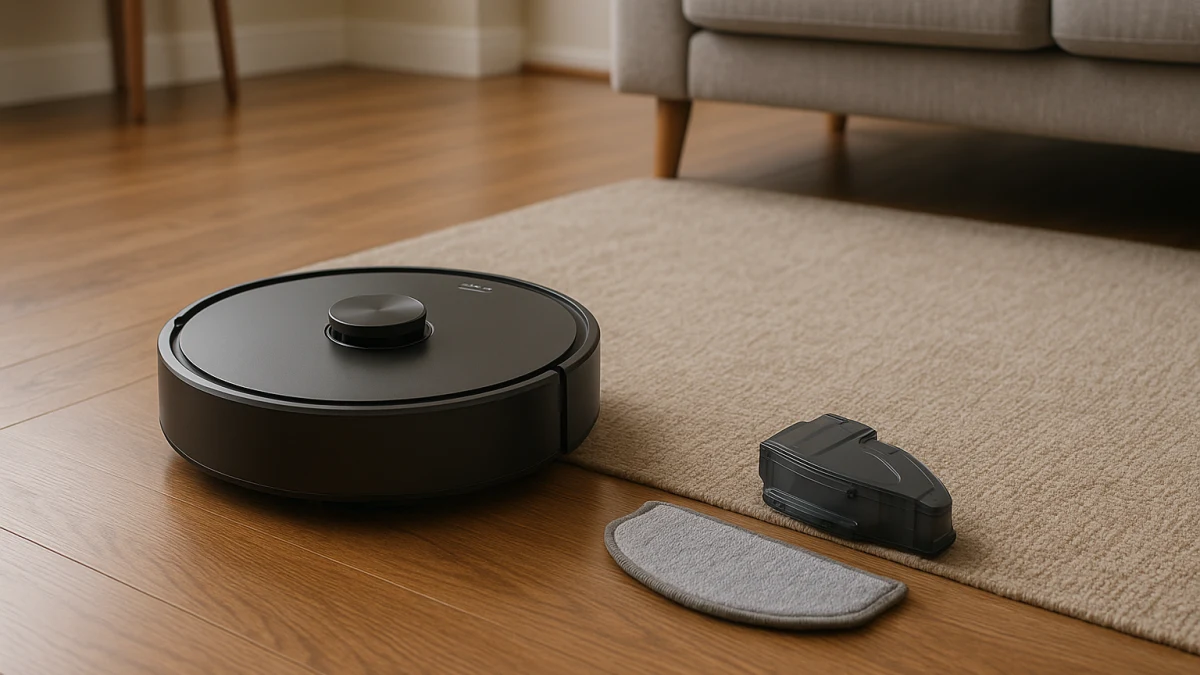
Mixed floors create two different robot-vacuum mistakes: buying a vacuum-mop combo that drags a damp pad onto rugs, or buying a dry robot vacuum that looks powerful but gives you too little to judge carpet pickup. Raised thresholds and thick rug edges add a third problem, but clearance should be a fit check after you decide whether dry pickup or mop convenience matters more.
A normal robot-vacuum listing can mix dry vacuums, mop combos, pet-hair claims, and clearance language without explaining what matters for rugs and hard floors together. This guide separates vacuum-first models from vacuum-mop combos, looks for rug-protection controls before trusting mop pads near carpet, and treats transition specs as a secondary screen rather than a promise.
Pick the failure mode you most need to avoid
- Rugs and carpet are the priority, and automated mopping is not worth the wet-pad tradeoff: start with vacuum-first robot vacuums for rug pickup.
- The home is mostly hard floors, but area rugs sit in the robot’s mopping route: compare vacuum-mop robot vacuums only when carpet detection, mop lifting, carpet avoidance, or no-mop zones are visible, then verify the details.
- Raised thresholds, thick rug edges, or floor-type changes have trapped robots before: use transition-friendly language as a tie-breaker after choosing the main cleaning path.
- Pet fur pickup and anti-tangle maintenance are the main buying problem: use a pet-hair-first robot vacuum path instead of forcing that decision into this mixed-floor page.
As you compare, keep five questions in mind: dry pickup or mop-combo convenience, rug-protection controls, carpet pickup language, transition and rug-edge fit, and which claims need manufacturer confirmation before checkout.
Choose your risk: wet rugs, weak pickup, or stuck transitions
The right starting point is the failure you are trying to avoid, not the longest feature list.
- Wet rugs: prioritize carpet detection, carpet recognition, mop lifting, mop raising, carpet avoidance, no-go zones, or no-mop controls before considering a mop combo.
- Weak pickup on rugs: look for dry vacuum language such as suction power, floor detection, brush design, multi-surface cleaning, and carpet-cleaning modes, while remembering that suction numbers alone do not prove deep carpet cleaning.
- Stuck transitions: check threshold crossing height, obstacle crossing height, vertical step height, carpet climbing height, or NeverStuck-style language only after the cleaning approach makes sense.
Keep mop-only, shampooer, and pet-hair detours out
This page is limited to robot vacuums for homes with rugs, carpeted areas, and hard floors. It does not try to compare manual mops, steam mops, carpet shampooers, or pure robot mops, because those solve different cleaning problems.
Pet-hair language may appear on some robot-vacuum listings, but pet fur and anti-tangle upkeep are not the main organizing decision here. If shedding is the top reason you are shopping, a pet-hair-first comparison will be more useful than a mixed-floor wet-rug guide.
Do not let a mop pad or suction number decide alone
A mop combo is not automatically a good mixed-floor choice just because it can vacuum and mop. If rugs sit in the mopping route, the important question is how the robot recognizes carpet, lifts or raises the mop, avoids carpet, or lets you set no-mop zones.
A dry robot vacuum is not proven by a large Pa number alone, either. Pair suction language with carpet detection, floor detection, brush or roller design, multi-surface cleaning language, and the manufacturer’s guidance for carpet height, rug fringe, and maintenance.
Dry pickup first: rugs, carpet, and hard floors without a mop pad
Choose this path when area rugs and carpet pickup matter more than automated mopping. The products shown here are meant to keep the decision focused on dry vacuuming rather than water tanks, wet pads, or mop maintenance.
Useful comparison cues include suction power, carpet detection, floor detection, brush design, multi-surface cleaning, and carpet-cleaning language. Some listings also mention self-emptying or pet hair, but those should not distract from the main question: does the product give you enough reason to consider it for rugs and hard floors without adding a wet-mop tradeoff?
Read these as vacuum-first candidates, not as upright-vacuum replacements. Before buying, check the product page for brush or roller design, filter type, no-go zone setup, and any manufacturer cautions about high-pile carpet, loose fringe, or rug fibers.
Mop combos only when rug protection is visible
This path is for homes that are mostly hard floors but still have area rugs in the robot’s route. A vacuum-mop combo can be convenient, but it adds a wet-pad decision that a dry robot vacuum does not have.
The products shown here are useful to compare when the listing combines vacuum, mop, and carpet language with visible rug-protection controls. Look for carpet detection or carpet recognition first. Mop lifting or mop raising can reduce contact with rugs, but the stated lift height needs to be checked against your actual rug pile and edges.
Carpet avoidance, no-go zones, no-mop controls, mop detachment options, and water-control settings also matter. A mop combo with stronger rug controls may make sense for hard floors with rugs; a dry vacuum-first model may be the better fit if you do not want to manage wet-cleaning risk at all.
Use this group to compare how each model claims to handle rugs before, during, and after mopping. Do not assume a mop lift or carpet mode means every rug will stay dry in every layout, especially around thick edges, loose fringe, or rugs that shift.
Measure rug edges before treating clearance as solved
Before relying on any crossing or lifting claim, measure the real trouble spots: raised thresholds, metal or wood saddles, thick rug borders, curled corners, and the pile height where the robot will actually travel. Then compare those measurements with the manufacturer’s stated mop lift height, supported carpet height, and threshold or obstacle clearance.
This is not a separate obstacle-avoidance buying path. Measuring simply keeps you from overreading a feature phrase such as threshold crossing or mop lifting as a guarantee for your specific rooms.
Threshold fit: a tie-breaker for raised saddles and rug edges
Use this shorter group when your home has transitions that have trapped robots before: raised saddles, thicker rug edges, frequent floor-type changes, or small obstacles between rooms.
These products are helpful for comparing terms such as threshold crossing height, obstacle crossing height, step height, vertical step height, carpet climbing height, climbing capability, obstacle clearance, or NeverStuck-style language. Treat that language as a final fit check, not as a substitute for deciding between dry pickup and a mop combo with rug protection.
Checkout checks for rugs, mop pads, and thresholds
Before you choose a model, confirm the details that are most likely to affect mixed-floor results:
- Whether carpet detection or floor detection is described clearly enough for your layout.
- How mop lifting, mop raising, carpet avoidance, no-mop zones, or mop detachment work on the specific model.
- The stated mop lift height and whether it makes sense for your rug pile and rug edges.
- Manufacturer guidance for supported carpet height, rug fringe, and loose or lightweight rugs.
- Threshold crossing height, obstacle clearance, or climbing claims for the raised transitions in your home.
- Brush or roller design, how hair is removed, and whether replacement filters or parts are easy to identify.
- Water tank, mop pad, and water-control instructions for the flooring you plan to clean.
Manufacturer wording decides the edge cases
Catalog language can help you screen products, but the edge cases are model-specific. Mop lift height, carpet detection behavior, no-mop zone setup, water control, flooring-safe wording, supported carpet height, rug-fringe cautions, and threshold clearance should come from the product page or manufacturer documentation.
In short: choose vacuum-first if rug pickup is the priority, choose a vacuum-mop combo only when rug protection can be checked, and use transition specs as the last fit check rather than a promise that the robot will never get stuck or wet a rug.