
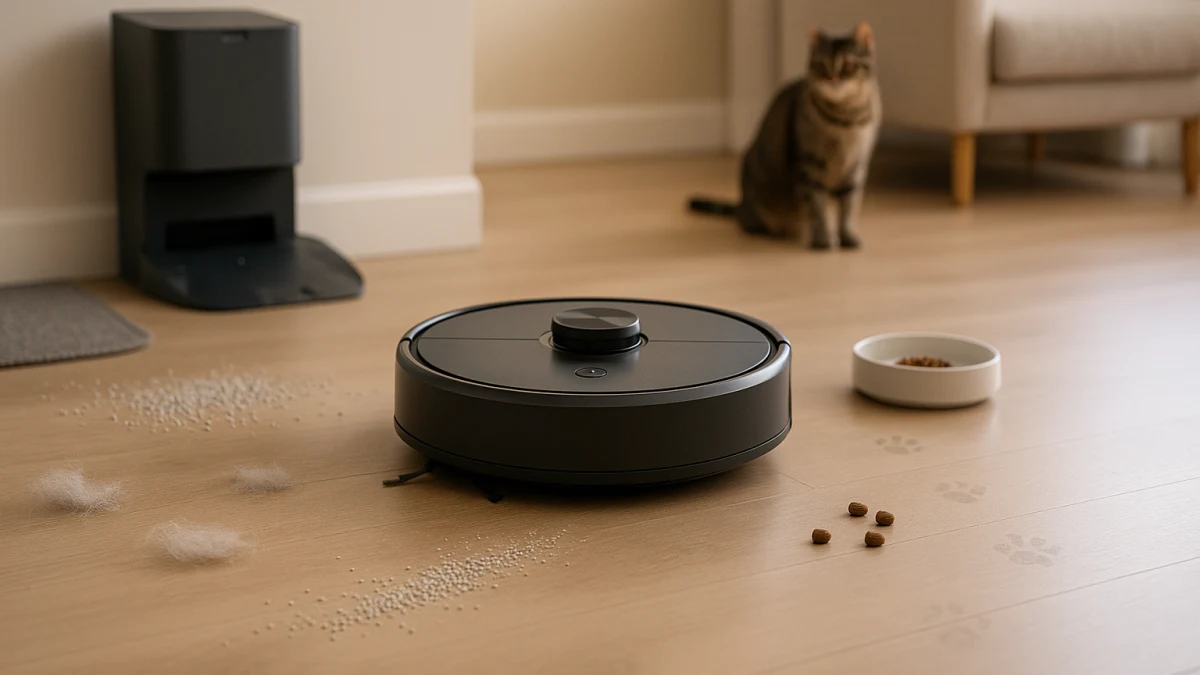
Pet-hair robot vacuum listings often stack the same badges: anti-tangle brushes, self-emptying docks, high suction, mopping, filters, smart navigation, and pet-friendly wording. The useful question is not which model has the longest feature list, but which pet-home problem creates the most work: hair wrapping around the roller, a small bin filling quickly, tracked litter and other dry debris, or light paw prints on hard floors.
Use this collection to separate those problems before comparing products. For shedding homes, brush design and maintenance access usually matter first. For heavy fur volume, bin and dock capacity become more important. For litter, kibble, crumbs, and dirt, focus on dry-pickup design rather than suction numbers alone. Treat mopping as a secondary feature for compatible hard floors. Claims involving HEPA filtration, allergens, pet-waste avoidance, or tested pickup need separate verification.
Which pet mess should drive the robot-vacuum choice?
| If this is the problem | Better fit | What to compare first |
|---|---|---|
| Long pet or human hair repeatedly wraps around the main roller | Anti-tangle robot vacuums for daily fur pickup | Main-brush design, anti-tangle or hair-detangling claims, removable roller, and access for manual cleaning |
| Fur fills the onboard bin quickly or requires frequent manual emptying | Self-emptying or higher-capacity robot vacuums | Auto-empty dock, onboard bin size, bagged versus bagless base, base capacity, and replacement consumables |
| Tracked litter, kibble, crumbs, dirt, and fur collect on hard floors | Robot vacuums with strong dry-debris pickup cues | Main brush, suction path, hard-floor compatibility, edge cleaning, spot cleaning, and suction information |
| The remaining mess is mainly light paw prints on compatible hard floors | Vacuum-and-mop robot vacuums | Mop system, water control, floor compatibility, carpet avoidance, and no-mop zones |
| The listing relies heavily on HEPA, allergen, dander, pet-waste avoidance, or tested-pickup claims | Verify before treating the claim as a deciding factor | Manufacturer documentation, clearly defined test conditions, applicable standards, and reputable independent testing where available |
Start with the problem you actually see
Walk through the rooms before comparing specifications. If you regularly remove hair from the main roller, brush-roll design is the first filter. A larger dock does not solve hair wrapped around a brush.
If the robot collects fur successfully but its onboard bin becomes packed quickly, capacity and automatic emptying deserve more weight. A full or heavily packed bin can also reduce useful airflow or leave less room for additional debris even when the robot does not detect that the bin is full.
For litter around the box, crumbs or kibble near bowls, dirt from paws, and fur along baseboards, concentrate on dry pickup. Suction ratings can be useful for comparing manufacturer specifications within context, but a higher Pa number does not by itself prove better real-world pickup. Brush design, intake geometry, edge cleaning, surface transitions, debris size, and how much material is already in the bin can all affect the result.
If vacuuming is already handled well and the remaining issue is light paw prints, then mopping becomes worth comparing.
Keep allergies, grooming, and pet accidents outside this comparison
This collection covers robot vacuums and vacuum-and-mop robots. It is not a comparison of pet grooming vacuums, handheld vacuums, air purifiers, odor-control devices, pool cleaners, or dedicated pet-waste cleanup products.
Treat allergy-related wording carefully. Terms such as HEPA, anti-allergen, dander filtration, or sealed system describe specific product features or marketing claims; they should not automatically be interpreted as allergy treatment or medical protection.
Pet-waste avoidance also belongs in a separate verification lane. Obstacle-recognition features may reduce the chance of contacting certain objects, but they should not be treated as permission to run a robot around known urine, feces, vomit, or other wet pet accidents. Unless the manufacturer explicitly states otherwise, remove those hazards before starting the robot.
For hair wrap, begin with the main brush
For homes where hair repeatedly winds around the roller, look for listings that clearly describe the brush mechanism rather than relying on generic pet-friendly wording. Useful terms include anti-tangle brush, tangle-resistant roller, hair-detangling system, self-cleaning brush, or similar manufacturer-specific language.
Then check what happens when the anti-tangle system is not enough. The main roller should ideally be accessible for routine inspection and cleaning, because no marketing term should be interpreted as a guarantee that hair will never accumulate.
Smart navigation, mapping, app controls, voice controls, and obstacle avoidance may improve convenience, but they do not replace a suitable brush design when hair wrap is the actual maintenance bottleneck.
Read the products shown here as anti-tangle candidates, not as proof that manual cleaning disappears. Compare the main-brush design, roller access, hair-removal instructions, replacement parts, and compatibility with the floor types in your home.
Anti-tangle does not mean maintenance-free
Hair can still collect around roller ends, bearings, side brushes, wheels, filters, or the intake area. Before choosing a model, check whether the main brush can be removed without a complicated procedure and whether the manufacturer provides clear maintenance instructions.
Side brushes matter too, especially when long hair gathers around their shafts. Replacement availability is worth checking because these are wear parts rather than permanent components.
Filters are a separate maintenance item. Confirm the stated filter type, whether it is washable if the manufacturer allows washing, how often inspection or replacement is recommended, and whether replacement filters are readily available. Do not assume that an anti-tangle brush also means low filter or bin maintenance.
Choose a self-emptying dock when fur volume is the problem
Move to this lane when the robot picks up hair adequately but frequent bin emptying becomes the nuisance. Compare self-emptying, auto-empty, automatic dust collection, base station, dust bag capacity, bagless base, and onboard bin size.
The dock changes disposal convenience, not the robot's fundamental ability to pick debris up. A self-emptying base cannot compensate for poor brush design, unsuitable floor compatibility, or a frequently tangled roller.
Marketing intervals such as 30 days, 60 days, or several weeks without emptying should be read as estimates under particular usage assumptions. A heavy-shedding or multi-pet home can fill a bag or collection chamber substantially faster.
Use this group to compare the emptying system itself: onboard bin size, bagged versus bagless base, stated base or bag capacity, replacement-bag requirements, and how the dock transfers debris from the robot. Continue to evaluate brushes and filters separately.
For litter, kibble, and crumbs, compare dry-pickup design
Tracked litter, food crumbs, dirt, and loose fur create a different problem from brush-roll tangles. Look for clear hard-floor or mixed-floor compatibility, a suitable main brush, edge cleaning, spot cleaning, and manufacturer information about dry-debris pickup.
Suction figures can provide one specification, but do not rank products by Pa alone. Pa measures pressure rather than complete cleaning performance. The final result also depends on airflow, brush agitation, intake design, debris size and shape, floor surface, edge geometry, and whether particles are pushed or scattered before reaching the intake.
This matters especially around litter boxes and food bowls, where larger or irregular particles may behave differently from fine dust. A general claim of strong suction is not the same as verified performance on the particular litter or kibble used in your home.
Treat the products shown here as dry-pickup candidates. Check the product documentation for floor compatibility, brush design, edge-cleaning features, and supported debris examples. Do not assume that a high suction rating guarantees litter, kibble, or anti-scatter performance.
Use mopping only after the vacuuming problem is solved
A mop feature should not dominate the choice when the real problem is tangled hair, limited bin capacity, or poor dry-debris pickup. Solve those issues first.
Vacuum-and-mop models can be useful when the remaining mess is light paw prints or similar surface marks on flooring that the manufacturer approves for wet cleaning. Compare the mop mechanism, water control, pad maintenance, rug handling, and navigation rules rather than treating every 2-in-1 robot as equivalent.
Homes with rugs near bowls, doors, or pet areas should also check how the robot handles carpet while mopping. Depending on the model, that may involve carpet detection, mop lifting, carpet avoidance, or configurable no-mop zones.
The products shown here are candidates for light maintenance mopping, not substitutes for deep wet cleaning. Follow the manufacturer's guidance for compatible flooring, water or cleaning-solution use, mop-pad care, carpet handling, and no-mop settings.
Final checks for heavy-shedding homes
Before choosing, verify:
- How the main roller is removed, inspected, and cleaned
- Whether the anti-tangle or hair-detangling claim refers to the main brush, another component, or the overall cleaning system
- Whether hair can accumulate around roller ends, side brushes, wheels, or other moving parts
- Onboard bin size and how easily the bin can be emptied and cleaned
- Dock type, collection capacity, and replacement-bag requirements if the robot is self-emptying
- Filter type, maintenance instructions, and replacement availability
- Compatibility with the hard floors, carpets, rugs, and thresholds in your rooms
- Edge-cleaning and spot-cleaning options where debris collects around walls, litter boxes, and food areas
- No-go zones, carpet avoidance, mop lifting, or no-mop zones if they matter in your layout
- Whether any advertised multi-week emptying interval is an estimate rather than a guaranteed interval for a heavy-shedding home
Verify HEPA, anti-tangle, waste-avoidance, and pickup claims separately
Some claims need more evidence than a product-card badge provides.
For HEPA or allergen-related language, check exactly what component is being described and whether the manufacturer identifies a filtration standard or test method. Do not convert filtration wording into claims about treating allergies or providing medical protection.
For anti-tangle systems, determine what the claim actually covers. A design intended to reduce hair wrapping can still require periodic manual cleaning.
For camera- or sensor-based pet-waste avoidance, check which objects the system is designed to recognize, the conditions under which the feature operates, and the manufacturer's limitations. Avoid running the robot around known pet accidents regardless of the feature.
For litter, kibble, pet-hair, or percentage-pickup claims, look for clearly described test conditions or reputable independent testing before treating the numbers as directly comparable between models.
The best starting point is the maintenance bottleneck you encounter most often: brush design for recurring hair wrap, bin and dock capacity for high fur volume, dry-pickup design for litter and crumbs, or mopping for light paw prints only after the vacuuming job is already covered.