
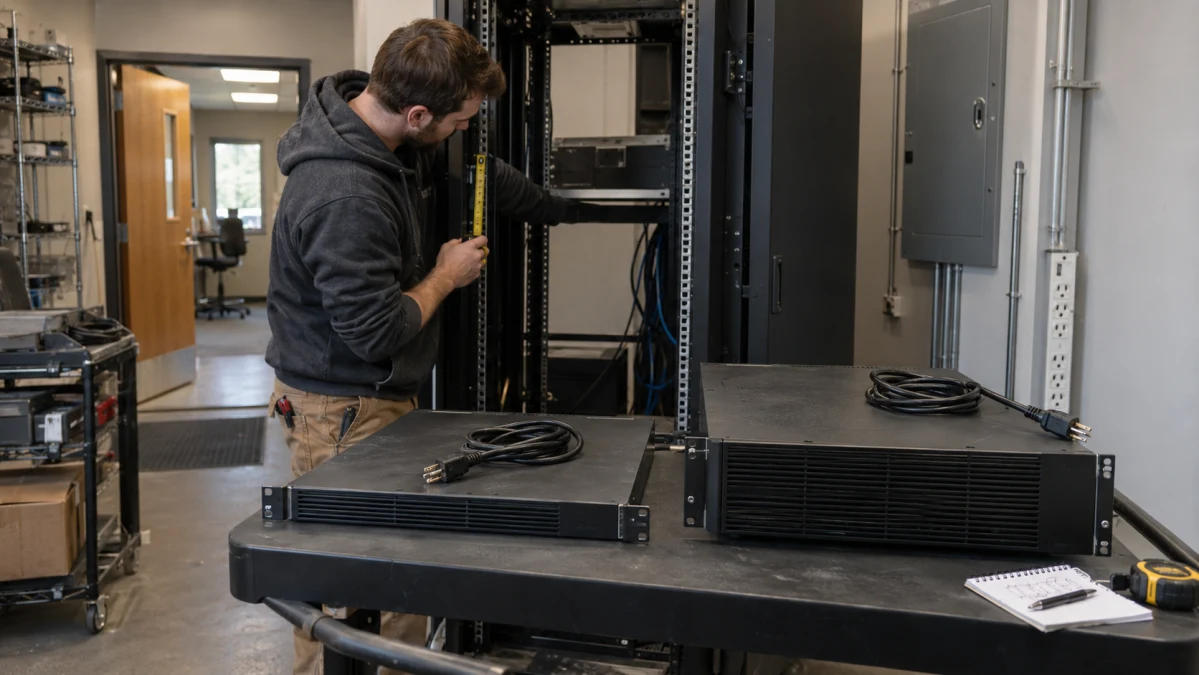
A 1U UPS is not automatically the smaller choice. In these two Eaton models, the 1U unit is substantially deeper and heavier, while the 2U unit gives up an extra rack unit in exchange for a much shorter chassis. They also differ in power capacity, battery-mode waveform, outlet count and remote management.
That means the practical choice is not simply “1U or 2U.” First determine what physically fits. Then check the load in both watts and VA, the required runtime at that load, the power connections and any requirements the protected equipment has for UPS output waveform.
The rack itself may decide the choice
The Line-interactive UPS uses only 1U of rack height, but Eaton specifies a 20-inch-deep chassis weighing 32.5 pounds. That can be a good trade when rack units are scarce and the cabinet has enough depth.
The 5P1000R is designed as a rackmount UPS rather than a shallow appliance hanging only from its front ears. Eaton's installation documentation specifies a 4-post rail kit for the rackmount 5P line and an optional 1U two-post rail kit. Before buying, measure the distance between the rack posts and the usable space behind the UPS, including room for the power cord and connected equipment cables.
The Line-Interactive UPS takes 2U, but its chassis is only 8.27 inches deep and 16.8 pounds. Eaton describes it as suitable for 2-post or 4-post rack installation as well as tower placement.
That makes the 2U model the more practical physical fit in many shallow wall cabinets and small network racks. It also demonstrates why rack height by itself is a poor proxy for overall size: this particular 2U UPS is less than half as deep as the 1U 5P1000R.
Measure usable rack depth rather than the enclosure's advertised outside depth. A chassis that technically fits can still be unusable if the rear door presses against a plug, cables have to bend too sharply, or the mounting hardware cannot span the rack.
The 1U 5P1000R gives you considerably more power capacity
The 5P1000R is rated for 1000 VA and 770 W. The SMART750LCDNC is rated for 750 VA and 475 W.
Those limits matter independently. Add up the equipment that must remain powered during an outage and make sure the total stays below both the watt and VA rating of the UPS. Do not plan a new installation around running continuously at the published maximum; leave room for equipment changes and load variation.
A protected load above 475 W immediately eliminates the SMART750LCDNC, even if its shallow chassis is ideal for the rack. The 5P1000R can support a larger load, but anything above 770 W or 1000 VA eliminates that model as well.
If neither UPS has comfortable capacity for the intended load, moving to a larger model is a better answer than choosing between 1U and 2U.
Runtime depends on the actual load, not the number of rack units
The two UPSs should not be compared by generic “half-load runtime” claims because half load means a different number of watts on each model.
For the 5P1000R, Eaton's published 5P runtime data gives approximate runtimes of 11 minutes at 400 W, seven minutes at 600 W and six minutes at 700 W. Eaton also warns that actual runtime varies with battery age, temperature, configuration and other conditions; its interactive runtime tool states that actual results may vary around the typical values.
For the SMART750LCDNC, Eaton publishes seven minutes at half load and one minute at its 475 W full load. Half load here is about 238 W, so that seven-minute figure should not be compared directly with a runtime quoted at 400, 600 or 700 W on the 5P1000R.
Start with the number of watts your equipment actually draws and the amount of time you need. If the goal is merely to ride through brief interruptions or shut equipment down cleanly, a few minutes may be enough. If the equipment must continue operating through a longer outage, verify the manufacturer's runtime data at a load close to your own rather than extrapolating from a half-load figure.
The battery-mode waveform is an important difference
The 5P1000R is specified with sine-wave output. The SMART750LCDNC uses a simulated or modified sine wave while operating from battery, according to Eaton's documentation for the model.
That difference can matter more than rack height. If the power-supply or equipment manufacturer specifically requires a pure sine-wave UPS, the SMART750LCDNC is not the safer assumption just because its wattage is sufficient. The 5P1000R is the stronger match on this criterion.
A modified-sine-wave UPS is not automatically unsuitable for every server, switch or other electronic device. The useful question is whether the actual equipment being protected has a waveform requirement. Check its documentation rather than assuming compatibility in either direction.
Five outlets versus eight — and very different remote-management approaches
Both of these US models use a NEMA 5-15P input plug and nominal 120 V power, but their output arrangements differ.
The 5P1000R provides five NEMA 5-15R receptacles. It includes USB and serial communications, and Eaton offers an optional network management card for remote monitoring.
The SMART750LCDNC provides eight NEMA 5-15R outlets and has cloud-connected remote management built into the product. Eaton says its Brightlayer interface can report UPS and power status remotely and control switchable outlet banks, including cycling a bank to reboot connected equipment.
For an unattended network closet, that built-in remote control can be more useful than the extra power capacity of the 5P1000R. Conversely, if remote cloud management is unnecessary but the protected hardware needs more than 475 W or requires sine-wave battery output, the 5P1000R has the more relevant specifications.
Count plugs as well as watts. Five outlets may be insufficient even when the total load is modest, while eight outlets do not make the SMART750LCDNC capable of powering equipment whose combined load exceeds 475 W or 750 VA.
Make the choice from the constraints that actually matter
Choose the Eaton 5P1000R when one rack unit is all you can spare, the rack can accommodate a 20-inch chassis and its mounting hardware, and you need its higher 1000 VA/770 W capacity or sine-wave output. Its five outlets and deeper, heavier chassis are the main physical trade-offs.
Choose the Eaton SMART750LCDNC when you have two rack units available but depth is severely limited. Its 8.27-inch chassis, eight outlets and built-in cloud monitoring make it particularly attractive for a shallow or remotely managed rack, provided 750 VA/475 W is enough and simulated-sine-wave battery output is acceptable for the connected equipment.
If you have only one free rack unit and less than roughly 20 inches of usable depth, the two featured models do not give you a valid choice: the 2U unit cannot use the available height, while the 1U unit is too deep. Likewise, neither exact model is appropriate when the protected load exceeds the 5P1000R's limits, when the required runtime is longer than its battery can provide, or when the site's power connection is incompatible with these 120 V NEMA 5-15P configurations.
The useful rule is simple: treat 1U and 2U as mounting dimensions, not performance classes. Measure the rack, calculate the load, check waveform and connections, and then compare runtime at that load. The UPS that survives all four checks is the one that fits the job.