
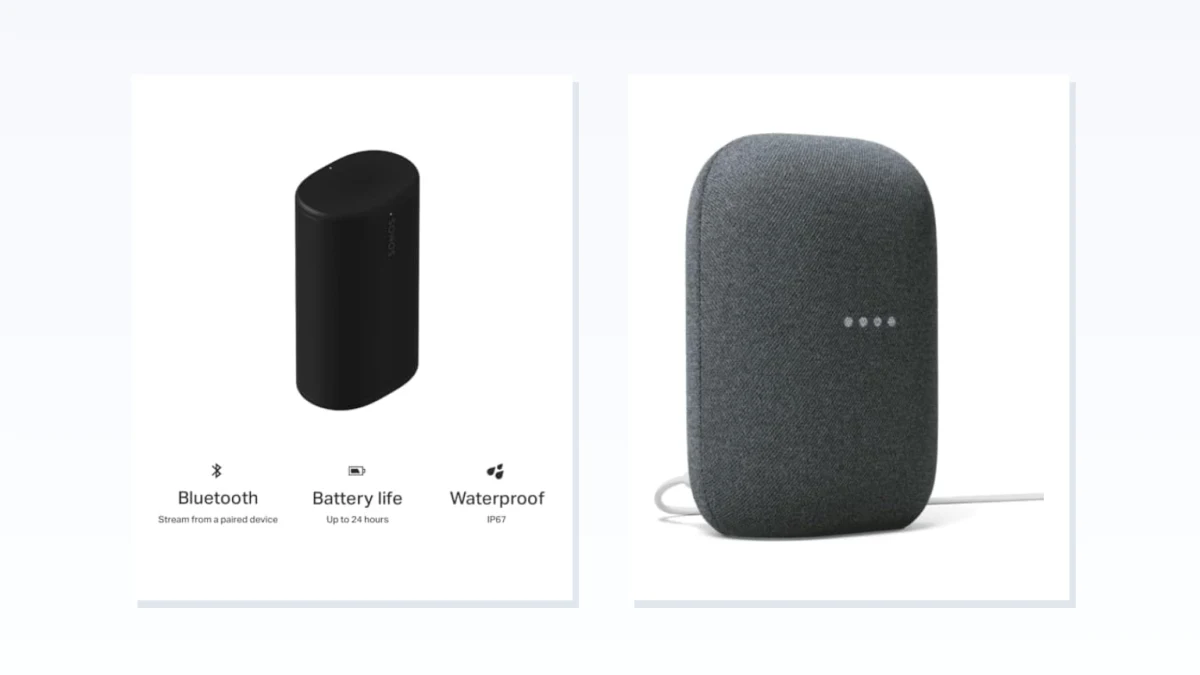
Battery power sounds like a simple upgrade: unplug the speaker, carry it to another room, and keep listening. In practice, it changes more than placement. A portable smart speaker has a battery to manage, may behave differently when it is away from Wi-Fi or sitting idle, and can be much less “smart” once you take it beyond your home network. A plug-in speaker gives up that freedom but is usually the more dependable choice for a permanent voice-assistant or smart-home role.
There is one important rule before comparing power sources: choose a speaker that works with the assistant, music services, and smart-home platform you actually use. Battery versus plug-in matters only after that compatibility check. AirPlay, Chromecast, Spotify Connect, Alexa, Siri, Google/Gemini services, Matter support, and smart-home hub capabilities are model-specific; the presence of a battery tells you almost nothing about them.
Once compatible models are on your shortlist, the power decision becomes straightforward: buy battery power when you will genuinely move the speaker, and buy plug-in when you want a fixed device that can stay powered and connected without becoming another thing you have to charge.
Start with the job, not the battery-life number
The most useful question is not “How many hours does it last?” It is “Where will I actually use it?”
| If this sounds like your routine... | Better starting point |
|---|---|
| I regularly move one speaker between the kitchen, bedroom, patio, or garage | Battery-powered portable smart speaker |
| The speaker will live permanently on a nightstand, counter, shelf, or desk | Plug-in smart speaker |
| I need a dependable smart-home controller or Thread/Zigbee/Matter hub role | Usually plug-in; verify the exact hub hardware |
| I want music outside my home Wi-Fi network | Portable, but make sure Bluetooth use without Wi-Fi meets your needs |
| I want hands-free voice control on a patio or porch | Portable can work well if home Wi-Fi reaches the location |
| I mainly want a rugged speaker for trips, beaches, or camping | Consider whether you need a smart speaker at all; a Bluetooth speaker may be the better fit |
That last distinction matters. A battery-powered smart speaker is often designed primarily to move around the home, not to behave like a rugged travel speaker. Some portable smart models are relatively large and heavy, and “portable” does not automatically mean waterproof, drop-resistant, or convenient to carry in luggage.
What counts as a portable smart speaker
For this comparison, a portable model needs more than Bluetooth and a battery. It should have built-in smart-speaker functionality—such as an integrated voice assistant or comparable hands-free voice platform—plus a rechargeable power source.
That excludes the enormous number of battery-powered Bluetooth speakers that rely entirely on your phone for intelligence. Those can be excellent outdoor speakers, but they solve a different problem.
The distinction becomes especially important once you leave home. Cloud-based voice assistants and many smart-speaker features depend on a network connection. A portable smart speaker may work as a full voice-controlled speaker while connected to your home Wi-Fi, then fall back mainly to Bluetooth playback after you carry it beyond that network. Exactly what remains available varies by model.
Likewise, a plug-in speaker belongs in the other group only when its specifications explicitly require external power. The absence of a battery specification by itself is not enough to establish that.
Battery-powered smart speakers: best when you really move them
A portable smart speaker earns its extra complexity when one device regularly serves several locations.
Maybe you listen to podcasts while cooking, carry the speaker outside for dinner, and bring it back into the living room later. In that routine, installing separate speakers everywhere would be wasteful, and a charging dock or easy charging connection can make the portable model feel almost like a plug-in speaker when it is home.
The products below are the relevant battery-powered smart-speaker options.
When comparing them, look past the headline runtime figure. The more consequential differences are:
- How easily you can keep it charged. A drop-on charging base is harder to forget than a cable you have to plug in manually.
- Whether the battery can eventually be serviced or replaced. Rechargeable batteries lose usable capacity with age; replacement options can materially extend the useful life of an expensive speaker.
- What happens when the speaker is idle on battery. Some portable speakers use power-saving behavior or automatic shutdown after a period of inactivity. That matters if you expect the speaker to sit quietly for hours and still answer immediately when you call for it.
- Whether voice features require Wi-Fi. A speaker that becomes a conventional Bluetooth speaker outside your home network may still be useful, but that is different from taking your voice assistant everywhere.
- Weight and carrying design. A handle is useful for room-to-room movement; it does not make a large home speaker a good travel companion.
- Weather resistance. Check for an explicit IP rating rather than assuming anything with a battery is outdoor-ready.
This is also where published battery-life numbers need context. Manufacturers typically quote battery life under defined playback conditions, and actual runtime can change with volume, network activity, content, settings, temperature, and other factors. A claimed “up to” figure is useful for comparing models, but it is not a promise that every owner will get that many hours.
The biggest portable-speaker limitation may be Wi-Fi, not battery
A patio is a good example of why battery life can be the wrong thing to obsess over.
If your Wi-Fi signal becomes unreliable five feet beyond the back door, a 20-hour battery does not solve the problem. Music streamed directly over Wi-Fi may stop, voice requests may fail, and some multi-room features may disappear. You may still be able to switch to Bluetooth from your phone, but the experience has changed from “portable smart speaker” to “portable speaker controlled by a phone.”
Before buying specifically for a porch, patio, workshop, or garage, check Wi-Fi performance at the exact location. Your phone is not a perfect proxy for the speaker's radio performance, but a weak or disappearing signal there is an obvious warning sign.
Also check the fine print around water resistance. An IP-rated speaker may tolerate splashes or rain while its charging base, power adapter, or connectors are intended only for dry indoor use. The rating belongs to the components the manufacturer explicitly rates.
Battery power can change the meaning of “always ready”
One of the weaker reasons to buy a portable model is the assumption that it gives you all the behavior of a plug-in speaker plus freedom from the cord.
Sometimes it comes close. But battery conservation creates incentives that do not exist in a permanently powered speaker. A manufacturer may use standby modes, automatic shutdown, or other power-saving behavior when the speaker is unplugged. Those choices can affect how quickly the device responds after sitting unused.
Do not assume this behavior from the mere presence of a battery, either. It varies by product. If instant hands-free response after long idle periods matters, check the manufacturer's documentation for standby and auto-power-off behavior rather than relying on the product card's battery-life claim.
There is a useful opposite case too: during a brief household power failure, a charged portable speaker can remain powered. That does not mean its cloud features will keep working. If your router, modem, or internet connection is down, the assistant may still lose the services it depends on.
Plug-in smart speakers: the lower-maintenance choice for a permanent room
If the speaker is going to spend almost its entire life three feet from an outlet, a battery is solving a problem you do not really have.
A plug-in model stays powered without a charging routine, never loses capacity because its internal battery has aged, and is better suited to jobs where continuity matters: kitchen timers, bedroom alarms, voice commands, household announcements, multi-room audio, and smart-home control.
The relevant plug-in models are below.
The purchase decision here is less about power and more about what the speaker does while it is sitting there.
Check the assistant and music ecosystem first. Then look at connectivity and smart-home hardware. Some plug-in speakers can act as Matter controllers, Thread border routers, Zigbee hubs, or broader home hubs; others simply send voice commands to devices through their platform. Those are not interchangeable capabilities.
If you are buying the speaker partly to support a Matter or Thread smart home, verify the exact model's role. “Works with Matter” does not automatically mean “contains a Thread border router,” and voice control of compatible devices does not necessarily mean the speaker provides the radio or hub infrastructure those devices need.
A permanently powered smart-home hub is also one of the strongest arguments for choosing plug-in over portable. Moving a piece of your home's network infrastructure around—or letting its battery run flat—defeats the point of having infrastructure that should stay available.
Plug-in does not mean literally always on
“Always-on” is convenient shorthand, but it should not be read as a reliability guarantee.
A plug-in speaker still depends on household power, and most cloud-based features also depend on your home network and internet connection. An outage can take the speaker, router, or both offline. If uninterrupted smart-home control during outages is genuinely important, that becomes a larger system-design question involving backup power and devices capable of local operation—not simply a reason to choose one speaker over another.
For ordinary use, though, the advantage is real: when mains power and the network are available, you do not have to remember whether the speaker was charged yesterday.
Do not choose by power source alone
Battery versus plug-in is only one layer of the decision. Before buying either type, check the things that can make a technically good speaker wrong for your home:
Voice assistant and region support
Confirm the exact assistant available on the exact model in your country and language. Assistant availability and features can differ by region, and third-party speakers do not necessarily receive every feature offered on the platform owner's own hardware.
Music and multi-room ecosystem
If your household already uses AirPlay, Chromecast, Alexa multi-room audio, Sonos, Spotify Connect, or another platform, make sure the new speaker fits into it. A battery does not compensate for a speaker that cannot join the system you use every day.
Smart-home hub hardware
If you need Matter, Thread, Zigbee, or another protocol, verify the hardware rather than assuming every smart speaker can serve as a hub.
Microphone behavior and privacy controls
If the speaker will sit in a bedroom, office, or another sensitive location, check how its microphone mute works and whether there is a hardware control that disables the microphones.
Audio performance at the volume you use
Power source alone does not tell you how a speaker sounds. Cabinet size, drivers, tuning, placement, and room acoustics matter far more. A large battery-powered speaker can outperform a tiny plug-in model, while a fixed speaker can devote space and cost to audio hardware instead of a battery. Compare the actual products rather than treating either category as inherently better sounding.
What to verify before buying a portable model
For a battery-powered smart speaker, the most useful product-page checks are:
- claimed playback time and the conditions attached to that claim;
- charging time and charging method;
- whether the charging base, cable, and adapter you need are included;
- whether it can remain usable while connected to external power;
- standby or automatic power-off behavior on battery;
- whether the battery is replaceable or serviceable;
- Wi-Fi and Bluetooth support;
- which features continue to work away from Wi-Fi;
- weight, handle or carrying design, and dimensions;
- an explicit IP rating if it will be used around water or outdoors.
A speaker you plan to move twice a day should be easy to pick up and easy to put back on charge. Those mundane details matter more than another few hours added to an optimistic maximum-runtime figure.
What to verify before buying a plug-in model
For a fixed speaker, check:
- assistant and language support;
- compatibility with your music services and multi-room system;
- Matter, Thread, Zigbee, or home-hub capabilities if you need them;
- the supplied power adapter and cable;
- cord length and where the connector exits the speaker;
- whether the planned location has a practical outlet;
- Wi-Fi requirements and coverage at that location.
Cord placement sounds trivial until the perfect shelf turns out to be several feet from the nearest outlet or leaves a power brick hanging somewhere you do not want it.
Which type should you buy?
Choose a battery-powered portable smart speaker when movement is part of the routine—not merely something you might do someday. It makes sense when the same speaker regularly moves between rooms, onto a patio, or to other places still covered by your home network. It can also double as a Bluetooth speaker away from Wi-Fi if the model supports that use well.
Choose a plug-in smart speaker when it has one permanent home, when you do not want another rechargeable device to manage, or when the speaker is expected to perform an ongoing smart-home or voice-assistant role.
And if your main goal is music at the beach, campsite, park, or anywhere else without reliable Wi-Fi, reconsider the category entirely. A rugged Bluetooth speaker may give you better portability, weather resistance, battery life, and fewer compromises than paying for smart features that disappear when you leave the network.
The practical dividing line is simple: battery power is valuable when you routinely use the freedom it buys. Otherwise, the cord is usually the feature, not the limitation.