
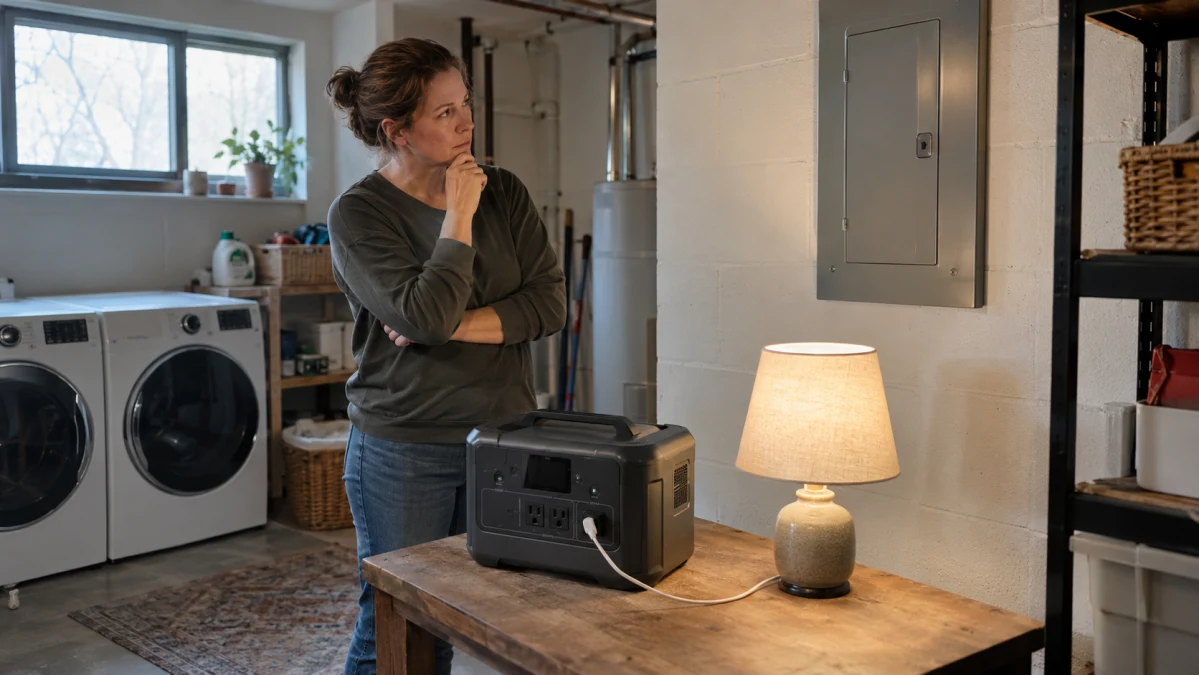
Plugging essentials into a portable power station is the more direct outage plan when you can reach each device and manage its connection. A home power kit may suit loads better served through selected household circuits, but the equipment and installation must match the house. Neither label tells you whether the loads will start, how long they will run, or how the battery can recharge during an outage.
Choose the connection path first
With direct backup, each device runs from a compatible receptacle on the station, not through its usual wall outlet. This avoids relying on household-circuit integration, but makes reach, plug type, voltage, and the number of devices running together your responsibility. A high-output receptacle is not, by itself, a route into household wiring.
With a home kit, the intended path is from the station through compatible home equipment to isolated, selected circuits and their connected loads. It needs a documented station-to-panel connection and circuit arrangement, not merely a panel in the box. Isolation prevents backup power from feeding utility lines; the Department of Energy’s explanation of islanded operation describes that principle, not an approved wiring plan for a particular kit. Establish the path for your home before counting on any circuit being backed up.
Size the loads, then estimate runtime
List what must run at the same time. From each appliance label or manual, record running watts, startup or surge demand, and voltage. Add the simultaneous running watts, then check the proposed configuration’s continuous output at the applicable voltage, its per-output limits, and its ability to handle the startup combination. A system-wide watt rating does not prove that a particular socket can supply the load or that a motor will start.
Suppose, hypothetically, a group of 120V loads draws 500W while running, briefly rises to 1,200W in total at startup, and needs to operate for four hours. It calls for at least 500W of applicable continuous output, verified support for that 1,200W startup event, and 2,000Wh of delivered AC energy before any extra reserve. Those are illustrative loads, not confirmed appliance requirements; replace them with your own figures. The supplied F3800 Plus ratings do not establish that this particular startup event will succeed.
Watts describe power at a moment; watt-hours describe energy over time. Anker rates one US F3800 Plus at 3,840Wh nominal capacity and 6,000W of 120V/240V AC output. For a runtime illustration—not a measured result—assume that losses and a reserve leave 80% of nominal capacity deliverable to AC loads: 3,840Wh × 0.80 = 3,072Wh. At a steady 500W with no charging, that would be about 6.1 hours. Actual delivered energy and changing loads may alter the result. An expansion battery adds nominal energy, not a promise of proportional runtime; Anker’s 12,000W, 7,680Wh rating requires two F3800 Plus stations with the Smart Home Power Kit, not one station.
Direct backup for devices you can connect individually
Choose direct connections when essentials are reachable, use compatible outputs, and fit the station’s verified simultaneous and per-output limits. You can manage those devices without depending on a household-circuit installation, though every added load draws from the same energy supply. A required hardwired load, incompatible plug or voltage, or loads that cannot operate together can make this the wrong approach.
The Anker SOLIX F3800 Plus is an example to check against that inventory. Anker lists 3,840Wh nominal storage and 6,000W, 120V/240V AC output for one US station; neither figure guarantees that a given appliance will start or that 3,840Wh will reach its plug. Anker also specifies up to 6,000W at 240V through the L14-30R and up to 3,000W at 120V through the TT-30R in its stated generator-use configurations. Do not apply those port figures to every outlet or mode. If a load needs 240V while the station charges from 120V AC, this mode will not serve it: Anker says 240V output is unavailable then.
A planned route to selected household circuits
Consider circuit integration when essential loads are better served through existing wiring than by individual plugs. That convenience depends on more than battery capacity: the station, home equipment, selected-circuit work, and grid isolation must form a supported path. A bundle name does not establish a finished backup installation.
The Anker SOLIX F3800 Plus + Smart Home Power Kit + Installation Service is an offered configuration to investigate for this use, not proof that every home connection or installation task is covered. Anker lists the single-station kit option at 6,000W and 3,840Wh. Its 12,000W and 7,680Wh option requires two F3800 Plus stations with the Smart Home Power Kit. These are supplier ratings, not delivered-energy or household-runtime measurements.
The separate Smart Home Power Kit listing names a Home Power Panel, subpanel, circuit breaker, and ground bar; it does not establish the full contents or labor scope of the combined offer. Anker says the panel supports 120/240V split-phase, not 120/208V. Before ordering, have the installation plan identify the station-to-panel connection, which circuits will be served, how backup power will be isolated from the grid, and what cables, circuit work, and labor the offer covers. Establish whether permits or utility coordination apply at the site rather than assuming they are included or unnecessary.
Check what recharging can do during an outage
For directly connected, compatible panels, Anker rates the F3800 Plus for up to 3,200W of solar input through two 11–165V inputs. Its claim of a full recharge in under two hours assumes optimal sunlight; it is not an expected outage recharge time, especially while loads are drawing power. A solar-dependent plan needs panels that fit those inputs, not just a panel wattage that resembles the maximum.
An existing rooftop array is a different connection path. Anker says rooftop panels cannot recharge the F3800 Plus through the Home Power Panel during an outage; it directs users instead to connect compatible 11–165V panels directly to the station’s solar inputs. Do not count normal grid-tied rooftop production as battery recharge through that panel while the grid is down.
On 120V AC input, Anker lists maximum charging power of 1,800W and maximum bypass power of 1,440W. Those are different limits: the input rating is not the power available to bypass loads. Anker also says 240V output cannot be used in this charging mode, so a plan needing uninterrupted 240V service cannot rely on 120V AC charging without changing that plan.
If generator charging matters, the Anker installation-service listing qualifies its 6,000W generator figure: it states 3,300W for one F3800 Plus and 6,000W with at least one expansion battery, and requires an Anker SOLIX Generator Adapter that supports only one F3800 Plus station. These figures alone do not establish the full generator connection or which outputs remain available during charging. Verify that operating arrangement before relying on generator recharge.
Choose direct connections if your reachable devices have compatible plugs and voltages and their verified running, startup, and delivered-energy needs fit a station. Investigate a home kit if selected circuits are the better way to serve the loads, but commit only after the connection, site compatibility, installation scope, and outage-time charging path are established. If neither arrangement passes those checks, reduce the planned loads or verify another configuration rather than declaring a winner.