
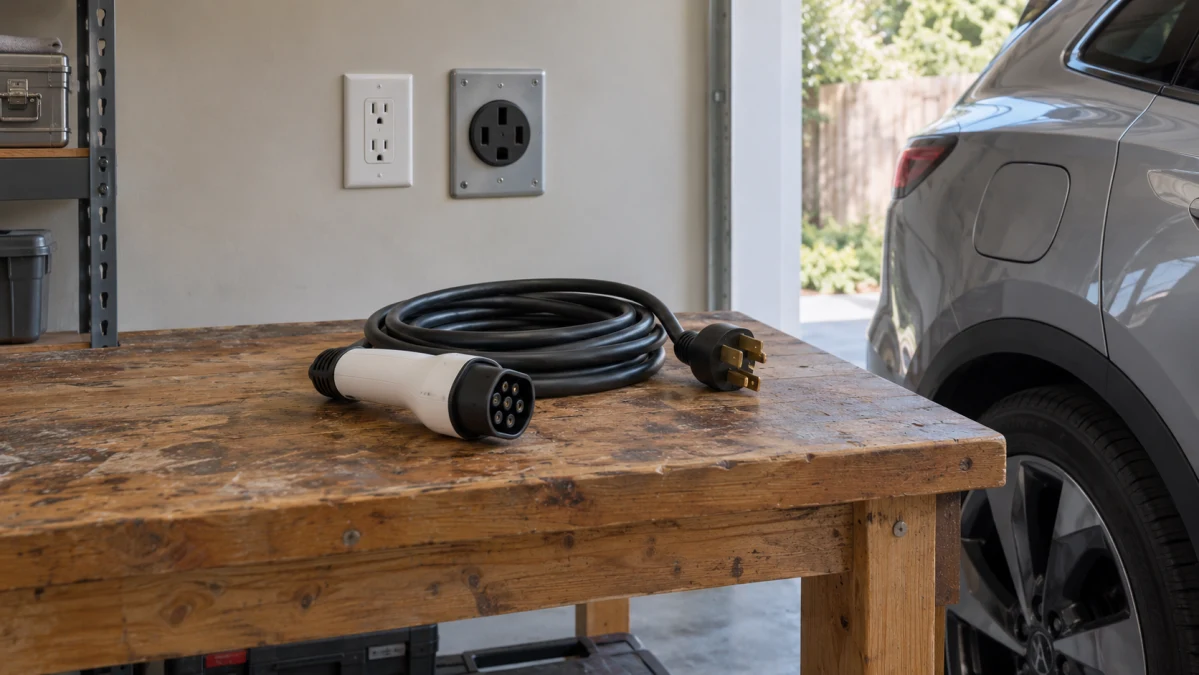
If some charging locations have only a household 120V outlet, prioritize a portable charger with both a documented 120V mode and a usable wall adapter. If you mainly charge at a 240V NEMA 14-50 outlet, look for a specified NEMA 14-50P plug and check the charger's circuit requirements. These needs can overlap, but neither package discussed here establishes both complete wall connections.
The route from outlet to vehicle matters more than the label on the charger: the operating mode, wall connection, circuit and vehicle-side connector all have to match.
Choose by location, not by charger label
The US Department of Energy describes 120V Level 1 charging as an option where only a 120V outlet is available; residential Level 2 charging uses 240V service. Charging time also depends on the vehicle, battery and electrical service. A fallback outlet may provide a way to charge without meeting every driver's overnight needs.
VEVOR's Level 1 & 2 EV Charger, model EV-ACS1602U/K3, has 120V use through an included NEMA 5-15 adapter and 240V use through its NEMA 6-20P plug. Its Level 2 EV Charger, model EV-ACS4001U/K3, is specified for 240V use with a NEMA 14-50P plug. The latter model's manual lists a wider 110–240V input range, but does not specify an included household 120V adapter or a circuit arrangement for one. Its plug does not rule out 120V capability; its voltage-range entry does not establish a usable 120V household-outlet path.
For locations where a 120V fallback matters
Where suitable 240V power is unavailable, a documented household-plug arrangement preserves a charging option that a 240V plug alone does not provide. It is useful only if the actual outlet and circuit meet the charger's requirements and the vehicle connection matches.
For the Level 1 & 2 EV Charger, VEVOR specifies the included NEMA 5-15 adapter for 120V and the NEMA 6-20P plug for 240V. Its SAE J1772 connector serves a compatible J1772 vehicle directly. VEVOR says Tesla use of this J1772 version requires a vehicle-side adapter; one is not established as included. If your 240V location has only a NEMA 14-50 outlet, this package's documented 6-20P connection does not establish a way to use it there.
For a verified 240V NEMA 14-50 location
A specified NEMA 14-50P plug is relevant if the place you intend to charge has a suitable 240V NEMA 14-50 outlet. Physical fit is only the first check: it says nothing by itself about the outlet's wiring, circuit capacity or a 120V fallback elsewhere.
VEVOR lists the Level 2 EV Charger, EV-ACS4001U/K3, as a 240V portable model with a NEMA 14-50P input plug, a 40A maximum and an SAE J1772 vehicle connector. That makes its documented path relevant to a suitable NEMA 14-50 site and a compatible J1772 vehicle. A different vehicle inlet needs a verified vehicle-side adapter arrangement; none is established as included. The manual lists lower selectable currents and a 110–240V input range, but neither establishes an included 120V household plug or adapter. Verify the complete 120V connection separately if that fallback is essential.
Check the full connection path and circuit
Check the exact package before relying on an outlet: the dual-voltage Level 1 & 2 EV Charger lists a NEMA 6-20P plug and an included NEMA 5-15 adapter, while the Level 2 EV Charger lists a NEMA 14-50P plug. Both selected versions use SAE J1772 vehicle connectors. Match the wall connection to the outlet and the connector—or a separately verified vehicle-side adapter—to the vehicle inlet. Portable does not mean universal fit.
Then match the intended mode to the supply. The EV-ACS1602U/K3 instructions pair 120V at 12A through the 5-15 adapter with a 15A circuit breaker, and 240V at 16A through the 6-20 plug with a 20A breaker. For the EV-ACS4001U/K3's documented NEMA 14-50 use, its instructions state a 40A maximum, a 50A circuit-breaker requirement and a properly grounded outlet. Selecting a lower current on that model does not independently approve a different outlet or circuit.
A matching plug cannot establish the condition or capacity of unseen wiring, grounding or the branch circuit. Department of Energy home-charging guidance says Level 1 use presumes a dedicated branch circuit, treats EV charging as a continuous load and notes that installations must meet applicable local and state requirements. Confirm the actual outlet, circuit and planned setting against the charger's instructions and local requirements; have a qualified electrician assess the installation where needed.
When to consider a fixed home setup
If you charge mostly at one home and do not need to take a unit elsewhere, a fixed Level 2 setup may be worth assessing instead of buying for portable flexibility you will not use. Available overnight charging time is one reason to consider Level 2, and the Department of Energy notes that an electrician may need to add a suitable circuit. Fixed installation is a site-specific trade-off, not an automatic upgrade over a suitable portable arrangement.
A US supplier identifies the AC Lite Home EV Charger, part MAXI US AC LW12KW-DK, as a hardwired J1772 option. Autel describes its AC Lite Home 50A J1772 family as hardwired with 208/240V input, but that page does not identify this exact part number. Before choosing the listed part, obtain its manufacturer installation instructions and confirm its vehicle connection and electrical requirements against the home installation; the family's specifications alone do not settle those checks.
If a household 120V fallback is essential, prioritize the 1602's documented adapter path, provided the outlet, circuit and vehicle match. If your priority is a suitable 240V NEMA 14-50 site, the 4001 provides the specified plug path, subject to the same checks. If you need both, require explicit documentation of both operating modes and complete wall-plug arrangements; neither package here confirms both paths. If portability matters less, assess a fixed home installation and its exact-part requirements instead. Choose by the connections you can actually make, not by plug shape or a voltage-range entry alone.