
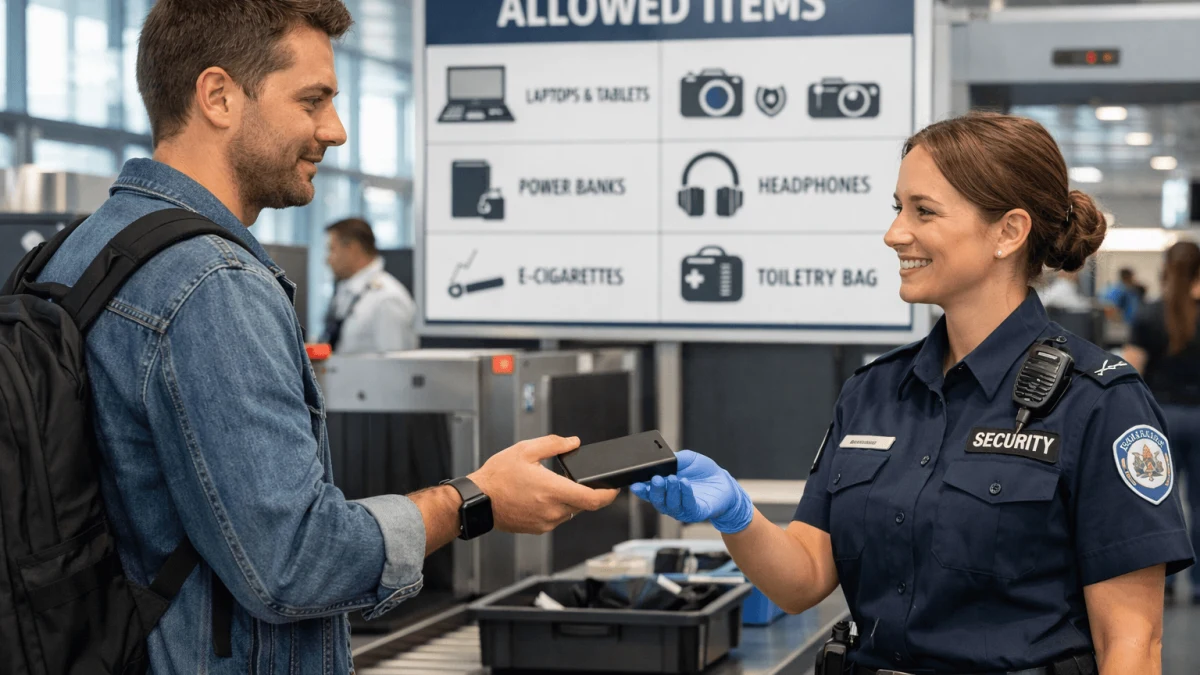
If you fly a lot (especially across multiple airlines/countries), the "best" power bank is usually the one that never becomes a security conversation. That’s why I’m firmly in the sub‑100Wh camp for most frequent flyers: you give up some maximum capacity, but you drastically cut the odds of confiscation, gate drama, or being told to check a bag you absolutely do not want to check.
Why under-100Wh is the default smart move
Most airline rules converge around a simple pattern: under 100Wh is the least annoying category. Over that, you may need airline approval; over some thresholds, it’s a hard no. If you’re doing multi-carrier itineraries or transiting strict airports, you’re optimizing for predictability, not theoretical maximum recharges.
What to look for (so security doesn’t 'do math' on your behalf)
- Clear labeling: ideally Wh printed on the bank itself (not just online).
- Reasonable size/weight: the bank you actually carry beats the monster bank left at home.
- Common-spec charging: even if you’re not chasing max speed, avoid painfully slow outputs if you can.
A few examples that fit the 'easy through security' vibe
- Portable Charger Power Bank 10000mAh is a classic “no surprises” size class. From the provided specs, it’s 10000mAh, uses Lithium Polymer, and has 5V/2.1A max output—not a speed demon, but a straightforward travel backup. It also lists 11.8 oz weight and an “Ultra Slim” style, which is exactly the kind of thing that disappears into a personal item.
- If you like the convenience of cable-less top-ups (especially in cramped seats), Magnetic Portable Charger is focused on wireless charging and is 9.1 oz per the listing. Wireless is never the most efficient way to use limited battery capacity, but it is very “no fuss” in an airport lounge when you’re juggling coffee and boarding groups.
Takeaway: If your #1 goal is to avoid confiscation risk and keep your travel day smooth, pick a sub‑100Wh bank that’s clearly labeled and sized for your bag—not the biggest number on the product page.
If your life is short layovers and “I have 18 minutes to get from gate B12 to C47,” capacity matters—but charging speed matters more. A fast power bank can turn a quick coffee stop into a meaningful top-up, while a slow one just gives you the emotional comfort of plugging in.
The decision point: do you need speed, or just emergency power?
- If you’re charging a phone overnight in a hotel: almost anything works.
- If you’re trying to recover battery between flights: you want USB‑C PD and you want it high enough output to matter for your devices.
Products here that illustrate the fast-top-up idea
- USB C Portable Charger PD 20W Fast Charging Power Bank is the clearest match in the results for “fast charging.” Its specs explicitly call out PD 20W and “Fast Charging,” plus a digital display. At 13.4 oz, it’s not tiny, but it’s still in normal power-bank territory—and 20W PD is a noticeable step up from basic 5V charging when you’re trying to refill quickly.
- Dual Port USB C Wall Charger is a wall charger (and is 2.4 oz), which can be fantastic in airports with accessible outlets—just don’t mistake it for onboard battery capacity.
- USB C Wall Charger, 2-Pack, 40W Fast Charging Block, 4-Port PD Power Adapter lists 40W wattage and multiple ports; again, awesome for lounge/outlet situations, but it won’t help if you’re stuck on a plane with no power or at a gate where every outlet is occupied by someone charging an iPad at 3%.
A practical “frequent flyer” setup
If you regularly have short connections, consider pairing:
- One PD power bank (like the PD 20W bank above) for on-the-move charging, plus
- One small wall charger for when you do get an outlet (because wall power is still the fastest “battery refill” you can get).
Takeaway: For tight connections, prioritize USB‑C PD power banks like the USB C Portable Charger PD 20W Fast Charging Power Bank—capacity is nice, but watts are what rescue you between flights.
If you truly need enough energy for back-to-back long-hauls (and you hate carrying multiple gadgets), a single high-capacity bank sounds perfect—until you remember the downside: anything near/over airline Wh limits turns into a permissions game.
Here’s the honest friend advice: I only recommend going over 100Wh when (1) you’re confident you can get airline approval, and (2) you’re not doing a complicated multi-carrier, multi-country routing where one strict checkpoint can ruin your day.
When a >100Wh bank makes sense
- You’re flying mostly one airline (or one alliance) and can get written approval.
- You have power-hungry devices (tablet + phone + accessories) and you can’t rely on seat power.
- You prioritize “one item, one cable, done” over maximum compliance simplicity.
The real-world risks people underestimate
- Confiscation isn’t theoretical if the labeling is unclear or the agent is strict.
- If you’re forced into checking baggage unexpectedly, remember: power banks generally can’t be checked, so you can end up stuck repacking at the counter like it’s a game show challenge.
- Approval can be inconsistent across carriers—even on the same itinerary.
Takeaway: A single high-capacity bank is a “power move,” but it’s also a “paperwork move.” If your travel is complex, default back to sub‑100Wh and save yourself the headache.
Multiple smaller banks feel a little extra—until the day one fails, one gets left in a seat pocket, or one gets questioned at security. Redundancy is boring… and then it saves your trip.
Why a multi-bank kit can be the most travel-proof solution
- No single point of failure: if one dies, you’re not stranded.
- Flexibility: you can split devices (phone on one bank, earbuds on another).
- Compliance comfort: several sub‑100Wh banks are usually easier to justify than one borderline unit—just keep them clearly labeled and accessible.
The “don’t make it annoying” rules
- Standardize on one cable type where possible (USB‑C is the easiest life).
- Keep one bank in your “always” pocket, another in your bag—so you don’t have to dig at the gate.
- Avoid banks with vague specs; you want something that doesn’t invite questions.
Takeaway: If you travel hard and can’t afford a dead phone, carrying two smaller, airline-friendly banks is often smarter than betting everything on one big one.
You’re balancing two kinds of pain: too many items (bulk, clutter, losing things) vs. too much capacity in one item (compliance risk, confiscation risk). The sweet spot for most frequent flyers is: minimal items, maximum compliance.
If you’re a minimalist (and you want zero airport drama)
Go with one sub‑100Wh bank that:
- has clear labeling,
- charges at a speed you can tolerate,
- fits your daily carry without you “thinking about it.”
That’s where something like the Portable Charger Power Bank 10000mAh can shine: simple, known-capacity class, and not trying to be clever.
If you hate carrying cables and tiny extras
A built-in-cable design like the Portable Charger with Built-in Cables can reduce the “I forgot the one thing I needed” tax. Minimalism isn’t just fewer objects—it’s fewer failure points.
If you’re tempted by the big one-bank solution
Ask yourself one question: Would I rather carry one bigger bank, or never have to argue about Wh at security?
If you transit strict airports or fly mixed carriers a lot, the answer is usually the second one.
Takeaway: The best minimalist strategy is usually one clearly labeled, sub‑100Wh bank that you can charge quickly enough for your schedule—plus a simple backup plan if you’re crossing oceans regularly.