
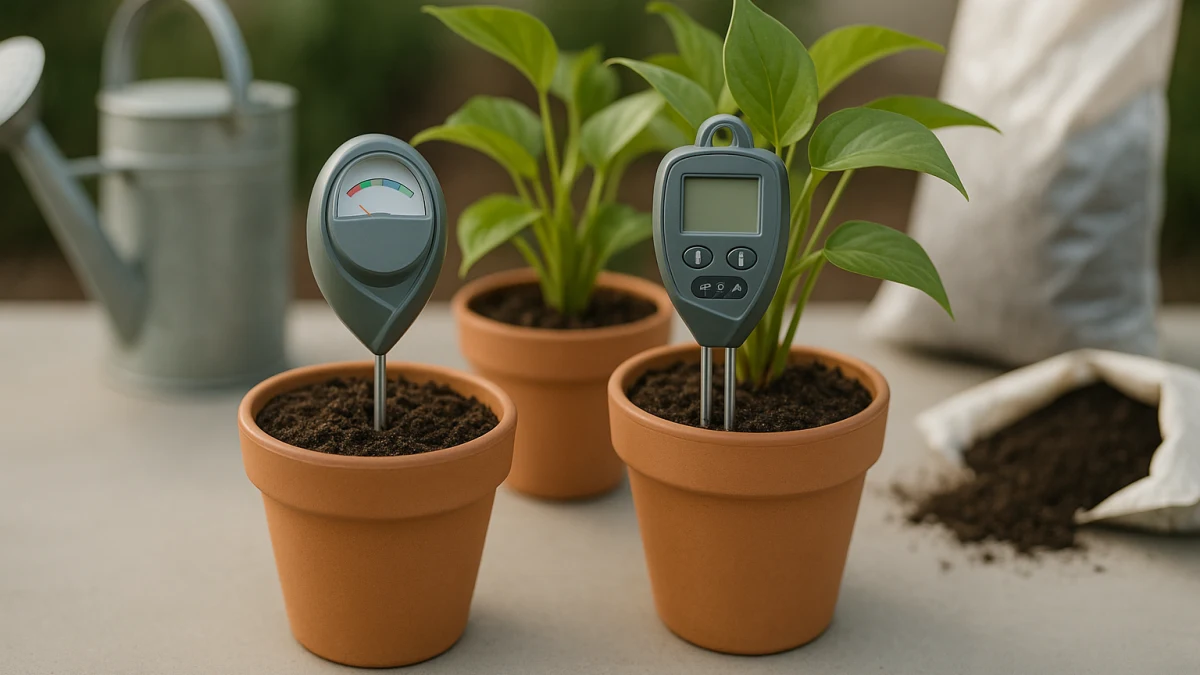
A soil moisture meter can be a simple watering cue, or it can be sold as a compact soil tester with pH, light, temperature, fertility, EC, or nutrient-style readouts. This page starts with the watering job first: which reading will actually change what you do next?
A normal product grid can mix analog probes, smart moisture sensors, and multifunction soil meters together. Use this comparison to separate dry/moist/wet guidance from extra soil-test-style claims before you pay for readings you may not use or cannot interpret.
Pay for the readouts that will change your next step
| If this is your need | Better fit |
|---|---|
| You mainly want a dry, moist, or wet cue before watering a pot, bed, or garden area. | Moisture-only soil sensors |
| You already know you will use pH, light, temperature, fertility, EC, or nutrient-style information alongside moisture. | Multifunction soil meters |
| You want app alerts, but the only measurement you care about is soil moisture. | Choose a moisture-only sensor with app viewing or alerts; do not treat connectivity as a separate readout lane. |
| You expect lab-grade soil test results or fertilizer recommendations. | Do not use either lane as a substitute for proper soil testing or fertilizer guidance. |
As you compare, focus on five things: whether the readout changes your watering decision, how much interpretation the reading requires, whether accuracy or calibration claims are actually stated, how the meter fits your routine, and whether the product stays inside the soil moisture sensor category.
Pay for the readouts that will change your watering decision
The cleanest split is not analog versus smart, or cheap versus feature-rich. It is whether the product gives you a moisture cue only, or whether it adds readings that ask you to interpret more than watering status.
- Moisture-only makes sense when the next step is simple: check the soil, decide whether it is dry enough to water, and move on.
- Multifunction makes sense when the extra reading has a job: for example, you specifically want to look at light exposure, soil acidity language, temperature, EC, fertility, or nutrient-style indicators alongside moisture.
- Connectivity is a workflow feature, not a third lane: Wi-Fi, Bluetooth, Zigbee, app viewing, alerts, and gateways can matter, but they do not change what is being measured by themselves.
- Accuracy language needs product-level support: terms like 3-in-1, 6-in-1, soil analyzer, or smart sensor do not automatically tell you how precise, calibrated, or interpretable the readings are.
Keep app alerts and lab-style tests from becoming fake lanes
A connected moisture sensor can be useful if you want alerts or remote viewing, but the app does not turn moisture into pH, fertility, or nutrient analysis. Treat app compatibility, alert settings, hub requirements, and measurement intervals as practical checks inside the moisture-only or multifunction lane.
The opposite mistake is treating a small soil meter like a formal soil test. Standalone pH meters, nutrient test kits, fertilizer products, hydroponic or indoor garden systems, planters, plant disease diagnosis, and lab testing are outside this collection. If you need amendment advice or a formal soil report, neither lane here should be treated as the final authority.
Moisture-only meters for straightforward watering cues
If the real question is “is this soil dry enough to water?”, a moisture-only meter is the baseline. Products in this lane can range from basic probe-and-dial meters with color-coded moisture scales to smart plant moisture sensors that show soil humidity in an app or send alerts.
Compare the products shown here by how they fit your routine: probe type and length, display style, indoor or outdoor positioning, waterproof language, battery needs, app compatibility, alert options, gateway requirements, and stated measurement interval. A no-battery probe-and-dial meter suits quick spot checks; a Wi-Fi, Bluetooth, or Zigbee sensor may be more useful if you want reminders or remote viewing.
Read this lane as the “enough information to water” option, not as the less serious option by default. If moisture is the only reading you will act on, avoiding pH, light, fertility, EC, nutrient, or temperature readouts can keep the purchase simpler. Still, do not assume every moisture-only sensor is equally accurate, calibrated, waterproof, or lab-grade; check the individual product page for those claims.
Before upgrading: pH, EC, fertility, and accuracy claims need proof
Multifunction labels can be useful, but they can also hide the important question: what exactly is being measured, and how should you use that number or scale? A “3-in-1,” “4-in-1,” or “soil analyzer” label only tells you to inspect the actual readouts, not that the extra readings are equally important.
Be especially cautious with pH, fertility, EC, NPK, nutrient-style, and soil acidity language. Unless a listing clearly states ranges, calibration language, claimed accuracy, and how the reading should be interpreted, treat those features as context rather than a replacement for formal soil testing or fertilizer guidance.
Multifunction meters when extra readouts have a real job
Move into this lane only if at least one extra readout will change a decision you actually make. Multifunction soil meters may combine moisture with pH, light or sunlight, temperature, fertility, EC, ambient humidity, or nutrient-style indicators. The value is not the highest function count; it is whether those readings answer a specific question for your plants or growing area.
Before comparing products, translate the label into exact measurements. A 6-in-1 soil tester may advertise light, pH, temperature, soil moisture, fertility, and ambient humidity, while another soil analyzer may include pH, moisture, temperature, EC, fertility, light intensity, and air temperature. Those are different workflows, even if both sound feature-rich.
Use the products shown here to verify the readouts, stated ranges, display or app requirements, battery needs, probe design, and whether the product is aimed at indoor pots, outdoor beds, gardens, or broader farm-style use. If you cannot explain how you will use pH, light, temperature, fertility, EC, or nutrient-style information, the moisture-only lane is probably the cleaner fit. Do not treat low-cost pH, fertility, EC, or nutrient readings as lab-quality unless the manufacturer documentation clearly supports that claim.
Listing checks that matter for these soil meter readouts
Before choosing, scan the product page for the details that affect how the meter will actually work in your watering routine:
- Exact readouts: Confirm whether it measures moisture only or also pH, light, temperature, fertility, EC, ambient humidity, or nutrient-style indicators.
- Display and workflow: Check whether readings appear on an analog dial, digital display, or app, and whether alerts, Wi-Fi, Bluetooth, Zigbee, or a gateway are required.
- Probe details: Look for probe type, probe length, and any instructions about where and how to insert it.
- Use location: Verify indoor, outdoor, potted plant, garden bed, or farm positioning, plus any waterproof or weather-resistance language.
- Power requirements: Note whether it is a no-battery probe, uses replaceable batteries, rechargeable power, or requires a connected hub.
- Measurement behavior: For smart sensors, check the stated measurement interval and notification options.
- Accuracy and calibration: Look for stated ranges, claimed accuracy, resolution, and calibration language instead of assuming every meter is equally precise.
- Soil-test boundaries: Do not rely on either lane for fertilizer recommendations, plant disease diagnosis, or formal lab-style soil conclusions.
The best fit is the smallest set of readouts you will actually use. Choose moisture-only for straightforward watering cues, consider multifunction only for specific pH, light, temperature, fertility, EC, or nutrient-style questions, and keep lab soil testing separate from both.