
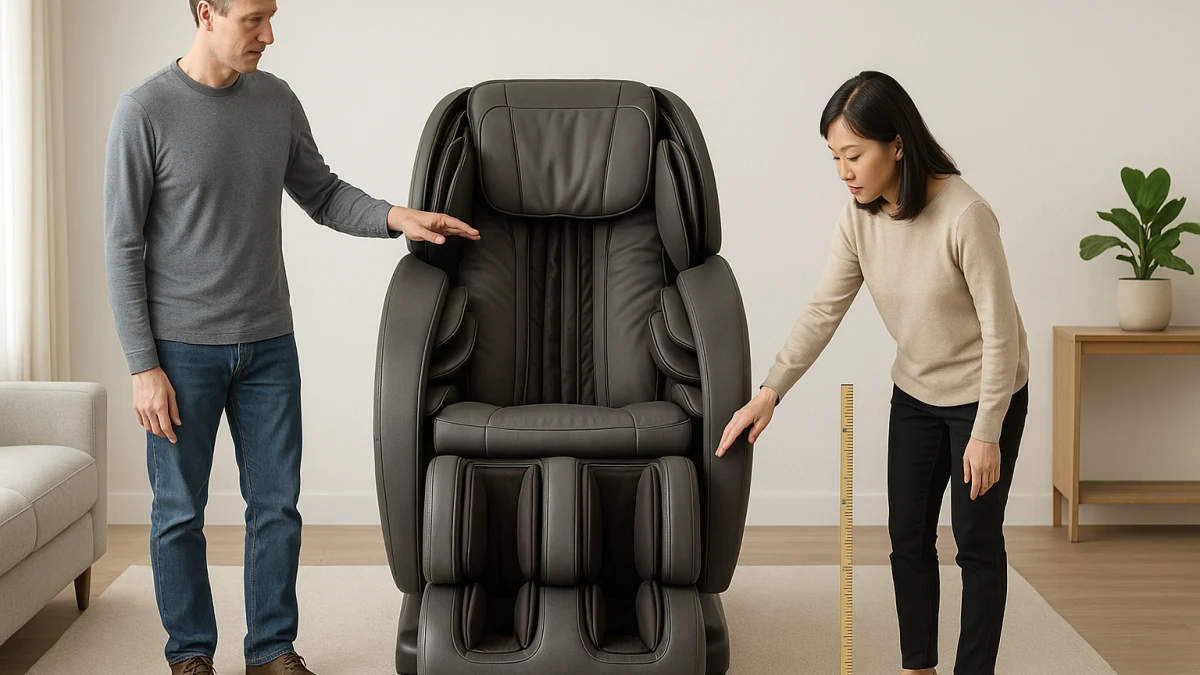
A massage chair can have 4D rollers, heat, Bluetooth, and voice control and still feel wrong if the rollers start above your shoulders, the calf airbags miss your legs, or the foot rollers sit under the wrong part of your feet. This guide treats massage chairs as a body-fit decision first: user-height range, maximum user weight, seat width, track length, body scan behavior, and leg-rest adjustment come before the comfort-feature list.
The comparison is intentionally uneven. Adaptive-fit chairs deserve more attention when tall and petite users will share the same chair, while standard-fit chairs are a narrower path for one known body size. A normal category page can show features and prices; this page is here to help you decide whether the chair is likely to put the massage hardware in the right place.
Choose by body measurements, not feature count
| If this is your situation | Better fit path |
|---|---|
| Two or more users differ meaningfully in height | Start with massage chairs that combine body scanning or shoulder detection with SL-track language, roller adjustability, and calfrest or footrest extension. Then verify the user-height range, track length, and leg adjustment. |
| One primary user has a known height and weight | A compact or standard-fit massage chair can make sense if the published height range, weight capacity, seat width, and footrest extension match that person. |
| A listing leads with 4D rollers, heat, Bluetooth, or voice control | Treat those as comfort extras. Look for body scan behavior, shoulder detection, seat width, maximum user weight, track length, and leg-rest adjustment before relying on the chair for fit. |
| A smart chair with light massage looks tempting | Keep it as a seated-comfort option, not a substitute for a full-body massage chair chosen around roller, airbag, calf, and foot alignment. |
The comparison points that matter most are simple but easy to miss: published user-height range and maximum user weight, shoulder detection or body scan behavior, SL-track or stated track length, seat width, calfrest or footrest extension, and whether the chair is adaptive enough for multiple users or should be matched to one measured person.
Start with the user's measurements, not the feature list
Before comparing massage modes, write down the likely user's height, weight, and any fit concern that could affect the chair: broad shoulders, shorter legs, long legs, or a need for more seat width. Then use the product page to check:
- User-height range or height capacity: stronger than a general full-body claim, especially for tall or petite users.
- Maximum user weight: a hard limit to verify, not a comfort feature.
- Seat width: important when airbags and side bolsters are close to the body.
- Track type and length: SL-track language and track lengths around 52 to 59.05 inches give a more concrete sense of shoulder-to-seat coverage than a broad massage label.
- Body scan and shoulder detection: useful when the chair can adjust the starting point of the massage path.
- Calfrest or footrest extension: critical for keeping calf airbags and foot rollers from landing too high, too low, or too far forward.
The wrong purchase usually does not fail because it lacks another mode. It fails because the chair was never a good match for the user's frame.
Keep smart chairs, zero-wall space needs, and health claims out of scope
This collection is about full-body massage-chair fit. Smart recliners, office chairs, gaming chairs, lift recliners, recliner sofas, and light-massage seating may be comfortable, but they should not be treated as equivalent if you need roller, airbag, calf, and foot alignment across the body.
Zero-wall or room-clearance language is also not the deciding factor here. It can matter for placement, but it does not tell you whether the shoulder rollers, SL-track, seat, calf section, or footrest will match the user. Health and therapy claims are outside this decision too; use the chair's fit specs, not medical promises, to narrow the options.
Adaptive fit chairs for mixed-height homes
If a tall user and a petite user will share the same chair, start here. The useful comparison is not simply which chair has the longest feature list, but which products show adaptive fit details: body scan, shoulder detection, SL-track language, adjustable rollers, and calfrest or automatic footrest extension.
Track details deserve special attention. Products in this lane commonly surface SL-track wording, body scan language, 3D or 4D roller systems, and track lengths such as 52, 53, or 55 inches, with the broader fit question centered on how well that path lines up from shoulders through the seat. Longer or shaped tracks may help with coverage, but they do not guarantee a correct fit unless the chair's height range, seat width, weight capacity, and leg-rest adjustment also work for the users.
Read these products as a comparison set for adjustability. Look for the models that provide the clearest combination of body scan or shoulder detection, SL-track or stated track length, and extendable leg support. If the listing talks more about 4D, voice control, heating, or Bluetooth than fit measurements, treat those features as secondary until the manufacturer specs confirm the basics.
This is the better starting lane for mixed-height households, but it still has limits. Body scanning can help position the massage path; it should not be read as a guarantee that every tall, petite, broad-shouldered, or long-legged user will fit perfectly.
When a known height range beats broader adjustability
A simpler massage chair can be the better choice when one primary user's measurements are known and the chair publishes a matching fit range. In that situation, you are not asking the chair to adapt across many body types. You are checking whether one person's height, weight, seat needs, and leg length fall inside the stated limits.
That makes the published numbers more important than the styling. A user-height range such as 4.9 to 5.7 feet, a height capacity up to 6.1 feet, a stated 180 lbs weight capacity, or a 4.7-inch footrest extension should be treated as fit gates. If the user falls outside them, a compact size or attractive feature list does not solve the mismatch.
Standard-fit chairs when one user's size is known
Use this narrower lane when one person will be the main user and the listing gives enough measurements to check the match. Fixed rollers or simpler mechanisms can be reasonable if the published user-height range, height capacity, maximum user weight, seat width, and footrest extension align with that person.
The products shown here are useful for comparing stated fit limits, not for assuming broad adjustability. Pay close attention to ranges like 4.9 to 5.7 feet, height capacity up to 6.1 feet, weight capacity, and footrest extension. If multiple users need the same chair, or if the primary user sits near the edge of the published range, go back to the adaptive-fit lane and look for stronger body-scan, shoulder-detection, track, and leg-extension details.
Fit specs to verify with the manufacturer
Before buying, confirm the current model-level specs rather than relying only on the product title or feature bullets:
- Published user-height range or height capacity
- Maximum user weight
- Seat width and any side-airbag or bolster constraints
- SL-track or other track type, plus stated track length when available
- Whether the chair uses body scan, shoulder detection, manual roller adjustment, or automatic roller adjustment
- What the body scan actually measures or changes
- Calfrest extension and footrest extension range
- Whether the foot rollers and calf airbags are fixed or adjustable
- Any stated limits for big-and-tall or petite users
Measure the user first, then compare those numbers with the manufacturer's current fit specs. The right choice is the chair most likely to align rollers, airbags, calf support, and foot rollers with the body using verified measurements, not the one with the longest comfort-feature list.