
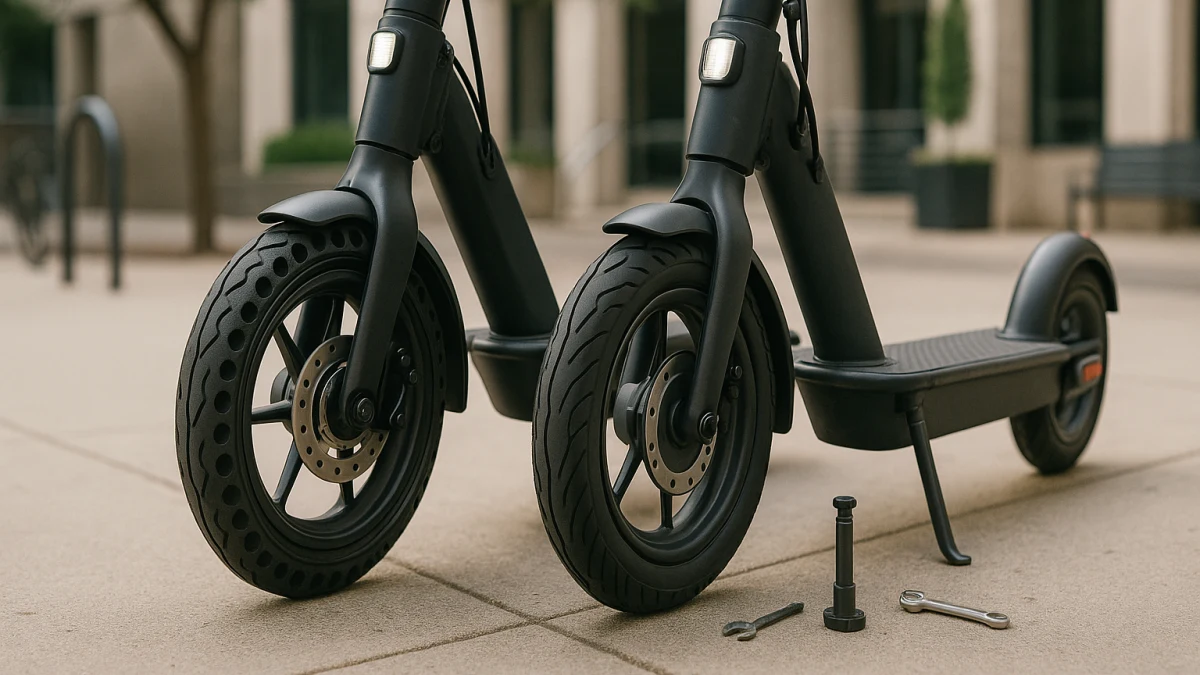
Most electric scooter category pages make it easy to sort by speed, range, price, or folding features. That can bury the maintenance question: what tire wording actually points toward fewer flat-tire interruptions, and what brake setup may add upkeep later?
This collection starts with tire construction language such as solid, honeycomb, flat-free, tubeless, self-sealing, and puncture-resistant. It is intentionally uneven: solid and honeycomb models get the main lane because the wording is usually clearer, while tubeless or self-sealing pneumatic-style options are a narrower path for shoppers who still want more ride comfort. None of these scooters should be treated as maintenance-free.
Choose by tire-maintenance signal first
| If this sounds like you | Better fit |
|---|---|
| You mainly want to reduce tube-related flat interruptions and can accept a firmer ride. | Solid-tire or puncture-resistant electric scooters |
| You want more air-tire comfort, but the listing must show tubeless, self-sealing, or puncture-resistant tire wording. | Maintenance-minded pneumatic or tubeless electric scooters |
| The listing mainly talks about suspension, rough pavement, fat tires, or off-road grip without clear tire-maintenance wording. | Treat it as a boundary case, not a core fit for this collection. |
As you compare, look past the usual commuter specs first. Tire construction wording is the first cut; flat-risk reduction versus ride softness is the main tradeoff; brake wording such as drum, disc, EABS, electronic, dual braking, and front/rear braking is the next upkeep check. Replacement-tire clarity and brake-service instructions matter too, because a low-hassle choice is weaker if the current product page does not make parts or service expectations easy to confirm.
Start with the flat-risk signal, not range or speed
A fast scooter with a long listed range can still be the wrong pick if the tire description is generic. Start with the terms that explain why the scooter belongs here:
- Solid, honeycomb, Honeycomb Solid, 8.5-inch solid tires, or 10-inch solid tires: the clearest starting point for reducing tube-related flat interruptions.
- Tubeless tire, Tubeless Self-Sealing Tires, reinforced, self-healing, or puncture-resistant wording: a narrower comfort-minded path, not a blanket approval for all pneumatic scooters.
- Brake details: drum brakes, disc brakes, EABS, electronic brakes, dual braking, and front/rear braking should be compared because they may carry different adjustment or service questions.
- Replacement clarity: check whether the product page or manufacturer support materials make tire replacement and brake service understandable before checkout.
Range, speed, lights, app control, and folding design can still matter for commuting. They just should not be the reason a scooter is considered low-maintenance in this collection.
False friends: comfort scooters, off-road cues, and generic pneumatic tires
Some scooters look like obvious upgrades because they mention suspension, rough-pavement comfort, fat tires, or stronger off-road grip. Those cues may matter for ride feel, but they do not prove fewer flats. If the listing does not clearly say solid, honeycomb, tubeless, self-sealing, reinforced, or puncture-resistant, treat it as outside the core decision here.
Also be careful with plain pneumatic tire language. A pneumatic tire can ride more softly, but generic air-filled wording alone is not the same as tubeless, self-sealing, or puncture-resistant wording. This page is for electric scooters only, not e-bikes, mopeds, mobility scooters, gas scooters, rideable suitcases, or off-road-first machines.
Solid and honeycomb-tire scooters for fewer flat interruptions
This is the main lane if your priority is avoiding tube-related flat interruptions over chasing the softest possible ride. Look for product wording such as solid tire, Honeycomb, Honeycomb Solid, 8.5-inch solid tires, 10-inch solid tires, flat-free, or puncture-resistant. Those terms are the reason to compare these scooters together.
Once the tire construction is clear, scan the brake language. The products shown here may mention drum brakes, EABS, electronic brakes, dual braking, or front/rear braking. That does not make one brake system automatically better, but it does tell you what to verify next: how braking is adjusted, what parts may wear, and what the manufacturer says about routine service.
Read this group as a practical shortlist, not a reliability ranking. Folding frames, lighting, and app features can help with daily commuting, but they are secondary here. If a solid or honeycomb scooter looks right on paper, check whether you can live with a firmer ride and whether the current product page explains tire and brake service clearly. If ride softness matters more, move to the next lane only when the listing has explicit tubeless, self-sealing, or puncture-resistant wording.
After solid tires: what you may be trading away
Solid and honeycomb tires can reduce certain flat hassles, but the tradeoff is often comfort. Because there is no air chamber to cushion the ride in the same way, these designs may feel firmer and may not be the most comfortable choice for rough pavement. They also are not a promise of no tire service; tread wear, wheel damage, and replacement logistics can still matter.
Before leaving this lane, decide which inconvenience you would rather manage: a firmer ride with clearer flat-risk-reduction wording, or an air-tire-style setup that may feel smoother but needs more careful wording to stay within this collection. That is where tubeless, self-sealing, or puncture-resistant pneumatic-style scooters may make sense.
Tubeless and self-sealing scooters when comfort still matters
Use this shorter lane if you want more air-tire comfort but still need maintenance-minded tire wording. The key phrases are Tubeless tire, Tubeless Self-Sealing Tires, reinforced or self-healing tire language, or a setup such as a pneumatic rear with a puncture-resistant front wheel. Without that wording, a pneumatic scooter should not be treated as a low-maintenance fit here.
Expect fewer choices in this lane. Compare the tire wording first, then look at brake descriptions such as front drum plus rear EABS, front disc plus rear electronic brake, disc, electronic, or front/rear braking. These scooters may be a better fit if solid tires sound too firm, but tubeless, self-sealing, and puncture-resistant tires still do not prevent every flat.
Manufacturer checks for tire and brake service
Tire and brake details are model-specific, so confirm them from the current manufacturer specifications, product manual, or support pages when available. In particular, check:
- Whether the tires are truly solid, honeycomb, tubeless, self-sealing, reinforced, or puncture-resistant as claimed.
- How tire replacement is handled and whether replacement tires are easy to identify for that exact model.
- What brake type is used on the front and rear, especially if the listing mentions drum, disc, EABS, electronic, or dual braking.
- Whether the manual explains brake adjustment, wear checks, and routine service in a way you are comfortable following.
If the product page uses maintenance-minded language but the support materials do not clarify the tire or brake setup, treat that as a reason to slow down rather than assume easy ownership.
Final fewer-flats checkout checks
Before buying, run through this quick checklist:
- Tire wording is explicit: solid, honeycomb, flat-free, tubeless, self-sealing, reinforced, or puncture-resistant appears in the listing.
- The lane matches your ride priorities: solid or honeycomb for clearer flat-risk reduction; tubeless or self-sealing only when you want more comfort and the wording is specific.
- Brake design is visible: drum, disc, EABS, electronic, dual braking, or front/rear braking is stated clearly enough to research service needs.
- Replacement parts are not a mystery: tires and brake parts can be matched to the exact scooter model.
- The listing is not drifting off-topic: suspension, off-road grip, fat tires, or rough-pavement comfort are not standing in for actual maintenance-minded tire construction.
- No maintenance-free assumption: even the best-fitting scooter here can still need tire inspection, brake checks, and eventual parts replacement.
Choose the tire tradeoff you can live with, then verify brake and replacement-tire details from current documentation. The right fit is not the scooter that promises zero upkeep; it is the one whose tire and brake design make the likely upkeep easier to understand before it arrives.