
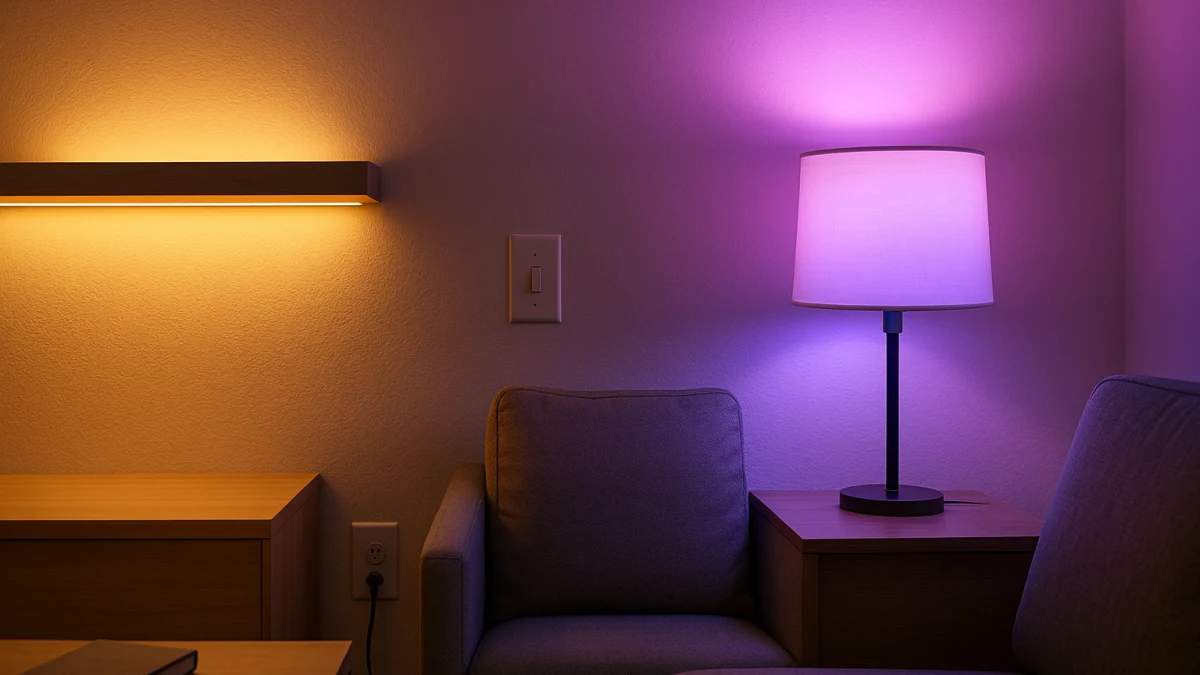
Start by deciding where the color should come from. LED strip lights create a visible run of light along an edge or surface; smart bulbs change the character of light from a lamp, ceiling fixture, sconce, or recessed fixture that already exists.
A normal category page can put strips, bulbs, plugs, and switches next to each other, but that does not answer the real placement question. Compare light placement, color effect, installation effort, coverage expectations, control style, and the risk of mistaking power control for ambience creation.
Trace an edge with strips; recolor a fixture with bulbs
| If you need... | Better fit | Why |
|---|---|---|
| A continuous line of light along shelves, cabinets, desks, bed frames, coves, or behind furniture | LED strip lights for linear accents | The strip itself becomes the visible placement path. |
| Color, tunable white, or dimming from lamps, ceiling fixtures, sconces, or recessed fixtures already in the room | Smart light bulbs for fixture-based ambience | The fixture already determines where the light lands. |
| Remote on/off, schedules, timers, or voice control for a decorative light that already creates the desired look | Smart plugs for existing decorative lights | The plug controls power; it does not create color by itself. |
| App, voice, schedule, or dimmer control for an existing wall switch or lighting circuit | Smart switches for circuit-level control | The switch changes how the circuit is controlled, not what the light source can produce. |
Use the table as a first filter before comparing app features. Wi-Fi, Bluetooth, Matter, voice control, timers, and schedules are useful only after the physical lighting effect is right.
Not sync boxes, panels, neon signs, or smart lamps
This page is focused on LED strip lights versus smart light bulbs for color ambience and accent lighting. It does not compare TV sync boxes, modular light panels, neon-style signs, standalone smart lamps, or professional architectural lighting systems.
Those products can overlap visually with accent lighting, but they solve different buying problems. Here, the decision is narrower: do you want a line of light, color from an existing fixture, or only smarter control of a light that already works?
Choose LED strip lights when the accent line is the point
Use this lane if the room needs color to run along a shelf, cabinet, desk, bed frame, cove, room edge, or behind furniture. A bulb in a fixed fixture can wash a space with color, but it cannot trace an edge in the same way.
The products shown here are useful for comparing strip-relevant details: length, flexible or rope-style form, RGB or RGBIC effects, scenes, app or voice control, adhesive mounting, magnetic installation, protective coating, and outdoor wording where a product states it. The practical question is not just whether the strip is smart; it is whether the strip can physically sit where the effect needs to appear and where the power supply can be placed.
Read this group with placement first. If the run length, mounting method, control method, coating, or stated location rating does not match the surface you have in mind, move on before comparing color modes. Do not assume every strip is cuttable, waterproof, renter-safe, equally bright, or suitable for damp or outdoor use.
Choose smart bulbs when the fixture already puts light in the right place
Smart bulbs make more sense when the lamp, ceiling light, sconce, or recessed fixture already puts light where you want it. In that case, swapping the bulb can be simpler than mounting a strip, routing power, and hiding or showing a linear run.
Compare base and shape first: GU10, A19, E26, and E27 products are not interchangeable just because they are all smart bulbs. Then look at the light behavior you actually want, such as RGBWW, RGBCCT, multicolor output, tunable white, dimming, brightness, color temperature, Wi-Fi, Bluetooth, Matter, app control, or voice control where listed.
This group is strongest for fixture-based ambience, not shelf-edge or cove effects. If the fixture is in the wrong location, the smartest bulb still sends light from the wrong place. Also check voltage, wattage, dimming support, and platform compatibility on the product page rather than assuming every bulb works with every fixture, wall dimmer, app, or voice assistant.
If it only controls power, it is not the ambience source
Smart plugs and smart switches are included here only because shoppers often find them while searching for smart lighting. They are control accessories, not substitutes for RGB strips or smart bulbs.
Use them when the light source already creates the effect you want. A plug can automate power to a decorative lamp or lighted object. A switch can control an existing lighting circuit. Neither one adds a linear accent path, RGB color, or tunable white to an ordinary light source unless the connected light already has those abilities.
Use smart plugs only when the light already has the look
A smart plug is enough when your decorative lamp, lighted object, or existing accent light already looks right and you only want remote on/off, schedules, timers, voice control, or possibly energy monitoring where offered.
Compare plug type, regional plug standard, current rating, maximum power, connected-device behavior after power loss, and app or voice compatibility. Skip this lane if you are trying to create color, dimming, tunable white, or a line of light from scratch.
Use smart switches when the wall circuit is the problem
Choose a smart switch only when the wall control or lighting circuit is the thing you need to modernize. This is a hardwired control lane for app control, voice control, scheduling, or dimming where the switch and the connected load support it.
Look closely at neutral-wire requirements, voltage, load rating, single-pole or multi-way configuration, dimmer compatibility, and installation requirements. A switch can make an existing circuit easier to control, but it does not turn ordinary bulbs into RGB or tunable-white lighting.
Check the physical fit before comparing app features
Before you compare ecosystems or voice assistants, check the non-negotiables:
- For LED strips: length, mounting method, power supply placement, control method, color type, coating, and any stated indoor, damp, outdoor, or IP rating.
- For smart bulbs: base type, bulb shape, fixture clearance, brightness, wattage, voltage, color temperature range, dimming support, and platform compatibility.
- For smart plugs: plug type, current rating, maximum power, regional standard, scheduling features, energy monitoring if needed, and how the connected device behaves after power is restored.
- For smart switches: wiring requirements, neutral-wire needs, voltage, load rating, dimmer compatibility, switch configuration, and installation requirements.
A smart feature is only useful after the product fits the socket, surface, outlet, or wall box involved.
Ratings and wellness claims need proof, not vibes
Treat numbers and ratings as product-page checks, not assumptions. Lumens, color temperature, CRI, cut points, adhesive claims, power-supply details, IP ratings, damp-location wording, certifications, voltage, load ratings, and maximum power should be verified from the product listing or manufacturer documentation.
Be especially cautious with sleep, mood, wellness, or circadian claims. Without clear source support, use these products for placement, color preference, dimming, and control convenience rather than expecting a specific health or wellbeing outcome.
In the end, return to the physical effect: pick strips if the room needs a visible line of color, bulbs if the existing fixture placement is right, and plugs or switches only when the real need is controlling lights that already create the look you want.