
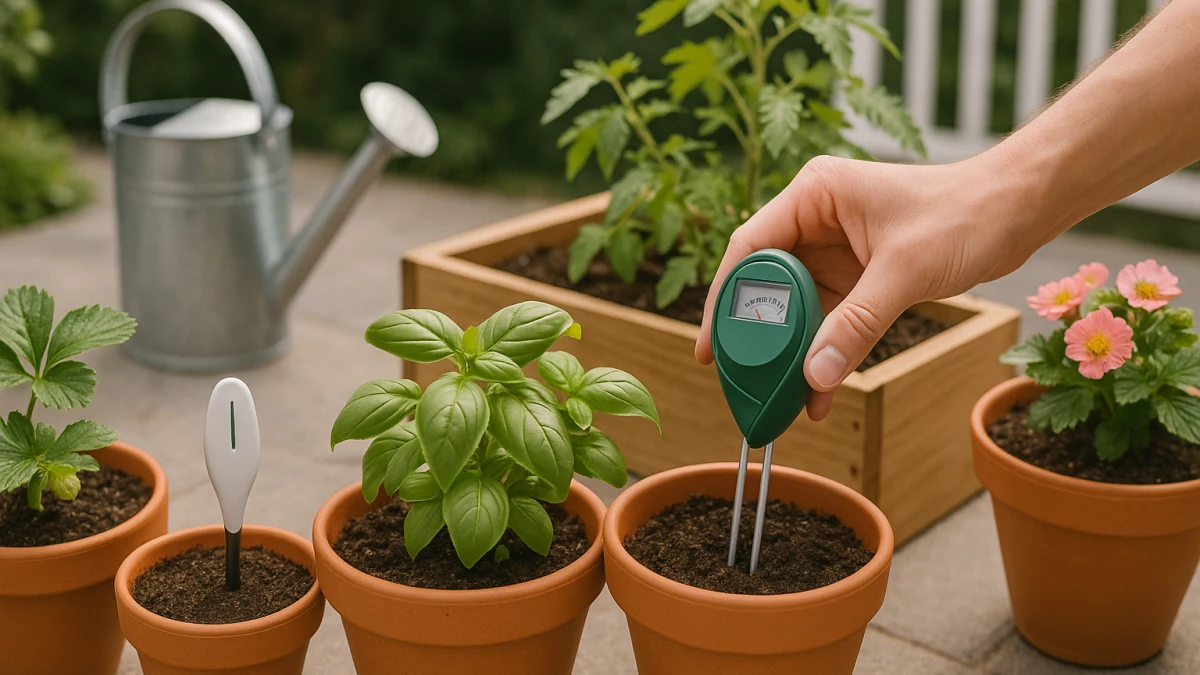
Soil moisture products often share the same shelf, but the real split is not analog versus smart. It is the watering routine: one probe you insert, read, remove, and carry to the next plant, or one sensor you leave in a particular pot, planter, bed, garden area, or lawn area for ongoing readings.
A normal category listing can mix analog dials, LCD testers, visual indicators, Zigbee sensors, Wi-Fi gateway kits, and plant monitors without showing which job they support. Use this page to compare coverage pattern, setup, reading consistency, power and connectivity, indoor/outdoor suitability, and whether extra measurements such as pH, temperature, sunlight, EC, or fertility are actually useful for the way you water.
Carry one probe or watch one spot?
| If this sounds like your routine | Better fit |
|---|---|
| You walk through several pots, beds, or lawn areas and only need to test before watering. | Spot-check soil moisture meters |
| You want ongoing readings from one specific pot, planter, bed, garden area, or lawn area. | Leave-in soil moisture sensors |
| You want Wi-Fi, Zigbee, app data, notifications, or smart-home compatibility. | Look within leave-in soil moisture sensors, but treat connectivity as secondary to the monitoring workflow. |
| You expect the product to turn watering on or off automatically. | Out of scope here: automatic irrigation controllers, hose timers, and water timers. |
The first question is coverage. One handheld meter can cover many locations if you are willing to take manual readings. One leave-in sensor usually represents one location, so the number of pots, beds, or lawn areas you want to watch matters. After that, compare setup burden, insertion depth or probe placement, battery needs, app or hub requirements, indoor/outdoor wording, IP rating, and any extra measurements the product claims to provide.
Do not turn this into a smart-watering page
Connected soil moisture sensors can be useful, but this page is not about automatic watering. A moisture sensor that reports data is different from a controller that turns water on or off.
Skip this comparison if you are shopping for automatic irrigation controllers, hose timers, water timers, self-watering planters, smart plant pots, indoor garden systems, or unrelated alert devices. Those products may use moisture data or plant-care language, but they solve a different buying problem than choosing between a handheld meter and a leave-in monitor.
Manufacturer wording that changes the lane
Some listing language changes what you can safely assume. Treat terms such as leave-in, continuous monitoring, outdoor use, weather-resistant, waterproof, rainproof, battery life, hub required, app alerts, and notifications as model-specific details.
Indoor/outdoor wording is not the same as an IP rating or a rainproof claim. Likewise, a probe shape alone does not prove that a product should stay in soil continuously. If the product page does not clearly support long-term placement, outdoor exposure, alert behavior, or hub-free setup, do not buy it as if those features are guaranteed.
Spot-check soil moisture meters for a watering walk-through
Choose this lane if you just need one simple tool to test several plants before you water. These are the analog dial meters, LCD probe meters, soil tester probes, and multifunction testers you insert manually, read directly, then move to the next pot, bed, or lawn area.
The practical checks are physical: display type, probe length, stated measurement depth, and whether the product is moisture-only or also reports pH, temperature, sunlight, EC, or fertility. Battery needs vary by design. Some analog meters are battery-free, while some LCD models use AAA batteries or need power for extra readings.
Read these products as handheld tools, not permanent monitors. If the instructions say to remove and wipe the probe after each test, that points to temporary spot checks rather than continuous soil placement. This lane is usually the simpler choice when a direct reading across many locations matters more than app data, hubs, alerts, or a dedicated sensor in every pot.
The probe you move vs. the sensor you maintain
With a handheld meter, your technique is part of the result. Insertion depth, contact with the soil, placement near the root zone, and cleaning the probe between tests can all affect how consistent your readings feel from plant to plant.
With a leave-in sensor, the work shifts from each reading to the setup. You choose one location, keep the sensor placed there, manage batteries if required, and check any app, hub, gateway, Zigbee, Wi-Fi, or compatibility requirements. A fixed sensor can make one spot easier to watch, but it does not automatically represent every pot or bed nearby.
Leave-in soil moisture sensors for ongoing readings in one location
Choose this lane when a specific pot, planter, bed, garden area, or lawn area deserves ongoing readings. Leave-in options can include simple visual indicators, battery-powered smart sensors, wireless soil moisture meters, Zigbee soil moisture sensors, and Wi-Fi gateway kits.
The key is not whether a product sounds smart. The key is whether the manufacturer clearly presents it for leave-in use, continuous soil moisture monitoring, or long-term placement. For connected models, also check battery type or battery life, app compatibility, hub or gateway requirements, Wi-Fi or Zigbee support, smart-home compatibility, and how many sensors are included or supported.
Read these products as monitoring commitments. A single leave-in sensor is most useful when one location is worth watching over time; it is not a substitute for walking around with a probe unless you buy and set up enough sensors for the locations you care about. Outdoor placement needs product-specific support such as indoor/outdoor details or an IP rating, and app alerts or notifications should be verified rather than assumed.
Checks before paying for continuous monitoring
Before choosing a leave-in sensor or connected kit, check the product page for:
- Clear leave-in, long-term placement, or continuous soil moisture monitoring language.
- How many sensors are included, and whether the system supports enough sensors for your pots, beds, garden areas, or lawn areas.
- Battery type, replacement method, and any stated battery-life details.
- Whether an app is required, and whether it is compatible with the devices or platform you use.
- Whether a hub, gateway, Zigbee setup, Wi-Fi connection, or smart-home platform is required.
- Indoor/outdoor usage details, plus any IP rating or weather-related wording if the sensor will be exposed outdoors.
- Whether alerts or notifications are actually listed for that model.
- Whether the product only monitors moisture or crosses into automatic watering control, which belongs outside this comparison.
If occasional manual checks will change when you water, buy the simplest spot-check meter that gives the reading style and probe size you need. Consider a leave-in sensor when ongoing readings from one specific location justify the extra setup, battery attention, compatibility checks, and sensor count.