
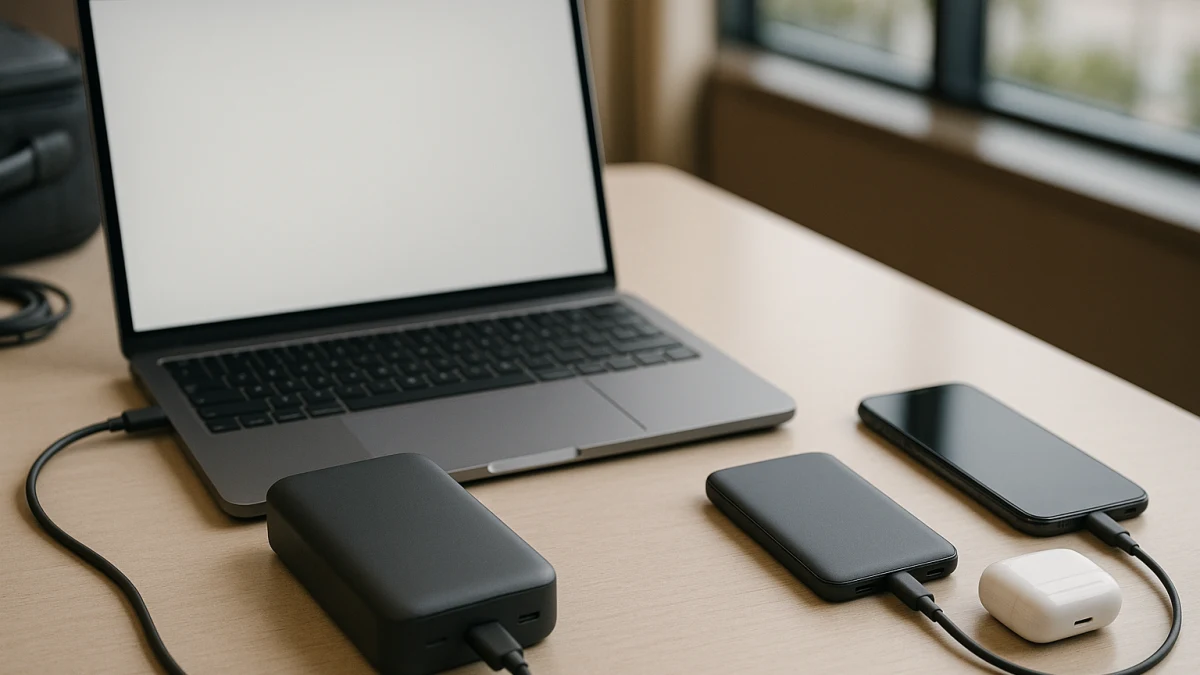
Travel power banks can look nearly interchangeable in a product grid, but the important split is not simply bigger versus smaller. For travel, the better question is whether you need real USB-C backup for a laptop or larger tablet, or whether you only need phone insurance with less weight in your bag.
This collection separates those jobs before you browse. Capacity matters, but it is not enough for laptop use unless USB-C output, charging protocol support, and the cable rating also match the device. On the other side, a compact 5000mAh or 10000mAh charger with built-in cables can be the smarter buy when the goal is a quick phone top-up, not laptop-level output.
Start with the device you cannot afford to lose
| If this is your travel problem | Better fit |
|---|---|
| You need meaningful backup for a USB-C laptop, larger tablet, or multiple devices during a travel day. | High-output USB-C laptop power banks |
| You mainly want emergency phone top-ups, pocketability, and less carry weight. | Compact phone and small-device power banks |
| Your laptop or specialty gear depends on a proprietary charger instead of USB-C charging. | Treat AC outlet power banks as a boundary case and verify the outlet need separately. |
| You are tempted by the biggest mAh number but have not checked USB-C output wattage or cable rating. | Pause on the laptop-capable claim until single-port USB-C output, protocol support, and cable rating are verified. |
As you compare, keep five things separate: the device load, the single-port USB-C output, total output when more than one port is used, capacity versus carry weight, and whether the cable or port setup actually matches what you pack. Capacity wording in watt-hours or carry-on language can also be useful, but it should be checked against current official guidance rather than treated as settled by a product title.
Four cues that split laptop backup from phone top-ups
- Device load: A USB-C laptop, larger tablet, or multi-device setup points toward higher-output USB-C models. Phones, earbuds, and small travel devices usually do not need that heavier lane.
- Useful output: For laptop backup, look beyond big capacity numbers and check USB-C output wattage, PD or Power Delivery language, and whether the advertised wattage applies to one USB-C port.
- Carry tolerance: Larger-capacity laptop-focused banks can be worthwhile when they solve a real workday problem. If you only need a phone reserve, slim, mini, or pocket-size models may be easier to live with.
- Cable and port fit: Built-in cables can reduce clutter for phone-focused charging, but they only help if the connector matches your device. For laptop charging, the cable rating matters as much as the bank’s advertised output.
USB-C laptop-capable does not mean AC-outlet power bank
This page is about power banks and portable chargers inside the power-bank category, not a guide to wall chargers, charging stations, jump starters, portable power stations, or AC-output shopping.
An AC outlet power bank is a boundary case: it may matter if a laptop or specialty device cannot charge over USB-C. For most USB-C laptop shoppers, the cleaner comparison is still between high-output USB-C banks and lighter phone-oriented banks. Do not add outlet size, inverter behavior, or wall-plug needs to the decision unless your device truly requires that path.
Use this lane when laptop backup is the actual job
Choose this lane if the trip includes a USB-C laptop, a larger tablet, or several devices that may need charging during the same day. Visible 45W, 60W, 65W, 70W, 100W, or 145W total-output language can be a useful first filter, but it is only the beginning of the check.
For laptop use, look for USB-C output, USB-C PD or Power Delivery language, and clear port behavior. A product may advertise 100W or 145W total output, while the wattage available from one USB-C port could be different, especially if a phone and tablet are plugged in at the same time. MacBook or laptop examples are helpful clues, not proof that the bank will charge every laptop model at full speed.
Read the products shown here as candidates to inspect, not as a ranked list of universally laptop-ready chargers. Compare single-port USB-C output, listed fast-charge protocols, capacity, product weight, and what happens when multiple ports are used. If the extra size and verification work do not solve a real laptop or multi-device problem, the compact phone lane may be the better travel buy.
The expensive mistake: buying watt-hours when the USB-C output is wrong
The common wrong purchase is paying for a bigger battery and still not getting the charging behavior the device needs. Watch for these traps:
- Big mAh, weak laptop fit: Capacity can describe how much energy the bank stores, but not whether it can deliver enough USB-C output to a laptop.
- Total output confusion: A 100W or 145W headline may describe the combined output across ports rather than what one USB-C port delivers.
- Cable mismatch: A laptop-capable bank still needs a cable rated for the charging level you expect.
- Multi-device drop-off: Charging a laptop, phone, and tablet together can change how power is split across ports.
- Compatibility overreach: Laptop or MacBook wording should be checked against your exact device requirements before checkout.
Use this lane when a pocketable phone reserve is enough
This lane is for travelers who want a lighter backup for phones, earbuds, and small mobile devices. Compact, mini, slim, pocket-size, 5000mAh, and 10000mAh descriptions usually point toward easier daily carry rather than laptop backup.
Built-in cables can be especially useful when you want fewer loose cords in a day bag. Some products in this lane may show phone-oriented compatibility, 15W or 22.5W output language, or 37Wh capacity labeling. Treat those as comparison details, not as a promise of universal phone fast charging or automatic flight compliance.
Use the products shown here to compare pocketability, cable setup, connector fit, and capacity for phone-focused travel. This lane is not an inferior version of the laptop lane; it wins when less weight and less clutter matter more than laptop-level USB-C output. Skip it if the device you truly need to protect is a laptop that depends on higher USB-C wattage.
Final checks: single-port watts, cable rating, and capacity in Wh
Before checkout, verify the details that product grids often blur:
- For a USB-C laptop: Check the laptop’s charging requirement, the power bank’s single-port USB-C output, and any PD or Power Delivery language on the product page.
- For multiple devices: Look for how total output is shared when more than one port is active.
- For cables: Confirm that the included or packed cable supports the charging level you expect.
- For phones: Make sure built-in cables and ports match your phone, case, and other small devices.
- For carry weight: Compare capacity against the size and weight you are willing to carry all day.
- For travel capacity wording: Look for Wh information when available, then check current official airline or regulator guidance rather than relying only on a product claim.
Claims that need official backing before publication
Treat USB-C PD, Power Delivery, fast charging, laptop compatibility, MacBook charging, output wattage, and flight-capacity language as specification-level claims. They should come from the manufacturer’s product page, an official standard, or current regulator-backed travel guidance before being treated as certain.
The safest buying approach is to choose the smallest power bank that covers the device you truly need to protect. Go heavier only when laptop-level USB-C output, port behavior, cable rating, and capacity checks all support that choice.