
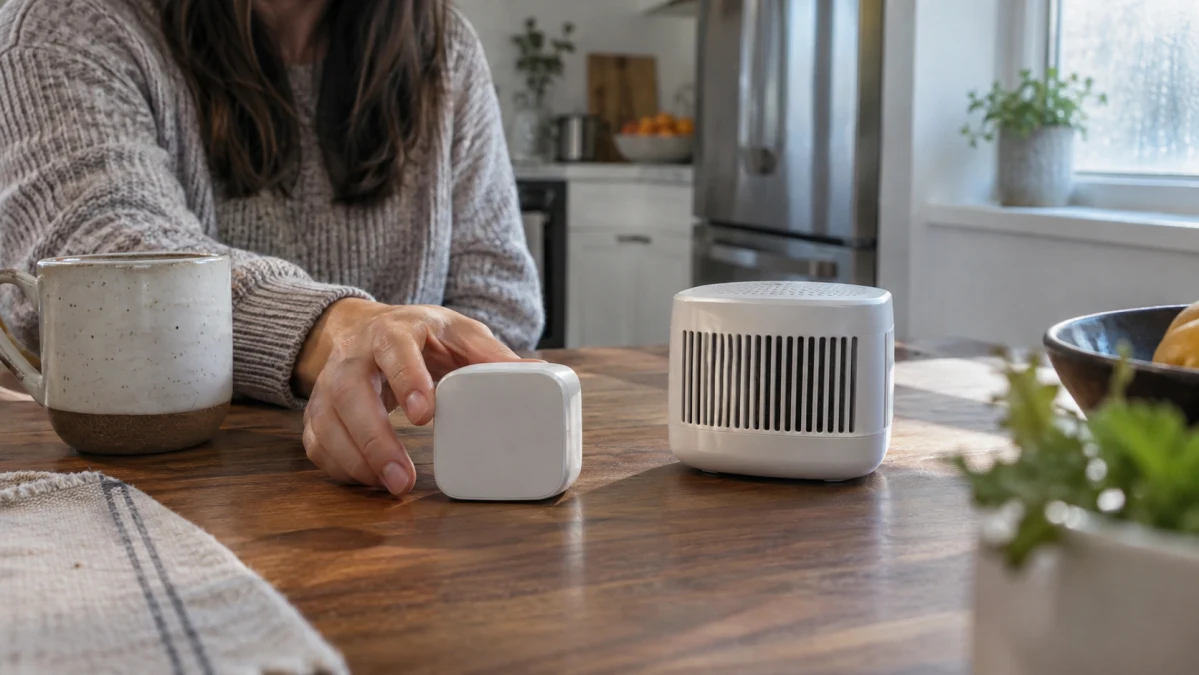
A damp basement, cooking fumes, and a bedroom that needs more fresh air are three different problems. Buying the monitor with the most numbers on its screen is not necessarily the best way to solve any of them. Start with the decision you want to make: whether to reduce humidity, remove particles, or improve ventilation.
The distinction matters because an “air quality” label does not promise a particular set of sensors. As EPA explains about consumer air monitors, each device reports only the pollutants or environmental conditions it is designed to measure.
For dampness or dryness, start with temperature and humidity
A temperature-and-relative-humidity monitor is the sensible starting point for checking a basement, following conditions around a humidifier, or seeing whether a room stays damp. EPA recommends keeping indoor relative humidity below 60% when possible, ideally between 30% and 50%. But the number is not a mold test: condensation, wet materials, and leaks still need attention even when the room's reading looks reassuring. EPA's moisture-control guidance explains why fixing the water source matters more than simply watching a display.
Read temperature alongside relative humidity, usually abbreviated RH. The same moisture content can produce a higher RH in cooler air and a lower RH in warmer air. Heating a room can therefore lower the percentage without removing water vapor. When following a moisture problem, compare readings at similar temperatures rather than treating every downward tick as evidence that the room is drying out. The National Weather Service explains this temperature–humidity relationship.
For an out-of-the-way room, prioritize a useful history and adjustable humidity alerts. Being able to see whether humidity stayed high all afternoon is more helpful than checking one number when you happen to walk downstairs.
The Tuya Smart WiFi Temperature Humidity Sensor offers that app-oriented approach. Banggood advertises AAA-battery power, Smart Life remote readings and history, plus sound and light alerts. Battery power gives you more freedom to choose a location without running a cable, but buy it for temperature and humidity—not particle pollution or CO2.
Treat the advertised 180-day standby time as a seller claim, not a guarantee of six months of frequent updates and alarms. Before buying, ask how often readings reach the app, whether humidity alert thresholds are adjustable, and how much history remains available. Those details determine how useful remote monitoring will be.
For cooking particles or ventilation, choose the right pollutant sensor
PM2.5: what happens during cooking or smoke events
PM2.5 refers to fine airborne particles generally 2.5 micrometers in diameter or smaller. A numerical PM2.5 reading, typically shown in micrograms per cubic meter (µg/m³), lets you follow particle levels rather than relying on a vague “good” or “poor” badge. EPA's particle-pollution explanation describes what this measurement covers.
For cooking, look for a monitor that lets you compare levels before, during, and after meal preparation. Use the range hood while cooking rather than waiting for an alarm; EPA recommends a hood that vents outdoors and leaving it running for 10–20 minutes afterward. Monitoring can help you understand the pattern, but you do not need a sensor's permission to use ventilation. See EPA's advice on reducing cooking particles.
CO2: a clue about fresh-air supply in an occupied room
People exhale carbon dioxide, so a CO2 monitor can help show when it is accumulating in an occupied room. For a bedroom or home office, a record across the hours you use the space is more informative than a single reading taken after everyone leaves. Keep track of occupancy and whether windows or ventilation systems were operating. The UK's Health and Safety Executive explains how to interpret these patterns.
CO2 is measured in parts per million, or ppm. It is a ventilation clue, not a complete air-safety score: occupancy, placement, and airflow affect the reading. CDC's ventilation guidance cautions that one concentration target is not appropriate for every space. A low number cannot rule out particle pollution or other hazards.
For this job, buy a monitor that measures CO2 directly. NDIR, short for nondispersive infrared, is a common method. An eCO2 or CO2-equivalent output from a VOC sensor is different: it estimates a value from other gases rather than measuring CO2 itself. Adafruit's explanation of its eCO2 sensor illustrates the distinction. Ask the seller which CO2-sensing technology the device uses; a “CO2” label on a screen is not enough.
When a combined monitor makes sense
A combined PM2.5/CO2 monitor is useful when both particle pollution and ventilation matter in the same room. It is not necessary to put everything in one box: separate devices may suit you better when the damp basement and the bedroom are the places you actually need to watch.
The PT02 Plus puts PM2.5, CO2, temperature, and humidity on its own display, according to the PT02-Plus user guide. That gives it a practical advantage over the app-oriented humidity sensor when you want to glance at several readings without reaching for your phone. Supplier The HBS Centre says it uses NDIR for CO2 and laser sensing for particles. Those are supplier specifications, not an independent accuracy test.
There is an important purchase check with this model: the user guide specifies a 5V/2A input, while GZAIR's PT02 Plus sales page also contains PT02 Pro descriptions and a Pro specification image listing 12V/2A. Before ordering, have the seller confirm the exact unit, its power label, and the included adapter. Do not choose a power supply from the model name alone.
Filtration and ventilation are not interchangeable
A particle filter can reduce airborne particles without lowering CO2. Consequently, a CO2 reading that stays high does not, by itself, mean an air purifier is failing. HSE notes that air-cleaning units do not remove CO2 or improve ventilation. To judge particle removal, follow the particle reading instead.
Opening a window has a different trade-off: it brings in outdoor air, which may also bring in pollution. During wildfire smoke or other poor outdoor-air conditions, EPA advises keeping windows closed and using appropriate filtration. Check EPA's guidance on outdoor particles entering homes before treating every high indoor reading as a cue to open a window. This is where having both PM2.5 and CO2 information can be useful: the two readings may call for different responses.
Choose something you can live with—and place correctly
Check the everyday interface. For a bedside monitor, look for controllable lighting and audible alerts. For a basement, prioritize remote access and a clear last-updated time. Ask whether the device records measurements during an internet outage and how long its history is retained; “app history” does not tell you either. The PT02-Plus guide specifies 2.4-GHz Wi-Fi and an internet connection for mobile linking, so check those requirements before assuming it will work on your network.
Compare accuracy, not just resolution. A display that changes in tiny increments is not necessarily accurate to those increments. For example, the PT02-Plus specifications list humidity accuracy of ±5 RH percentage points. A displayed 50% therefore should not be treated as precise to a single percentage point. If humidity control is your entire reason for buying, prioritize a tighter, clearly stated RH accuracy specification over extra pollutant fields.
Leave room for air to reach the sensor. For representative room readings, avoid placing a monitor immediately beside the stove, blocking its air openings, or putting it directly in a draft from a window or HVAC outlet. EPA suggests the occupants' breathing zone, generally about 3–6 feet high for adults. A convenient outlet is not necessarily a useful measuring location; follow EPA's placement guidance and the device instructions. For CO2, also keep the sensor out of your direct exhaled breath and follow the manufacturer's calibration instructions, as HSE recommends.
Finally, keep dedicated smoke and carbon monoxide alarms. CO2 and carbon monoxide, or CO, are different gases. Even a multi-sensor monitor with a CO field is not automatically a substitute for a certified CO alarm. EPA distinguishes consumer-monitor alerts from emergency alarms.
For tracking room humidity, a good temperature-and-humidity monitor is enough. Add PM2.5 for particles and direct CO2 measurement for ventilation questions. Favor trustworthy readings, accessible history, and a device you can leave in the right place—not the largest number of measurements printed on the box.