
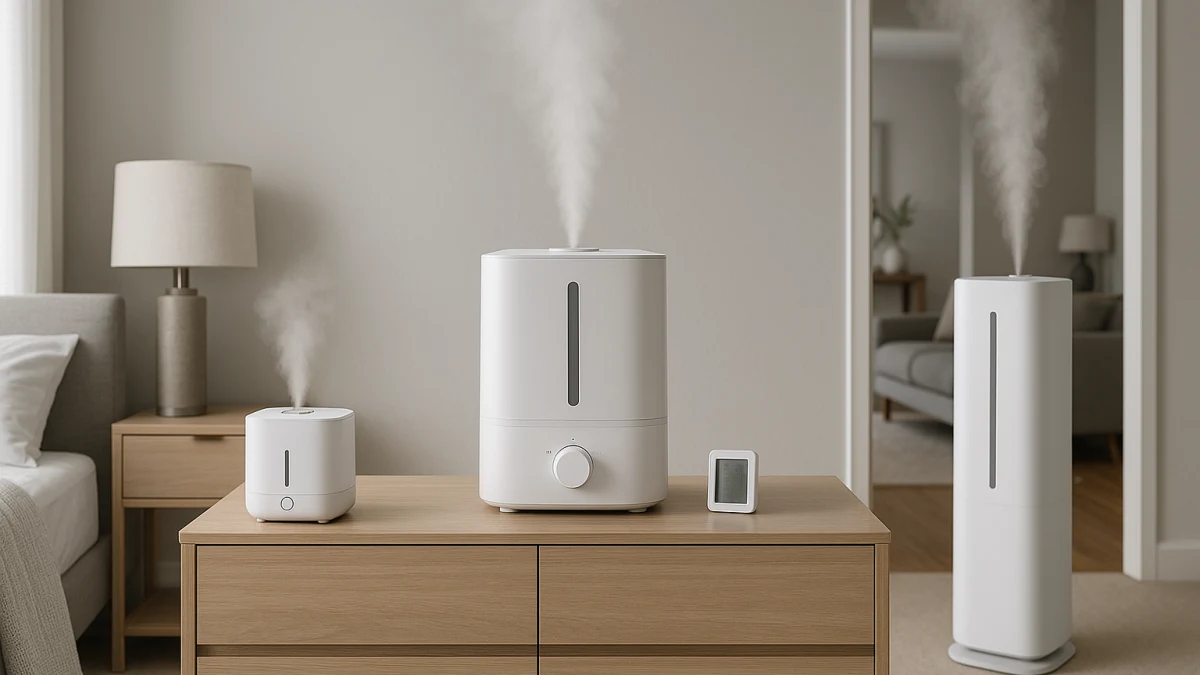
Humidifier listings often give tank size, runtime, and claimed coverage without telling you whether the unit fits your actual room. This guide turns those scattered details into a sizing ladder: compact bedside units, medium bedroom humidifiers, larger portable room models, and humidity monitors as a secondary check.
Tank capacity only helps when it is read alongside coverage cues such as 65 sq ft, 220-350 sq ft, or 500 sq ft and above. Runtime claims can change with mist setting, room conditions, ventilation, ceiling height, and starting humidity, so use them to set expectations rather than as a guarantee. RH readings can help you decide whether to run, adjust, or stop a humidifier, but a monitor does not add moisture by itself.
Pick by room size before comparing mist features
| If this sounds like the room | Better fit | Check before comparing extras |
|---|---|---|
| Nightstand, desk, nursery, office, or very small bedroom with mini, portable, desktop, 65 sq ft, or 100-200 sq ft cues | Small bedside humidifier | Placement, small tank size, auto shut-off, night-light behavior, and tank opening |
| Typical bedroom where overnight practicality, 2.3 L to 4 L capacity, about 1 gal, top-fill, or 220-350 sq ft cues matter | Medium bedroom humidifier | Refill access, claimed runtime, quiet operation language, and cleaning access |
| Living room, open area, or bigger bedroom where listings show 500 sq ft and above, 6 L to 16 L, app, remote, or humidistat cues | Large-room humidifier | Carry weight, controls, top-fill design, sleep mode, and auto shut-off |
| You are not sure whether the room is dry, comfortable, or getting over-humidified | Air quality monitor with humidity reading | RH display, temperature reading, app support, or data logging if useful |
Before sorting by cool mist, warm mist, app control, or night lights, compare the basics: claimed room coverage, tank capacity, refill frequency, runtime at the setting you expect to use, refill and cleaning access, night-use behavior, and whether you have a humidity reading to check the result.
Start with the room, not the biggest tank
The wrong purchase usually happens in one of two directions: a compact unit is asked to handle a larger room, or a large tank is placed in a small bedroom where it is bulky and harder to manage. Start with the room size and placement first, then decide how much tank you actually want to lift, refill, and clean.
Use compact listings when the product is clearly framed as mini, portable, desktop, bedside, or for a small square-foot area. Use the bedroom lane when the listing combines bedroom or nursery use with 2.3 L to 4 L, about 1 gal, top-fill, or roughly 220-350 sq ft cues. Step up to the large-room lane when the listing is built around 500 sq ft and above, larger tanks, longer runtime claims, humidistats, remotes, or app controls.
Out of scope: HVAC, dehumidifying, scent, and medical claims
This page is about portable room humidifiers and humidity-reading monitors. It is not a guide to installed whole-home HVAC humidifiers, dehumidifiers, essential oil diffusers, scent devices, or medical treatment. If a portable product uses whole-house wording, read it as a portable large-room claim to verify, not as installed HVAC humidification.
Bedroom, nursery, or bedside wording also should not be treated as a health promise. Compare these products for room fit, refill practicality, controls, and maintenance access, not for illness prevention or treatment.
Treat coverage, runtime, and RH advice as source-sensitive
For any specific model, confirm square feet, tank capacity, mist output, runtime, and control features on the product page or manufacturer materials. Runtime is especially setting-sensitive, so a long claim should prompt a closer look at the conditions behind it.
Be cautious with exact humidity ranges, condensation advice, cleaning schedules, distilled-water guidance, mineral buildup, and white-dust claims unless they are backed by the manual or an authoritative source. On this page, those topics are framed as things to verify rather than promises.
Small bedside humidifiers for nightstands and very small rooms
Choose this lane when the humidifier is meant to sit close by: on a nightstand, desk, nursery shelf, office surface, or in a very small bedroom. Look for cues such as mini, portable, desktop, bedside, 65 sq ft, 100-200 sq ft, or a compact tank such as 0.79 gal.
The advantage is convenience. Smaller tanks are easier to place and carry, and the footprint is less likely to take over the nightstand. The tradeoff is refill frequency: a compact tank is not the same ownership experience as a 2.3 L to 4 L bedroom unit. For night use, check auto shut-off, noise language, water-level visibility, night-light behavior, and whether the tank opening looks easy to clean.
Read the products shown here as close-range or very small-room options, not all-room solutions. If you want practical overnight coverage for a typical bedroom instead of immediate bedside moisture, move up to the medium bedroom section rather than stretching compact coverage claims.
When a mini tank turns into nightly refill frustration
A compact humidifier can be the right choice, but it is easy to overread small-format listings. Common mistakes include:
- Treating mini or portable as a room-size guarantee.
- Expecting a 65 sq ft or 100-200 sq ft unit to behave like a full bedroom humidifier.
- Choosing a night light or tiny footprint while ignoring the tank opening and refill routine.
- Assuming a small tank will run all night on any setting.
If the room is more than a very small sleeping area or desk zone, the medium bedroom lane is usually the more practical comparison point.
Medium bedroom humidifiers for overnight use without constant refills
This is the middle path for a typical bedroom: more capacity than a mini unit without the bulk of a large-room tank. Product cues in this lane include 2.3 L to 4 L, about 1 gal, bedroom or nursery wording, top-fill or top-refill designs, and coverage around 220-350 sq ft.
Top-fill access can reduce daily hassle, but it does not remove the need to inspect the tank shape and cleaning access. Quiet operation language and long runtime claims, including claims such as 36 hours, are useful comparison points, but they should not be read as a promise that every model will run all night on every setting.
Use these products to compare tank size, refill style, bedroom-scale coverage, and night-use practicality. If your room is open, larger, or closer to a living area, compare the large-room lane next. If you only need moisture near a desk or bed, a compact model may be easier to live with.
The 4 L-to-large-tank tradeoff: fewer refills, more cleaning access
Stepping beyond the 2.3 L to 4 L bedroom range can reduce how often you refill, but it also changes the daily routine. A 6 L, 7 L, 10 L, or 16 L tank means more water to move, more space to store the unit, and more reason to care about top-fill design, tank opening size, and access for cleaning.
Do not upgrade only because the bigger number looks better. Upgrade when the room size, coverage claim, and refill routine all point in the same direction.
Large-room humidifiers for open areas and bigger bedrooms
Use this lane for living rooms, open areas, and bigger bedrooms where small or medium tanks look underpowered on paper. Relevant cues include large-room wording, coverage around 500 sq ft, 596 sq ft, 1000 sq ft, or 1500 sq ft, and larger capacities such as 6 L, 7 L, 10 L, 16 L, 2.1 gal, or 2.64 gal.
Controls matter more as output and coverage increase. Before buying, inspect humidistat details, app or remote control, sleep mode, auto shut-off, top-fill design, and any long runtime claim. If a portable product uses whole-house wording, verify the actual coverage and tank specs rather than treating it like an installed HVAC system.
The products shown here are for comparing larger portable tanks and higher-coverage room use. They are not automatically better for a small bedroom. If the room is modest, a compact or medium model plus an RH reading may be the more practical path.
Use RH readings to verify the room-size call
Humidity readings help check whether your sizing choice is working. A compact humidifier may not change the room much beyond the immediate area, while a large humidifier in a small room may need closer control and monitoring.
Treat RH as a feedback tool, not a replacement for choosing the right humidifier class. It can help you decide when to run the unit, lower output, move up in size, or stop using it for the moment.
Humidity monitors to confirm whether the room actually needs moisture
If you are not sure the room needs added moisture, a monitor with humidity or RH readings can help you check first. Look for clear humidity display, temperature readings, 0-99% RH or 0-100% RH range language, app support, data logging, portable design, or smart-home connectivity if those features matter to you.
Keep this as a support step. A monitor can show humidity trends and help compare the effect of different humidifier sizes, but it does not humidify the room and should not be used to make medical claims or accuracy assumptions beyond the listed specifications.
Last check: coverage claim, tank capacity, runtime, cleaning access
Before choosing a model, verify the details that determine day-to-day fit:
- Claimed coverage: compare the listed square feet with the room you actually want to humidify.
- Tank capacity: decide whether the tank size matches your refill tolerance and where the unit will sit.
- Runtime: check whether the claim depends on a lower mist setting or other stated conditions.
- Refill access: look for top-fill or top-refill details if daily refilling would be annoying.
- Cleaning access: inspect the tank opening, removable parts, and manual guidance for upkeep.
- Night use: confirm auto shut-off, sleep mode, water-level visibility, noise language, and night-light behavior.
- Humidity check: consider an RH-reading monitor if you are unsure whether the room is dry, unchanged, or being over-humidified.
Choose the smallest humidifier class that credibly fits the room, then verify the model-level coverage, tank size, runtime, and cleaning access before relying on it every day.