
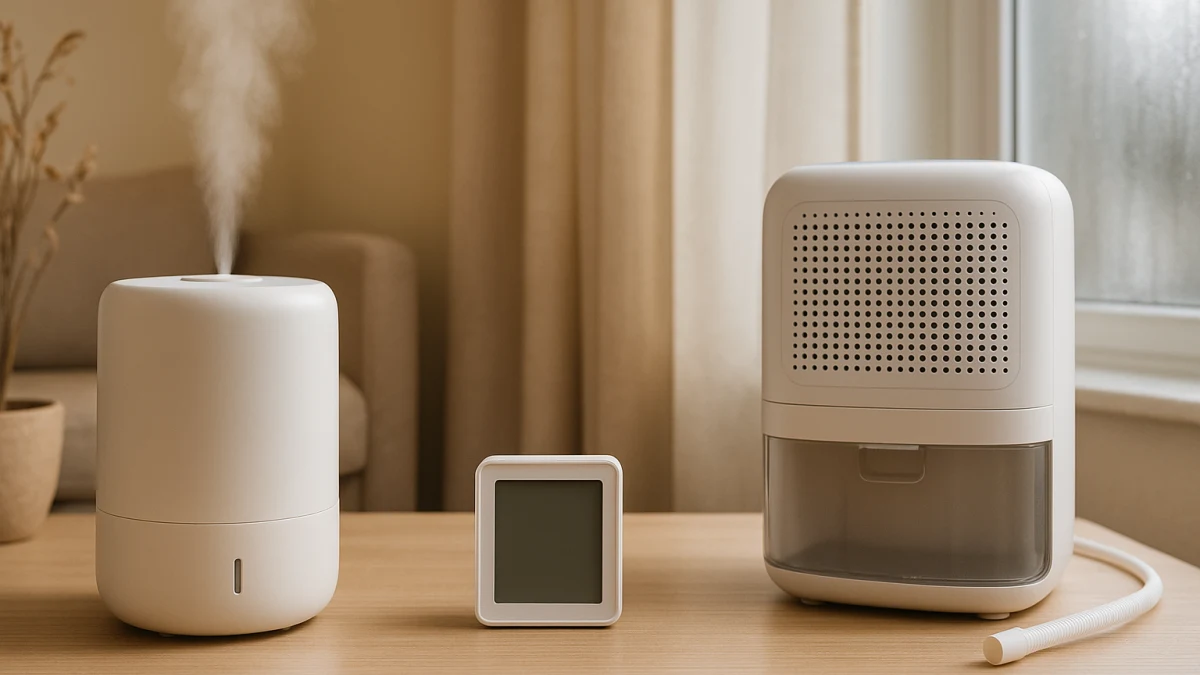
Humidifiers and dehumidifiers solve opposite problems, so the first question is direction, not which device looks more advanced. A humidifier adds mist when indoor air feels dry; a dehumidifier removes moisture when a room feels damp or shows humidity-related condensation. A search page can mix humidifiers, dehumidifiers, monitors, diffusers, purifiers, and absorbers side by side; this guide separates them by what they do to room moisture.
This collection is intentionally uneven: humidifiers get more feature attention because there is more to sort through, dehumidifiers stay focused on capacity and drainage, and monitors are only a tie-breaker. Use product specs differently by path: mist type, tank size, runtime, coverage, humidistat, and top-fill design for humidifiers; pints-per-day or liters-per-day capacity, tank volume, drain hose, floor-area coverage, timer, and auto-defrost for dehumidifiers; humidity display, stated accuracy, alerts, and logging only when you need a reading before choosing.
Dry air, damp room, or unknown reading?
| Room question | Better fit | Specs to compare |
|---|---|---|
| The room feels dry during dry seasons or in heated indoor spaces. | Humidifier for dry rooms | Mist type, tank size, runtime, top-fill design, humidistat, auto shut-off |
| The room feels damp or has humidity-related condensation. | Dehumidifier for damp rooms | Daily capacity, floor-area coverage, tank volume, drain hose, timer, auto-defrost |
| The clues conflict or change by time of day. | Humidity-capable monitor before choosing | Humidity display, temperature-humidity sensor, stated accuracy, app alerts, data logging |
| The goal is filtration, fragrance, building repair, whole-home HVAC, or existing mold removal. | Use another path | This collection is not the right comparison |
This first fork keeps water handling visible: humidifier ownership means filling a tank; dehumidifier ownership means emptying a tank or routing a drain; monitor ownership means reading a sensor before committing.
Dry-air clues vs damp-room clues
Start with the room condition, then read the products. Dry-season discomfort, heated indoor air, and a need for visible mist point toward a humidifier. In that path, tank capacity and runtime matter because they shape how often you refill, while mist type and controls shape how the device runs.
Dampness and humidity-related condensation point the other way, as long as the issue is room air moisture rather than a leak or repair problem. In that path, look for daily moisture-removal capacity, stated room coverage, tank volume, and whether a drain hose or continuous drain option is supported.
If both stories sound partly true, pause before buying either device. A humidity display or temperature-humidity sensor can help you decide which direction to move, but it does not add or remove moisture on its own.
False friends in humidity shopping: fragrance, filters, absorbers, and repairs
Several nearby products can look relevant but solve different jobs. Essential oil diffusers add scent and may produce mist, but fragrance is not the main decision here. Air purifiers focus on particles or filtration, not room moisture direction. Passive moisture absorbers and desiccant tubs are not the same as electric dehumidifiers with capacity, tank, drain, and control specs.
Also separate room moisture control from building problems. A dehumidifier can remove moisture from air, but it is not a repair for water intrusion and should not be treated as mold remediation. Whole-home HVAC changes and remediation services sit outside this collection.
Add moisture: humidifiers for rooms that feel dry
Use this path when the problem points toward adding moisture. Humidifier product pages may show warm mist, cool mist, ultrasonic operation, vaporizer language, tank capacity, runtime, mist output, room coverage, humidistat controls, digital displays, app or touch controls, top-fill tanks, and auto shut-off.
For room fit, do not stop at the word humidifier. Compare how much water the tank holds, how long the model is designed to run, how the tank is filled, and whether controls let you adjust the moisture target or shut off when the tank is empty. Top-fill access and cleaning access can matter more in daily use than lights or aroma-pad features.
Read the products shown here as a moisture-adding shelf, not a general wellness shelf. Compact desktop models and larger-room smart humidifiers can both be useful, but exact coverage, runtime, mist output, and tank claims should be checked on the product page. If the room is damp or has humidity-related condensation, this is the wrong direction; move to the dehumidifier path instead.
After you add mist: tank, runtime, and cleaning tradeoffs
A larger tank or longer runtime can reduce refilling, but it can also make tank handling and cleaning more important. A top-fill design may make refills easier if the product page confirms the access style. A humidistat or adjustable humidity control is useful when you want the unit to respond to a selected moisture level rather than run only by manual feel.
Before buying, check the routine you are accepting: where the tank fills, how it opens, whether filters or cleaning parts are mentioned, what auto shut-off does, and whether the stated coverage matches the room you have in mind.
Remove moisture: dehumidifiers for damp rooms
Choose this path when the problem is excess moisture in room air. The key comparisons are pints-per-day or liters-per-day capacity, stated floor-area coverage, removable tank volume, drain hose or continuous drain support, adjustable humidity control, timer settings, auto-defrost or auto modes, washable filter language, and energy-related claims when present.
Read these products by water removal and water disposal. A compact model may be easier to place, while a larger-capacity model may advertise more removal capacity or broader coverage. If emptying the tank sounds inconvenient, check for a drain hose option. Skip this path if the room simply feels dry; a dehumidifier does not add mist.
When the room clues conflict, measure before committing
Measuring is useful when your decision is stuck between dry and damp, not when you already know the direction. A humidity-capable monitor can show a humidity reading, temperature-humidity sensing, a readable display, and sometimes app alerts, Bluetooth or Wi-Fi, color-coded feedback, or logging.
Use those features to decide which device type to shop next. Do not turn the monitor into a substitute dehumidifier, a substitute humidifier, or a broad air-quality solution unless the product is being chosen for those separate, stated purposes.
Measure first only if the dry-or-damp choice is unclear
This is the short tie-breaker path. Look here if a humidity display, humiture reading, hygrometer-style monitor, stated humidity accuracy, detection range, app alerts, or data logging would help you avoid buying the opposite moisture-control device.
The products shown here can support a decision, especially when they visibly include humidity or temperature-humidity sensing. They do not humidify, dehumidify, remove pollutants, or fix dampness. After you have a clearer reading, return to the humidifier or dehumidifier path.
Final fork: fill a tank, empty a tank, route a drain, or verify a reading
Before checkout, match the device to the job you are willing to manage:
- Fill a tank if the room feels dry and you need a humidifier. Verify mist type, tank capacity, runtime, top-fill or fill style, humidistat or humidity control, and auto shut-off.
- Empty a tank if the room is damp and a dehumidifier is the right direction. Verify daily capacity, stated coverage, removable tank size, timer, controls, and filter maintenance.
- Route a drain if moisture removal is frequent and the model supports a drain hose or continuous drain. Confirm the manufacturer describes that setup for the product.
- Verify a reading if the room clues are unclear. Check that the monitor actually displays humidity and, if accuracy matters to you, that the manufacturer states the humidity accuracy.
Humidity numbers and dampness claims need sources
Treat exact numbers as verification items, not assumptions. Recommended humidity ranges, mold or mildew wording, condensation-risk claims, and dampness claims need appropriate official support before they should drive a purchase.
Product performance details also need manufacturer support. Check the product page for tank size, runtime, mist output, coverage area, dehumidification capacity, tank volume, drain compatibility, and stated sensor accuracy. The safe ending is simple: add mist when the room is dry, remove moisture when it is damp, and measure first only when the signs are unclear.