
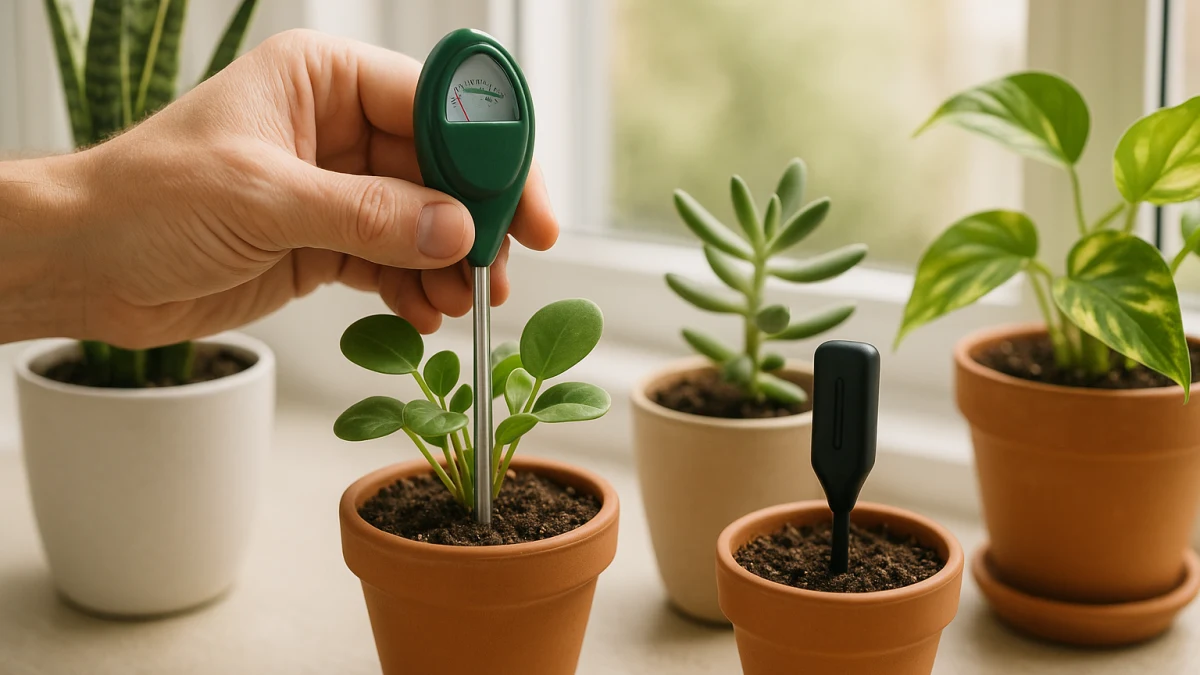
Many soil moisture listings look similar until the probe is too long, too thick, or awkward under a plant canopy. For small indoor pots, the better question is not simply whether a product measures moisture; it is whether the probe can make contact without crowding roots, whether the display clears the rim and leaves, and whether the device is meant to be removed after a reading or left with one plant.
This collection separates compact read-and-remove meters from leave-in monitoring sensors so the products shown here work more like a fit shortlist than a broad garden-sensor search page. Outdoor-oriented long probes, irrigation-style sensors, and app-heavy devices only make sense here when they still match the houseplant pot job.
Fit the probe before comparing features
| If this is your situation | Better fit to compare first |
|---|---|
| You want to check several houseplants quickly and put the tool away. | Compact probe soil moisture meters for indoor pots. |
| You want ongoing feedback for one plant, one pot, or a hard-to-check shelf location. | Leave-in houseplant moisture sensors, but only when continuous monitoring or leave-in use is stated. |
| The pot is very small, root-crowded, or filled with chunky mix. | Verify probe length, probe diameter, and probe contact before choosing either type. |
| The product looks built for garden beds, irrigation, or long outdoor probes. | Treat it as a mismatch unless your planter is unusually large. |
Use the product page to compare five things before brand or feature lists: probe length and diameter, display placement above the soil, insert-read-remove versus leave-in use, connectivity setup, and how your potting media affects probe contact.
The small-pot fit test: length, thickness, and display height
A small pot can reject a soil meter in three different ways. The probe may bottom out before it reaches the root zone you care about, the shaft may be too thick to slide between roots or barky mix, or the dial/display may hit leaves, stems, or the pot rim even though the probe technically fits.
Before checkout, look for manufacturer-listed dimensions rather than relying on words like compact or indoor. A listing that states a 7.6-inch probe gives you something to compare against your pot depth. A compact foldable analyzer with a 3.15-inch external probe length is a different fit conversation. Probe diameter matters too, especially for small nursery pots, root-bound plants, and narrow openings under dense foliage.
Chunky mix can change what a probe reading means
Soil probes need contact with the growing medium to give a useful reading. Succulent mix, cactus mix, coco coir, bark-heavy blends, perlite pockets, and fast-draining media can create wet and dry zones inside the same pot. A probe pushed into a dry pocket may not represent the whole container; a probe placed along a wet drainage path may read wetter than the root area you meant to check.
For small pots, take readings as clues rather than universal truth. Insert the probe gently, avoid forcing it through roots, and compare the reading with pot weight, recent watering, and the plant’s normal pattern. If the listing makes media-specific accuracy claims, check that language on the product page instead of assuming every probe behaves the same in every mix.
Outdoor-length probes are the exception, not the target
Some soil moisture products are built around garden beds, outdoor soil, irrigation decisions, or deeper measurement. Those can leak into a general soil sensor search, but they are not the center of this houseplant collection.
A long-probe outdoor sensor may be reasonable for a large indoor planter, a deep container, or a plant kept in a substantial pot. For small houseplants, it is more often a sign to slow down and check dimensions, display clearance, and whether the listing actually describes potted indoor use.
Compact probe meters for quick houseplant checks
Use these products when you want a simple way to spot-check multiple pots: insert the probe, read the dial or display, remove it, wipe it, and move on. This is the most direct fit for shoppers who do not need alerts, history, hubs, or a dedicated sensor living with one plant.
The details to scan are physical and practical. Look for houseplant or potted-plant language, a dial-style single-probe design, listed probe length, listed probe diameter, and care instructions. No-battery models can be enough when all you need is a moisture reading, but a stated 7.6-inch probe still will not fit every small pot. Compact or foldable analyzers with shorter external probe lengths may be easier to position, but still need enough contact with the medium to be useful.
Read the products shown here as a compact spot-check shortlist, not as permanent plant monitors. They are most useful when you compare probe size, display placement, handheld use, and remove-and-wipe language. If you are trying to watch one hard-to-reach plant over time, the next section is the more relevant comparison.
Remove-and-wipe does not mean leave-in
A meter that tells you to remove and wipe the probe after use is describing a temporary reading pattern. Do not assume that kind of tool is safe or accurate to leave in the soil continuously unless the manufacturer says so.
This distinction matters because the purchase changes. A handheld meter is about quick checks across several pots with minimal setup. A leave-in sensor is about one plant or one location, and it should clearly support continuous placement, automatic readings, alerts, history, or similar monitoring language before you treat it that way.
Leave-in sensors for one pot that needs watching
Choose this path only when ongoing feedback matters more than simplicity: a plant on a high shelf, a pot you tend to forget, or a specific plant where you want app-based reminders or history. When stated, features such as automatic readings every few minutes, app control, app alerts, historical data, Tuya, Zigbee, or WiFi can reduce manual checking, but they also add compatibility and setup questions.
Treat the products shown here as conditional monitoring candidates, not a straight upgrade over compact meters. Check whether the sensor is approved for leave-in use, whether it needs a hub, which app or wireless standard it uses, and what battery or power requirements apply. Be extra cautious with listings that mention indoor/outdoor use or measuring deep within a pot or garden, because that language does not automatically mean the device fits a small houseplant container.
Small-pot checks before checkout
- Measure usable pot depth before comparing probe lengths; do not assume a 7.6-inch probe or any other listed size fits your smallest pots.
- Check probe diameter if the plant is root-crowded, planted in chunky mix, or hard to access without disturbing stems.
- Picture the display above the soil: the dial or screen still needs room around leaves, stakes, pot rims, and nearby plants.
- Match the use pattern. Insert-read-remove tools are for temporary spot checks; leave-in monitoring should be clearly supported by the product listing.
- For smart sensors, verify Tuya, Zigbee, WiFi, app, hub, alert, history, battery, and power requirements before buying.
- Read media claims carefully if you use succulent mix, cactus mix, coco coir, bark-heavy blends, or other fast-draining potting media.
- Treat outdoor, garden-bed, irrigation, or deep-soil language as a warning sign unless your planter size justifies it.
The simplest matching device is usually the safest choice: a compact read-and-remove meter for quick houseplant checks, or a verified leave-in sensor only when one specific pot needs ongoing monitoring.