
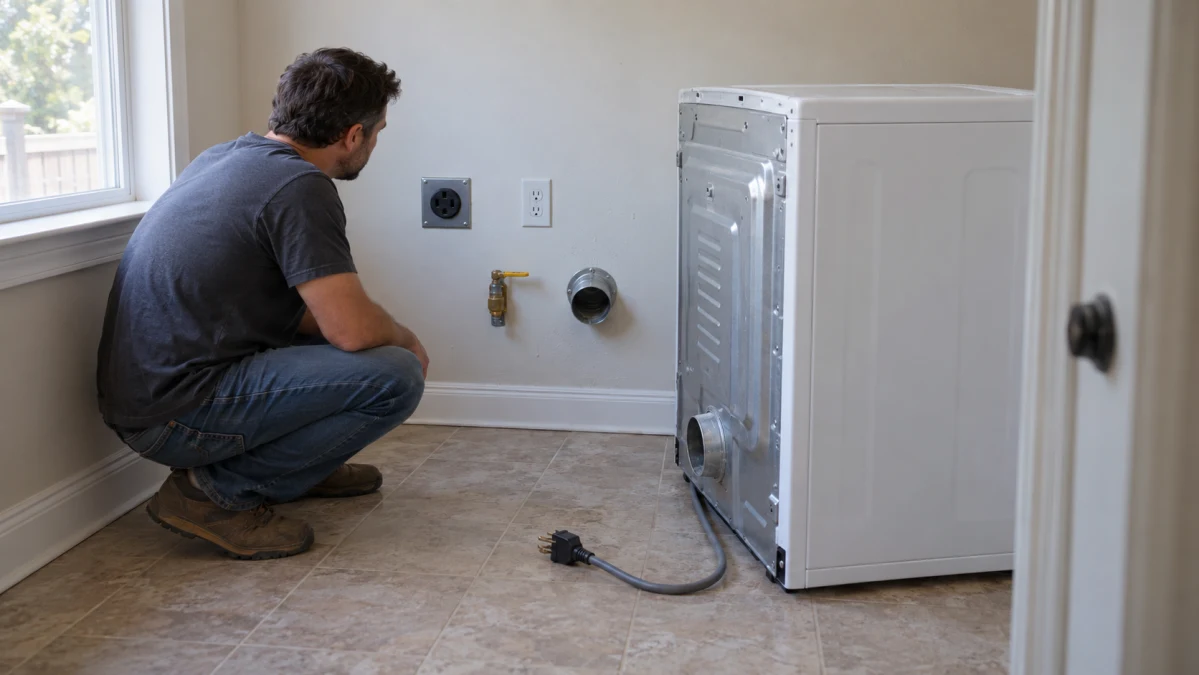
The right Maytag dryer starts with compatible hookups, not a favorite feature. Both gas and conventional electric dryers need electricity. First match the exact model's US installation instructions to your home's verified services; then check whether it can reach the laundry room, fit and vent properly.
If both heating types qualify, compare appliance price, installation work and locally dependent operating costs before choosing features. Neither type is universally preferable, and an attractive feature cannot compensate for an unsuitable installation.
First, match the exact dryer to your home's services
Conventional electric dryers generate heat with electrically powered heating elements. Gas dryers burn fuel for heat but also use electricity to operate, as Maytag explains. A gas line alone therefore does not establish gas-dryer compatibility.
For an initial screen, Maytag's US buying guide describes electric dryers as needing a dedicated 240-volt, 30-amp circuit, versus a gas line plus a standard 120-volt outlet for gas dryers. Those are general purchasing guidelines, not the installation requirements of every dryer or confirmation of your home's services.
Before committing to a model:
- Get its manufacturer model number and applicable US installation instructions. Obtain these for the actual listing, rather than choosing documentation by appearance or a similar product name.
- Identify its required services. Read the electrical supply, circuit, grounding and connection requirements. For gas, also check the specified fuel configuration and supply requirements. Do not assume a conversion is authorized simply because the appliance is labeled gas.
- Compare the instructions with verified home services. Have a qualified electrician resolve uncertain electrical conditions and an appropriately qualified installer resolve gas-service or fuel-configuration questions. Evaluate necessary changes before purchase, not on delivery day.
An electric dryer is a candidate when its documented electrical requirements match verified services; a gas dryer needs a match for both electricity and its specified fuel supply. If existing services match, move on to fit and venting. If changes are needed, get a qualified assessment and quote before keeping that candidate. If the documents or home services cannot be confirmed, neither heating type is confirmed—do not buy on the fuel label alone.
A working drum is not proof that gas heat is available. Maytag's troubleshooting guidance explains that a gas dryer's drum can turn without heating when the gas shutoff valve is closed. The same guidance directs readers to installation instructions for three- or four-wire electrical connections and recommends a qualified electrician when the electrical supply is uncertain.
Connecting an appliance is also different from creating the services it needs. Maytag says its basic installation excludes new connections; its gas-dryer service connects a flex line to an existing shutoff valve, and delivery agents do not perform LP conversions. Check the service terms for your location and arrange any necessary work separately.
Then check installed space, delivery access and venting
Cabinet dimensions are not installed-space requirements. Compare the exact model's dimensions with the space needed for connections, door operation and the clearances specified for your installation. A dryer that fits between the walls may still leave insufficient room behind it or prevent its door from opening properly.
Measure the delivery route separately, including doorways, hallways and stairwells. Maytag's delivery guidance calls for measuring both the route and installation space, allowing room for connections and door opening. Its crews do not remove interior doors or handrails or modify cabinets, so an access obstacle needs resolving before delivery.
Next, compare the planned exhaust route—including length and elbows—with the exact model's applicable Vent System Chart. Maytag explains that longer routes and additional elbows reduce airflow and encourage lint buildup; excessive runs can increase drying time and energy use. Suitable utilities do not make an unsuitable exhaust route workable.
Keep the appliance's requirements separate from the installer's service limits. Maytag's installation service specifies new four-inch rigid venting within eight feet of the appliance and does not connect to plastic or foil venting. That service condition is not a universal maximum dryer exhaust length.
If access, required clearances or venting fails the check, choose a different model or have the necessary installation change professionally evaluated before buying. Do not rely on cabinet width alone to settle fit.
Compare three costs—not just the appliance price
Keep three amounts separate:
- Appliance price: Get a current quote for each exact model and configuration. Maytag says electric dryers generally cost less to purchase than comparable gas models, but that tendency does not establish which particular listing costs less today.
- Installation-related costs: Include connection service and any necessary electrical, gas, venting or space modifications. Retaining confirmed compatible services may avoid new connection work; switching heating types should not be treated as an appliance-only purchase.
- Ongoing energy costs: Estimate these using local utility rates, documented energy use for the actual configuration and your household's expected usage. Include both gas and electricity for a gas dryer, not just its heating fuel.
Compare quoted upfront totals with estimated operating costs over the period you expect to own the dryer. If the reason for changing services is to save money, the estimated operating savings must cover the additional upfront expense within that period. Keep that calculation separate from a willingness to pay more for a useful feature.
Local rates, load frequency and installation quotes can change the recommendation. Maytag specifically cautions that professionally installing a gas line can outweigh potential operating savings.
If one type already matches your services, compare keeping that arrangement with a fully quoted change. If both match, compare current appliance and connection quotes, then estimate operation using the same household usage assumptions. A lower sticker price or an assumed fuel-cost advantage alone cannot establish the cheaper choice overall.
Electric dryers: compare features after confirming installation
Conventional electric dryers become candidates after the service and physical-installation checks; the shortlist below does not establish compatibility. Once costs are acceptable, choose features around a recurring laundry need rather than around heating type.
Capacity helps with load planning, but nominal drum volume does not guarantee that every bulky item will fit appropriately. Pet-hair handling may matter most in a pet-owning household, while steam refresh may be more useful for clothes that frequently need wrinkle attention. For large or bulky loads, consider the documented sensing functions rather than assuming electric heat means better drying.
The supplier lists the Front-Load Electric Dryer, 7.4 Cu. Ft., Midnight Steel as Smart Pet Pro, with a nominal 7.4-cu.-ft. capacity. It describes the Pet Pro Option as lifting and capturing hair in the lint trap on select cycles. That makes it worth considering for pet-heavy laundry, without promising complete hair removal or availability on every cycle.
For wrinkle refresh, the supplier also lists steam functions intended to help prevent wrinkles and refresh clothes. Check the exact model's water-connection instructions before ordering: confirming its electrical supply does not settle the separate requirements for steam. Likewise, any water-dependent pet-hair function needs its own connection check; the Pet Pro name alone does not specify how a particular model works.
The supplier describes remote start/stop and end-of-cycle smartphone alerts for this example, requiring Wi-Fi, an app and remote enable on the appliance. Those setup requirements matter if phone control is a reason for choosing it.
The white Front-Load Electric Dryer has a supplier-listed 7.3-cu.-ft. capacity and Advanced Moisture Sensing Plus. According to the supplier, its fourth moisture sensor and monitoring of inside moisture and air temperatures are intended to help dry large and bulky loads evenly and completely. This is a load-handling feature to weigh, not evidence that electric dryers outperform gas dryers.
Its supplier description also mentions remote monitoring and control away from home, but does not specify the same functions or setup requirements as the Smart Pet Pro example. If remote start matters, confirm that function and its prerequisites for the exact manufacturer model before ordering.
Gas dryers: shortlist features only after service checks
Gas dryers burn fuel for heat and still need electricity. Apply the same installation gate before considering features: neither an available gas connection nor a turning drum confirms suitability.
Then match functions to your routine. A small-load cycle may help with occasional quick turnarounds; continued post-cycle tumbling may be more useful when you cannot unload promptly. For thick fabrics or bulky loads, compare the supplier's drying and sensing descriptions without treating them as proof that gas heating is faster or more effective than electric heating.
The supplier identifies the Midnight Steel Dryer as gas and describes its Quick Dry cycle as drying a small load fast. That is a cycle-specific convenience, not a gas-versus-electric speed claim. Its Wrinkle Prevent option continues tumbling for up to 150 minutes after the cycle ends, making it relevant when unloading is often delayed.
For thick fabrics, the supplier says Extra Power boosts drying power to help get them drier the first time, with results varying by load size and type. It also describes Advanced Moisture Sensing as monitoring inside moisture and air temperatures to help dry loads evenly.
This example's supplier-described app controls include remote start/stop and end-of-cycle notifications. Wi-Fi, the Maytag app and remote enable are required, so those prerequisites belong in the decision if remote operation is important to you.
The white, front-loading 7.3 cu. ft. Gas Dryer is another option for households considering large or bulky loads. The supplier lists a nominal 7.3-cu.-ft. capacity and Advanced Moisture Sensing Plus, describing a fourth moisture sensor and monitoring of inside moisture and air temperatures intended to help those loads dry evenly and completely. Its Extra Power description targets thick fabrics, pockets, hems and seams in mixed loads. These descriptions help identify relevant functions; neither capacity nor sensing establishes installation fit or superior measured performance.
The supplier describes remote monitoring and control away from home for this example. Confirm its precise functions and prerequisites rather than assuming it has the other gas dryer's app capabilities.
Before ordering either gas example, confirm its manufacturer model number, fuel configuration and applicable installation instructions. Similar capacities, appearance or feature names do not establish equivalent gas and electric models, so do not transfer specifications between listings.
Choose the heating type that clears verified service, access, fit and venting checks. If both qualify, let total costs and useful, documented features decide; if only one qualifies, weigh it against a fully evaluated installation change. If neither is confirmed, resolve the installation questions before buying—not after choosing a favorite feature.