
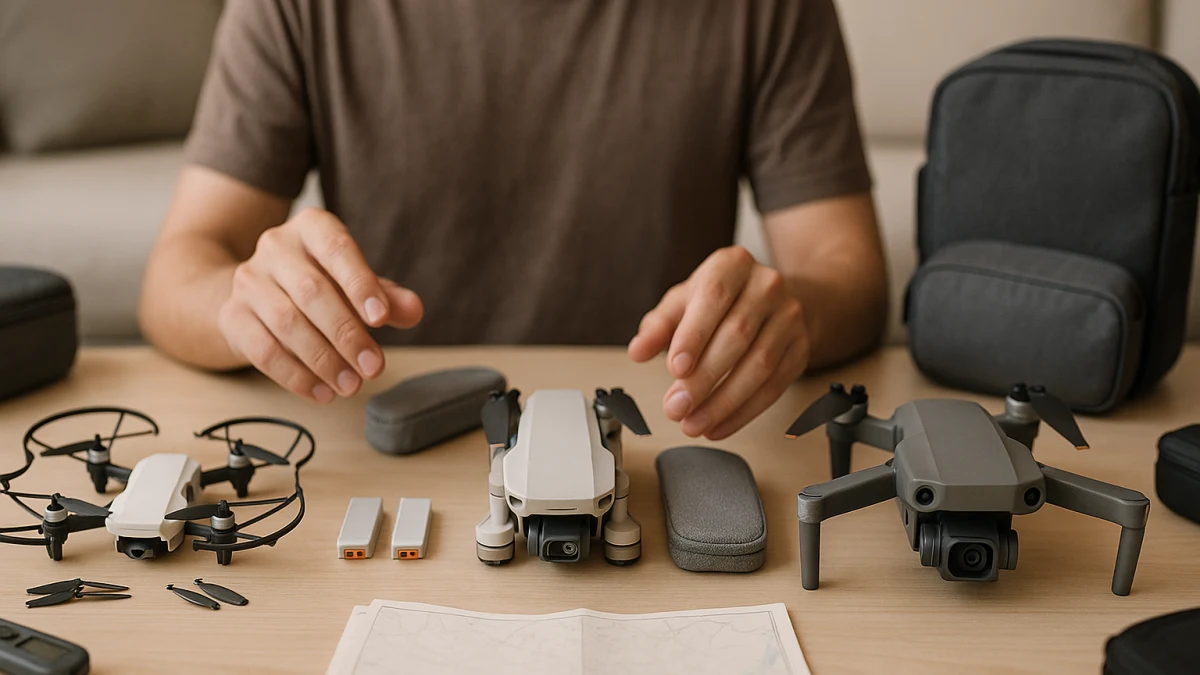
A first drone for home and travel photos is not just a search for the lowest price, the biggest 4K claim, or the longest advertised range. The main mistake is buying the wrong class: a mini practice drone with a basic camera, a lightweight foldable camera drone, and a gimbal-equipped camera drone can all look similar in a listing grid while solving very different problems.
Use this page to sort the listings by first-buyer risk before comparing specs. If you mainly need control practice, toy-style features matter. If you want backyard or travel snapshots, portability, takeoff weight, GPS features, batteries, and rule checks matter. If you care about smoother video and more confident outdoor flying, stabilization, sensing, controller details, storage support, and manufacturer-backed specs become more important than resolution alone.
Pick the drone class before trusting 4K, range, or price
| If your need is... | Better fit |
|---|---|
| Low-cost indoor practice, a kids gift, or learning orientation and throttle control | Indoor practice or toy-style drone |
| A portable first drone for casual home, backyard, or travel snapshots | Lightweight casual camera drone |
| Smoother video, stabilization, obstacle-sensing assistance, GPS features, or longer shoots | Higher-feature camera drone |
| FPV racing, inspection, delivery, agricultural, security, or privacy-invasive use cases | Use a different guide; those paths are outside this first-photo scope |
Before you trust a headline spec, compare the class clues. Practice value is not the same as photo value. Foldable design and actual takeoff weight matter for travel, but they do not settle regulatory questions. A 4K claim does not tell you whether the drone has a true gimbal, EIS, both, or neither. Altitude hold, one-key start, GPS, and return-to-home are different kinds of beginner support. Obstacle sensing is assistance, not a promise that crashes cannot happen. Battery count, spare batteries, and lithium-battery travel checks can shape real use as much as a single advertised maximum flight time.
Choose the class before comparing 4K, range, or flight time
Start by asking what would make the purchase a failure. If a child or first-time pilot needs a low-cost way to learn orientation, throttle, and landing, a mini drone with altitude hold, headless mode, propeller protection, spare propellers, or extra batteries may be the right mistake-proof choice. If the failure would be coming home from a trip with unusable or frustrating footage, skip toy-first thinking and compare lightweight camera drones instead.
For many first photo buyers, the middle lane is the real starting point: foldable, portable camera drones with beginner positioning, GPS or return-to-home where listed, included batteries, and carrying accessories. Step beyond that only when smoother footage, gimbal or EIS stabilization, obstacle-sensing assistance, longer shoots, or stronger camera details are worth the added cost and complexity.
Seller FAA and battery-travel claims are not the rulebook
Treat listing phrases about under-249g weight, no FAA, Remote ID, airline travel, carry-on use, or lithium batteries as prompts to verify, not as the final answer. The product page can help you identify the claimed takeoff weight, battery type, included batteries, and manufacturer specs, but current requirements can depend on where and how you fly.
Before buying for travel, check official regulator guidance for registration, Remote ID, airspace, and local flight restrictions, and check current airline or travel rules for lithium batteries. The safer shopping habit is simple: use seller language to know what to investigate, not to skip the investigation.
FPV racing and inspection drones stay outside this first-photo guide
This guide is for first-drone paths around practice, casual home and travel photos, and higher-feature camera flying. It is not trying to choose FPV racing drones, professional inspection tools, delivery drones, agricultural drones, security use, or privacy-invasive equipment.
That boundary matters because those adjacent categories can share words like camera, range, GPS, or obstacle sensing while requiring a different skill set, risk profile, and buying process. If that is your use case, do not force one of the lanes below to fit.
Start with a toy-style drone only if practice matters more than photos
Choose this lane if the real goal is indoor-style play, a beginner gift, or learning basic controls before spending more. The products shown here are useful for comparing mini, kids, and beginner drones with features such as altitude hold, headless mode, one-key start or landing, propeller protection, 3D flips, LED lights, spare propellers, and extra batteries.
Read the cameras in this lane cautiously. A basic 1080p or lower-resolution camera can be a learning bonus for framing, orientation, or simple snapshots, but it should not be treated as a travel-photo promise. If outdoor photos, smoother video, GPS support, or a more portable camera setup matter, move to the lightweight camera-drone lane instead.
A camera on a toy drone does not make it a travel camera
The wrong-choice pattern here is buying a fun practice drone because it says camera, then expecting it to behave like a travel camera drone. Toy-style listings often emphasize flips, LED lights, propeller guards, headless mode, altitude hold, and simple remote-control features. Those are useful for learning and play, not proof of stabilized footage, reliable outdoor wind handling, long range, or predictable travel performance.
Use this lane when crashes, short practice sessions, and basic control learning are part of the plan. Do not use it as a shortcut around checking flight rules, safe flying locations, battery limits, or the limitations of the individual model.
Choose a lightweight camera drone when travel snapshots are the goal
This is the likely fit for many first-time shoppers who want casual home, backyard, or travel photos without jumping straight into a higher-feature camera drone. Look for foldable design, portable carrying accessories, actual takeoff weight, lightweight or under-249g language, camera resolution, included batteries, and beginner-friendly outdoor features.
GPS and return-to-home can be useful beginner-support features when the specific model lists them, but they are not the same thing as advanced obstacle avoidance. Likewise, 4K language helps you compare listings, but it does not by itself tell you stabilization quality, sensor quality, wind handling, or typical real-world range.
Use the products shown here to compare the middle path: more photo-focused than a toy drone, usually simpler than a gimbal-heavy or sensing-heavy upgrade. Check each product page for the claimed takeoff weight, battery bundle, controller or app setup, carrying case, GPS or return-to-home details, and manufacturer-backed camera specifications. If the listing leans heavily on no FAA or Remote ID wording, verify that separately through current official sources before you rely on it.
Only step up if stabilization, sensing, or longer shoots matter
Move up only when you can name the reason. Good reasons include wanting smoother video, caring about the difference between a true 3-axis gimbal and EIS stabilization, wanting obstacle-sensing assistance, needing more serious GPS features, or planning longer shooting sessions where included batteries and manufacturer-backed flight-time claims matter.
If your main goal is casual snapshots from a compact travel drone, the lightweight lane may be enough. If your main goal is learning controls cheaply, the toy-style lane is still the lower-risk first purchase. A higher-feature drone adds capability, but it also raises the cost of choosing poorly.
Step up only for gimbals, sensing, and more serious camera flying
Choose this lane when you have already ruled out simple practice drones and basic lightweight camera drones. The products shown here are useful for comparing camera-drone listings that mention 3-axis gimbals, EIS stabilization, obstacle sensing or omnidirectional sensing, GPS, long-range transmission, extended flight-time positioning, premium camera language, or more complete controller and battery bundles.
Do not treat all 4K claims as equal. A drone that lists a true gimbal is setting a different expectation from one that lists only electronic stabilization, and both are different from a listing that simply says 4K. For travel and landscape footage, also compare camera sensor information where provided, supported storage, included batteries, controller type, and manufacturer-backed claims.
Read this lane as an upgrade path, not the default first-drone answer. Obstacle sensing can be helpful assistance, but it should not be treated as crash prevention in every situation. Advertised maximum range and flight time should be checked against the specific manufacturer information and your own flying conditions. If the intended use is FPV racing, inspection, delivery, security, or agricultural work, this first-photo lane is still the wrong guide.
Final first-drone checks: weight, rules, batteries, and spares
Before you buy, run the short checklist that a normal category grid usually hides:
- Confirm the actual takeoff weight listed for the model, not just broad lightweight language.
- Verify registration, Remote ID, airspace, and local flight-rule questions through current official sources for where and how you plan to fly.
- Check lithium-battery travel rules before packing a drone for a trip, especially if extra batteries are included.
- Use manufacturer information, not only seller headlines, for flight time, transmission range, camera specs, wind-resistance claims, gimbal details, and obstacle-sensing features.
- Look at the battery bundle: one included battery may feel very different from a kit with extras, but advertised maximum flight time still needs context.
- For practice drones, check whether propeller protection, spare propellers, and extra batteries are included.
- For camera drones, check the controller or app setup, supported storage, carrying accessories, GPS or return-to-home details, and any stated stabilization method.
- Plan the first flight for safe conditions and a legal location rather than assuming beginner features make the drone safe to fly anywhere.
The best first drone is the simplest class that honestly fits the photo goal: toy-style for control practice, lightweight camera drone for casual home and travel snapshots, or a higher-feature camera drone only when stabilization, sensing, and longer shooting matter enough to justify the step up.