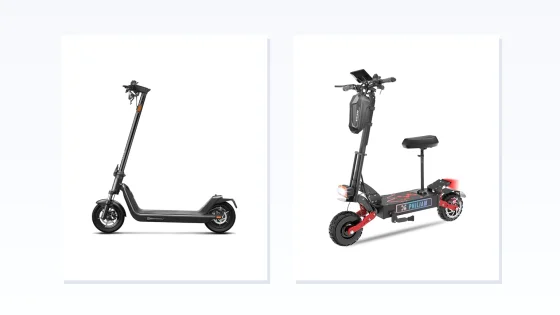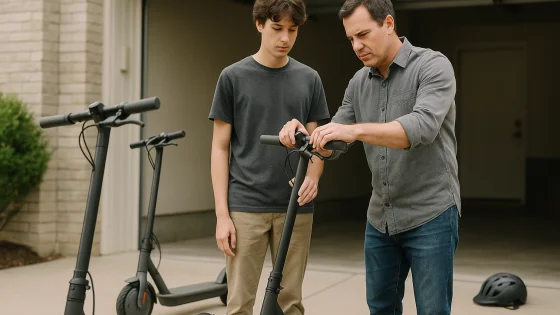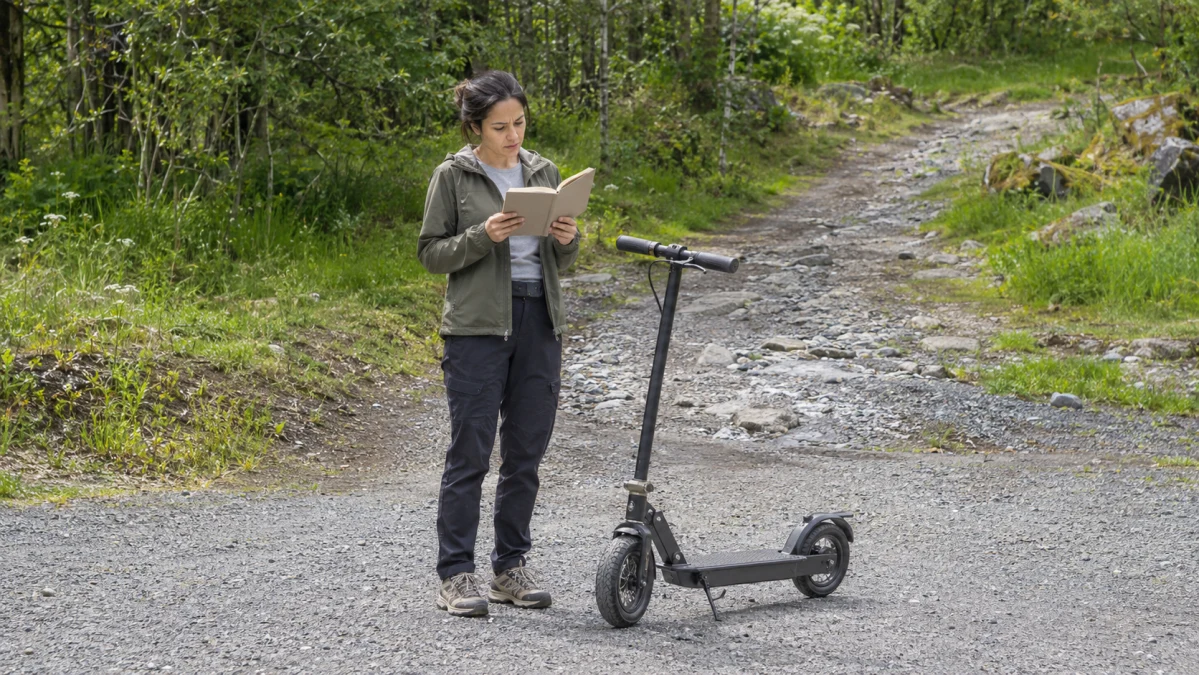
A scooter that can really leave the pavement has suspension at both ends that doesn't bottom out, pneumatic tires of at least 10 inches with a knobby tread, enough ground clearance to pass over roots and rocks, and brakes that stop it quickly on loose ground. Chunky tires and "all-terrain" styling alone don't make one. RiderGuide's Matt Kaye, who has tested electric rides since 2018, puts it bluntly: most scooters sold as off-road aren't built for serious off-road riding, and true capability comes down to suspension, tires, braking, torque and stability.
If your off-road riding means a gravel path or a dirt shortcut on the way to work, a commuter with front suspension and tubeless tires, like the NIU KQi 300X or Segway ZT3 Pro, is enough. For forest trails, rocky tracks and steep dirt climbs, reviewers point to dual-motor scooters with long-travel suspension, such as the GoTrax GX3, Varla Eagle One V2 or Kaabo Mantis King GT. Before you buy either kind, find out where you're allowed to ride it: on most public trails the answer depends on speed, and an electric scooter doesn't count as an e-bike.
Quick picks
| You ride | Choose | Why |
|---|---|---|
| Rough streets, gravel paths, light dirt | Segway ZT3 Pro | RiderGuide's budget off-road pick (tied); 11-inch tubeless tires, dual suspension, traction control |
| A hilly commute with unpaved stretches | NIU KQi 300X | WIRED's all-terrain pick; climbed a 15% grade at 10 mph in TechGearLab's test |
| Dirt and trails, one scooter for everything | GoTrax GX3 | RiderGuide's best overall off-road value: dual motors, hydraulic brakes, strong suspension |
| Forest trails and rocky tracks | Varla Eagle One V2 | 5.1 inches of clearance and a 2.0 m stop from 15 mph in Electric Scooter Insider's tests |
| The roughest terrain, adjustable ride | Kaabo Mantis King GT | Electric Scooter Insider's best all-terrain scooter; suspension adjusts with a dial |
| A lighter, simpler off-roader | VMAX VX4 GT or Navee NT5 Max | Single-motor scooters RiderGuide found smooth and predictable on gravel and light dirt |
What makes a scooter good off-road
Electric Scooter Insider's Josh shortlisted 25 scooters and rode them through parks, fields, dirt paths, forest trails and rocky tracks. His selection rules and RiderGuide's checklist line up closely.
Suspension that stays planted. Good suspension keeps the tires on the ground instead of bouncing over the terrain, RiderGuide explains. The type matters: Teverun, a scooter maker, notes that plain springs absorb bumps but don't control the rebound, so the scooter feels bouncy at speed, while hydraulic shocks damp both compression and rebound. Bottoming out, the clank when the suspension runs out of travel, is the sign it's too soft or too short for you. Electric Scooter Insider rated each scooter's shock absorption from 1 to 10 and checked whether the springs could be preloaded for heavier riders.
Pneumatic tires of 10 inches or more. The top performers in Electric Scooter Insider's tests had air-filled tires at least 10 inches tall with a knobby tread, which held the most traction on loose and gritty ground. RiderGuide asks for 10 to 11 inches at minimum. Solid tires don't absorb bumps well, WIRED's Julian Chokkattu warns: he found the solid tires on the Evolv Terra bumpy on rougher roads. Tubeless tires are tougher and less likely to go flat than tubed ones.
Ground clearance. The battery and controller sit under the deck, so a scooter that scrapes on a rock can damage its most sensitive parts. Electric Scooter Insider measured clearance for every model: the more it had, the rougher the terrain the tester recommended it for.
Brakes. Electric Scooter Insider kept only scooters that stopped from 15 mph within 3.5 meters, and counts anything under 2.5 meters as excellent. RiderGuide adds that hydraulic brakes become more important as speeds climb.
Torque before top speed. Strong acceleration and climbing matter more off-road than a big top speed, RiderGuide says. Electric Scooter Guide's hill test, a 200-foot climb at a 10% grade, separates scooters well: the Kaabo Mantis King GT did it in 7.5 seconds, while most scooters under $500 need about 20.
Wide handlebars. Electric Scooter Insider found a direct link between handlebar width and control, and shortlisted only scooters with bars 25 inches wide or more.
Weight you can live with. Off-road scooters are heavy: about 65 pounds for the Ausom Gosoul 2 Pro and ZT3 Pro, about 88 for the GoTrax GX3 and 117 for the Segway GT3 Pro, according to RiderGuide. Dirt Bike Magazine points out you'll usually need a car to get one to the trail. Check the load rating too: Dirt Bike Magazine suggests a scooter rated for about 10 kg more than your weight.
Off-road scooters reviewers rate best
The GoTrax GX3 is RiderGuide's best overall off-road scooter: dual 1000W motors, 11-inch pneumatic tires, hydraulic disc brakes and strong suspension, with the range and comfort to work as a daily scooter too. For less money, RiderGuide ties the Ausom Gosoul 2 Pro, with dual 1400W motors and 10-inch off-road tires, for riders who want raw capability, and the ZT3 Pro for riders who want smart features.
The Varla Eagle One V2 handled grassy hills, loose dirt, forest trails and rocky paths in Electric Scooter Insider's testing. Its 10-inch tubeless tires have an all-terrain tread, its swingarm suspension scored 8 out of 10 for shock absorption with no bottoming out, and it has 5.1 inches of ground clearance. The hydraulic brakes stopped it from 15 mph in 2.0 meters. Riding hard over tricky terrain and climbing 1,063 feet, the tester got 24.37 miles from a charge.
The Kaabo Mantis King GT won Electric Scooter Insider's best all-terrain award. A dial adjusts the hydraulic shocks front and rear, from soft for rough trails to stiff for fast riding. The 10-by-3-inch hybrid off-road tires sit on split rims, which makes changing them faster, and the 26-inch handlebars and steering damper keep it stable. It's also the strongest climber here, at 7.5 seconds in Electric Scooter Guide's hill test, and it weighs 74 pounds.
The SPLACH Titan packs dual 1000W motors and front and rear springs that never bottomed out in Electric Scooter Insider's tests, and stopped from 15 mph in 2.4 meters. Its knobby 9-inch tires are unusual for an off-roader, and a 10-inch version with a more textured tread costs extra. The deck is short, at 19.5 inches.
Two single-motor scooters made RiderGuide's off-road list. The VMAX VX4 GT has smooth, predictable power and enough torque that the reviewer rarely missed a second motor, on 10-inch tubeless off-road tires. The Navee NT5 Max is more about comfort, and handled rough pavement, gravel and light dirt while staying easy to live with.
The Segway GT3 Pro is RiderGuide's premium pick for long, mixed-terrain rides, with dual hydraulic suspension and up to 50 mph. Its stock tires lean toward the street, so RiderGuide suggests knobbier ones before loose, technical terrain.
Commuter scooters that can leave the pavement
Most riders asking about off-road scooters want a commuter that won't rattle apart on a gravel path or a broken road. These handle that well.
The Segway ZT3 Pro is the one WIRED's reviewer took on the worst roads in Brooklyn, about 16 miles across two bridges on one charge. It has 11-inch tubeless tires, front and rear suspension, disc brakes and traction control, plus Apple Find My support. In Electric Scooter Guide's hill test it reached the top in 9.6 seconds, but only in boost mode, which lasts about 30 seconds or until you brake; without it, the climb took 11.3 seconds.
The NIU KQi 300X is WIRED's all-terrain pick, with thick 10.5-inch tubeless tires and suspension. TechGearLab's testers rode it on an unpaved trail and up a 580-foot hill at a 15% grade, where it held 10 mph while many other scooters slowed to a crawl or quit. ERideHero measured a stop from 15 mph in 10.7 feet. The catch is the missing rear suspension: TechGearLab found it adds to fatigue on consistently bumpy ground, so it suits gravel paths better than rough trails.
The Segway GT3 is the heavier, faster option, at 87 pounds and 31 mph. Freshly Charged praised its rigid frame and 7.5 inches of deck clearance, but its suspension has limited travel and can bottom out under heavier riders. They call it ideal for commuting rather than serious off-road riding.
Dual-motor scooters with off-road tires also come from brands with fewer reviews. Read their listings against the checklist above. The Gotrax Ares lists dual 500W motors, 10-by-2.5-inch off-road tubeless tires, front and rear suspension and a climbing grade of up to 20% in dual-motor mode. The iScooter iX7 Pro pairs dual 1000W motors with 10-inch pneumatic off-road tires and swingarm suspension in front. The CUNFON RZ1000 has dual 1600W motors, 10.5-inch tubeless off-road tires and air-hydraulic suspension.
Where you can ride an off-road scooter
An electric scooter isn't an e-bike in federal rules. The National Park Service defines an e-bike as a two- or three-wheeled cycle with fully operable pedals and a motor of 750 watts or less, and its e-bike regulation doesn't apply to electric scooters. The Bureau of Land Management uses the same pedal requirement. So the e-bike access you read about for national parks and BLM trails doesn't carry over to a scooter.
Parks set their own rules, and some ban scooters outright. Hagerman Fossil Beds National Monument in Idaho, for example, prohibits electric scooters on all park roads, sidewalks and trails. Wilderness areas are closed even to regular bicycles under federal law.
On national forests, the Motor Vehicle Use Map is the legal record of which roads, trails and areas are open to motor vehicles. Each forest publishes its own, and you can carry it offline on your phone in a PDF map app.
On local multiuse trails, speed decides. Rails to Trails Conservancy, which advises trail managers, considers small scooters limited to 10 to 15 mph compatible with trail use, while devices that go beyond 20 to 25 mph warrant a ban. The fastest scooters, capable of 30 to 50 mph or more, are incompatible with people walking and cycling. Many off-road scooters reach those speeds, so on a shared path, ride in the lowest speed mode. RiderGuide notes that private land is generally the safest place to use a fast scooter's full capability.
How to ride a scooter on gravel and dirt
- Slow down before the loose section. Joyor, a scooter maker, recommends finishing your speed changes on pavement, before you reach the loosest gravel, and avoiding deep piles of stones, which make steering unpredictable.
- Keep the recommended tire pressure. Don't over- or underinflate for gravel; use the pressure for your model, Joyor advises.
- Stay loose. Bend your elbows, relax your shoulders and look ahead rather than at the front wheel, so small slides don't turn into big corrections.
- Brake gradually and leave more room. Stopping distances grow on loose ground, and more so in the wet. An IP rating covers rain and splashes, not every wet trail.
- Check the scooter after the ride. Clear stones and debris from around the wheels, and look into any new noise or vibration before you ride again.
- Dress for a fall. WIRED's reviewer recommends a full-face helmet above 15 mph.
Which to choose
Choose a commuter with suspension and tubeless tires, like the Segway ZT3 Pro or NIU KQi 300X, if your off-road riding means gravel paths, packed dirt and broken pavement on the way somewhere. They're lighter and easier to carry.
Choose a dual-motor off-road scooter, like the GoTrax GX3 or Ausom Gosoul 2 Pro, if you'll ride dirt trails and steep climbs regularly and can transport a 65- to 90-pound scooter.
Choose a long-travel, adjustable scooter, like the Varla Eagle One V2 or Kaabo Mantis King GT, for forest trails and rocky tracks, where clearance and suspension decide whether you finish the ride.
Whichever you buy, look up the rules for the trails you plan to ride before you pay for the speed.
FAQ
Can electric scooters go off-road?
Some can. A scooter for real off-road riding needs suspension at both ends, pneumatic tires of 10 inches or more with a knobby tread, good ground clearance and strong brakes. Many scooters sold as off-road have chunky tires and styling but not the suspension or clearance for rough trails.
Do electric scooters work on gravel and dirt roads?
Yes, if they have air-filled tires and suspension. Commuters like the Segway ZT3 Pro and NIU KQi 300X handle gravel paths and packed dirt. Slow down before loose sections, brake gradually and avoid deep gravel.
Are electric scooters allowed on trails?
It depends on who manages the trail. Federal e-bike rules don't cover scooters, some parks ban them on all roads and trails, and many local multiuse trails accept only scooters that stay at bicycle speeds. National forests list open motorized routes on their Motor Vehicle Use Maps.
Is a single-motor scooter good enough for off-road riding?
For gravel and light dirt, yes. RiderGuide found the VMAX VX4 GT and Navee NT5 Max capable off pavement thanks to smooth power and good tires. For steep dirt climbs and rough trails, dual motors give you more torque and traction.
What suspension is best for an off-road scooter?
Hydraulic or adjustable suspension with long travel. Springs alone absorb bumps but can feel bouncy at speed, while hydraulic shocks control both compression and rebound. Adjustable preload lets you set the suspension for your weight so it doesn't bottom out.