
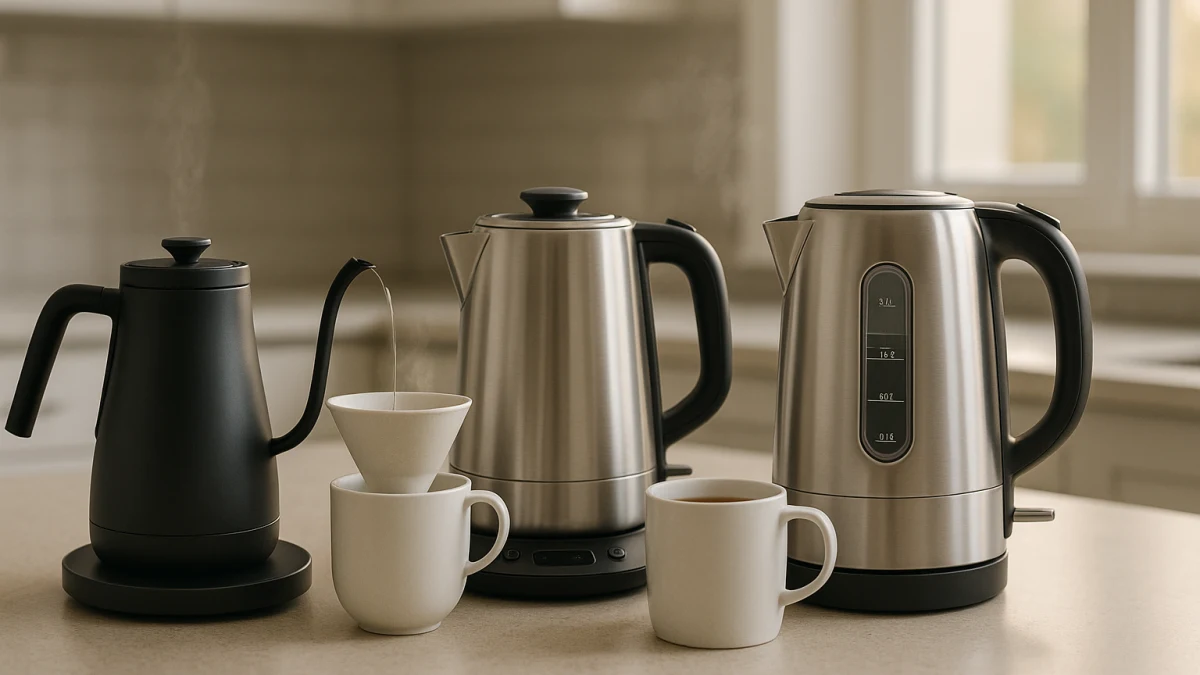
Electric kettles look interchangeable until you sort them by the job the water has to do. A normal listing can mix gooseneck pour-over kettles, preset tea kettles, simple rapid-boil models, and even nearby coffee results without explaining which design actually fits your routine.
This guide is intentionally asymmetric: gooseneck kettles are treated as a strong but narrower pour-control choice, standard variable-temperature kettles as the broad household middle path, and rapid-boil kettles as the simpler hot-water lane. As you compare, pay attention to pour control, adjustable temperature or presets, capacity and filling access, speed-related wording without assuming a measured speed winner, display complexity, cleaning access, and whether you actually need a coffee maker instead of a kettle.
Start with the water job: pour, preset, or full boil
| If you need... | Better fit |
|---|---|
| A controlled pour plus adjustable or preset heat for pour-over coffee or delicate teas | Variable-temperature gooseneck electric kettles |
| Tea-friendly temperature settings, keep-warm options, and more everyday capacity than a gooseneck design may offer | Variable-temperature standard electric kettles |
| Hot water quickly for instant drinks, oatmeal, or general kitchen use | Simple rapid-boil electric kettles |
| The appliance to brew coffee automatically rather than only heat water | Use a coffee maker comparison instead |
The key is not whether a kettle has the longest feature list. It is whether you will use the feature that changes the shape of the product: a gooseneck spout for controlled pouring, selectable heat for tea routines, or a straightforward full boil for general hot water.
Temperature dial, gooseneck spout, or just a full boil?
Use these cues before you start comparing individual products:
- Choose a gooseneck model when the pour itself matters. The spout shape is the point, not just a cosmetic upgrade.
- Choose a standard variable-temperature kettle when you want temperature-control, temperature-setting, programmable, preset, keep-warm, or display features without committing to a pour-over shape.
- Choose a rapid-boil kettle when you mostly press a button and wait for full-boil water. Rapid-boil, fast-boil, one-touch, high-wattage, and 1500W wording can help identify this lane, but it should not be read as proof that one model is the fastest.
- Across all three lanes, check capacity, filling access, handle feel, water-level visibility where shown, base design, and cleaning access. Those everyday details often matter more than an extra button.
Hot water only: where coffee makers and stovetop kettles split off
This page is about electric kettles for heating water. If you want the appliance to brew coffee automatically, a coffee maker is the right off-ramp. If you already use a manual dripper, French press, tea bag, loose-leaf infuser, instant drink, or oatmeal cup, an electric kettle may still be the hot-water tool.
Stovetop kettles, manual pour-over drippers, instant hot water dispensers, Turkish coffee pots, recipes, and coffee-machine comparisons are outside the main lanes here. They can be legitimate choices, but they solve a different problem than choosing between pour control, selectable heat, and simple full-boil convenience.
For pour-over control: variable-temperature gooseneck kettles
A gooseneck electric kettle makes sense when controlled pouring is part of how you make coffee or tea. The narrower spout can help you aim and pace the pour, which is why this lane is strongest for pour-over coffee routines and delicate teas where you also want adjustable or preset heat.
In the products shown here, compare the gooseneck spout with the actual control set: variable-temperature language, temperature control, presets, keep-warm, hold-temperature, or a temperature range. Then look past the control panel. Capacity, handle shape, display style, filling access, and cleaning access decide whether a precision-pour kettle will still feel convenient on an ordinary morning.
Read this group as a precision-pour lane, not as a universal upgrade. If the spout matters and you will use the temperature settings, this is the focused place to compare. If you want selectable heat but do not care about pour-over handling, the standard variable-temperature lane below is likely more practical. If you always boil to full boil, skip down to the rapid-boil options.
The gooseneck trade: precise pour, tighter everyday use
The benefit of a gooseneck is also the tradeoff: it is built around control. That can be worth it when you pour slowly and deliberately, but less convenient when you are filling several mugs, making a larger batch of hot water, or prioritizing fast access over pour shape.
Before choosing one, check the product page for capacity, lid opening, how easy it looks to fill at the sink, and whether the spout and interior are straightforward to clean. Also notice whether the controls are simple enough for daily use. A kettle with a precise spout and lots of temperature options can still be the wrong pick if everyone in the house only wants quick full-boil water.
For tea and everyday capacity: standard variable-temperature kettles
This is the middle path for shoppers who want temperature choices without a gooseneck form factor. Standard-body electric kettles may show temperature-control, temperature-setting, temperature-range, programmable, preset, keep-warm, or display features while keeping the shape closer to an everyday household kettle.
Use this lane when tea routines, shared household use, and capacity matter more than pour-over precision. Scan for adjustable versus preset controls, whether a keep-warm option is offered, how the display is arranged, and whether there are infuser or filter parts that add convenience or cleaning work. Capacity and filling access deserve more attention here than spout shape.
The products shown here are the practical upgrade over simple boiling when you will actually use selectable heat levels. If a product reads more like a pour-over gooseneck, compare it against the first lane. If you only see yourself pressing one button for boiling water, the next lane avoids paying attention to controls you may never use.
When presets turn into unused buttons
The easiest overbuy is choosing temperature-control, programmable, or keep-warm features because they sound useful, then treating the kettle like a basic boiler every day. That is not a failure of the kettle; it is a mismatch between the controls and the routine.
Watch for these wrong-choice patterns:
- You always want water at a full boil, but you are comparing detailed temperature ranges.
- You like the idea of keep-warm, but usually pour the water immediately.
- You want more hot water at once, but are distracted by a precision spout.
- You need automatic brewed coffee, but are comparing kettles that only heat water.
If those sound familiar, simplify the decision before comparing more product cards.
For quick hot water: simple rapid-boil kettles
This lane is for straightforward hot water: instant drinks, oatmeal, general kitchen use, and households that do not need pour-over control or selectable heat. Treat rapid-boil, fast-boil, fast-boiling, one-touch, high-wattage, and 1500W wording as helpful product-card language, not as a verified ranking of which kettle boils fastest.
Compare wattage wording, capacity, carafe shape, water-level visibility where shown, base design, and cleaning access. This is not a lesser version of the temperature-control lanes; it is the better fit when speed and capacity matter more than presets, programmable settings, keep-warm functions, or a gooseneck pour.
Claims to verify on the exact kettle listing
Some claims should not be assumed from the lane a kettle appears in. Check the exact product page or manufacturer documentation before relying on statements about:
- Temperature accuracy or one-degree precision
- Fastest-boil or measured boil-time comparisons
- Best hold-temperature or heat-retention performance
- BPA-free, plastic-free, glass safety, or stainless-steel water-contact claims
- Cool-touch construction
- Auto shutoff or boil-dry protection
- UL, ETL, or other certification language
Final choice should follow your real routine: choose gooseneck for controlled pouring, standard variable-temperature for tea-friendly household use, or rapid boil for uncomplicated hot water.