
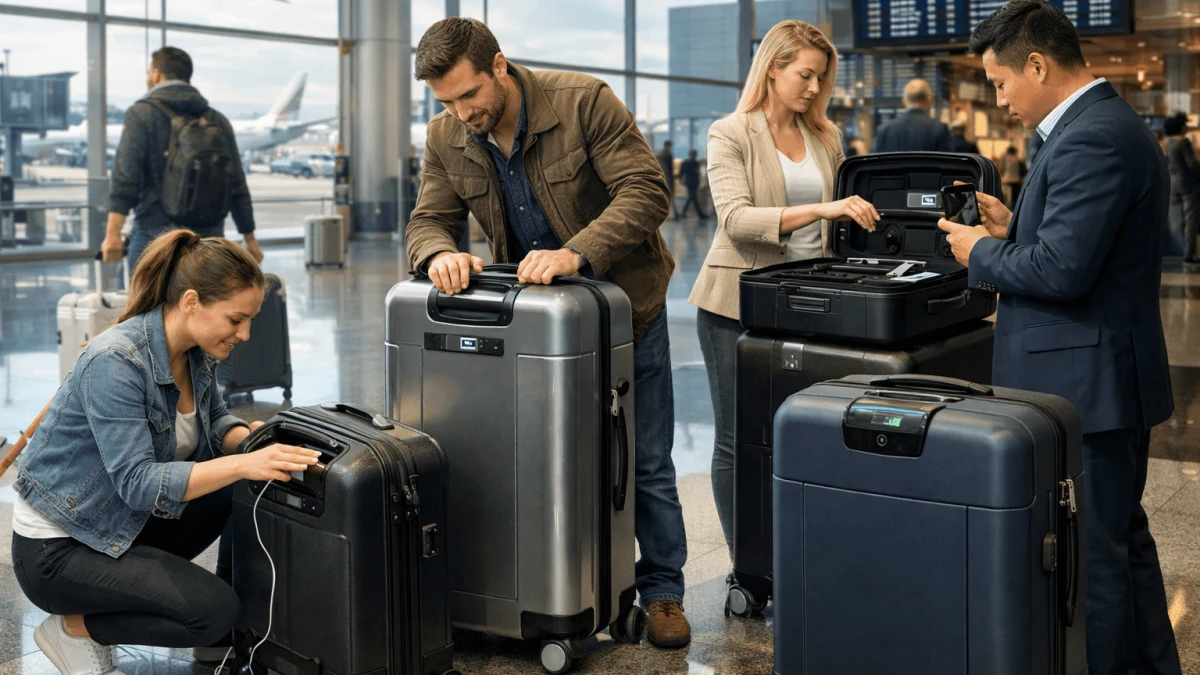
You’re basically deciding between airport convenience (a motor helping you roll) and travel predictability (never having a gate agent, TSA officer, or strict airline policy ruin your day).
Here’s the practical frequent-flyer framing I use: if you fly a mix of airlines/routes (especially internationally, or with budget carriers), motorized luggage is a “works great until it doesn’t” purchase. If you mostly fly one or two carriers you’ve checked in writing, and you routinely do long transfers with a heavy bag, then a removable-battery motorized option can make sense—just expect extra homework and occasional friction.
Evaluate High-Airline Compliance for Smart Travel
The real enemy isn’t the motor—it’s policy variation. One airline’s “fine if removable” is another airline’s “nope,” and you don’t want to discover that at boarding when you’re already sweating through your travel hoodie.
A lot of airlines aligned around the idea that “smart bags” are acceptable only if the lithium battery can be removed, especially if the bag ends up needing to be checked (planned or gate-checked). Delta spells out battery-powered item restrictions and how lithium batteries are treated in baggage rules (and you’ll see the same basic theme across major carriers): if it can’t be made safe by removing the battery, it’s trouble fast (Delta battery/fuel-powered restrictions).
What this means for your decision
- If you want minimum risk of confiscation/gate drama/extra fees, avoid motorized luggage and buy a bag that behaves like normal carry-on. If you still want motorized items, ensure they have removable batteries and check with your airlines.
Actionable move: before buying anything motorized, check the policies for your top 3 airlines and the strictest airline you use even occasionally. If any one of them is ambiguous or bans it, that’s your answer: go non-motorized.
Consider Battery Removability for Safety and Compliance
Here’s the blunt rule of thumb: non-removable lithium batteries are where trips go to die—because gate-checking happens, overhead bins fill up, and suddenly your carry-on is being treated like checked baggage.
Regulators and airlines generally follow watt-hour (Wh) thresholds for lithium batteries: 0–100 Wh is typically allowed, 101–160 Wh often requires airline approval, and above that is generally not allowed for passenger carriage. The FAA lays out these passenger battery rules clearly (FAA: Airline passengers and batteries).
Two common failure modes you can avoid
- You can’t prove the battery spec quickly. If the battery isn’t clearly labeled with Wh, you’re inviting a debate at security.
- You can’t remove the battery at the worst moment. If they force a gate-check and the battery can’t come out in seconds, you’re stuck.
My practical take
If motor assistance is a “nice to have,” don’t buy into a system that can strand you with a heavy, expensive suitcase and no motor. If motor assistance is a “need” (mobility, injury, long hub walks weekly), only consider models that make battery removal easy and obvious—and keep the battery spec well under common limits.
Prioritize Lightweight Options for Budget Carriers
Motorized carry-ons often lose the budget-airline game before you even pack them: motors + structure + battery housing = weight and bulk, and low-cost carriers love nothing more than a carry-on that’s 0.5 kg over.
Even some “normal” smart carry-ons (USB ports, reinforced frames) can be heavier than you expect. And once you’re close to the limit, one souvenir becomes a fee.
The frequent-flyer trick: buy weight margin
You want a bag that gives you headroom so you’re not playing airport-scale roulette:
- Pick the lightest bag that still rolls well.
- Avoid extra electronics you don’t truly use.
- Prefer clean, simple shapes that fit sizers easily.
Actionable move: if you regularly fly strict carriers, weigh your fully packed carry-on at home. If you’re routinely near the limit with a standard bag, a motorized one will probably cost you money and time.
Choose Power Bank-Ready Non-Motorized Bags
If your goal is “smoothest possible travel,” this is the sweet spot: a normal carry-on that just happens to be set up nicely for charging. No motors, no weird questions, no “is this a vehicle?” energy at the gate.
A good example of this style is Aluminium Frame Hard Shell Spinner Wheels Luggage TSA-approved lock for secure travel. The key detail isn’t that it’s “smart”—it’s that it has USB and Type-C charging ports but requires an external power bank (so the battery is your normal removable power bank, not a built-in pack). It also lists carry-on approved and uses a TSA-approved combination lock, which is the kind of boring compliance vibe you actually want in travel season.
If you want a more work-friendly setup, 2 Piece Set Hard Shell Spinner Wheels Luggage with Laptop Bag TSA-approved lock for secure travel includes a laptop compartment and the same idea: USB/Type-C ports with external power bank required. That’s the “I live in terminals” configuration without the regulatory headaches of motorized hardware.
And yes, there’s another listing variant of that set—2 Piece Set Hard Shell Spinner Wheels Luggage with Laptop Bag TSA-approved lock for secure travel—showing similar specs (USB/Type-C, power bank required, TSA lock). Treat these as the same concept: non-motorized luggage designed to make device charging convenient, while keeping the “battery part” fully removable.
How to shop this category without getting tricked
Look for:
- “Requires external power bank” (you control the battery and can remove it instantly)
- Clear carry-on dimensions (these bags list them; compare to your airline’s sizer)
- Front-opening compartment if you travel with a laptop/tablet (the Feilario models list this)
Takeaway: If you’re trying to minimize risk of confiscation, gate-checking drama, and surprise fees, a non-motorized, power-bank-friendly carry-on is the most frequent-flyer-proof choice.
Select Detachable Motor Models for International Flexibility
If you’re still tempted by motorized luggage, the international-flexibility question is: what happens when something breaks—or when a staff member says “remove the battery” and you can’t do it cleanly?
Detachable/modular thinking matters because:
- Motors and electronics fail at the worst times (tight connections, cobblestones, rain).
- Getting parts or service abroad can be slow or impossible.
- A “dead” motorized suitcase becomes a heavy regular suitcase, which is… not the dream.
Actionable move: if motorized is non-negotiable for you, prioritize designs where the battery removal is simple and tool-free, and where you can still roll it normally if the motor stops cooperating.
Evaluate Budget and Complexity in Smart Luggage Choice
Motorized luggage costs you in three ways:
- Upfront price (obvious)
- Complexity tax (rules checks, battery limits, extra screening time)
- Disruption risk (the occasional “this can’t fly” scenario)
Non-motorized smart carry-ons cost you in one main way: you still have to bring your own power bank and cable discipline (which, let’s be honest, you already do).
If you want the charging convenience without betting your trip on electronics working and policies aligning, the external-power-bank setup in bags like the Feilario hard-shell spinners is the pragmatic spend.
Takeaway: spend money where it reduces friction, not where it adds new ways for travel to go sideways.
Optimize Luggage for Frequent Walks and Heavy Loads
This is the only scenario where I’ll seriously entertain motorized: you’re doing long walks through huge hubs (regularly), often with heavy loads, and the convenience meaningfully changes how wiped you feel when you land.
But even then, you need to be honest about the trade:
- Are you often on packed flights where gate-checking is common?
- Do you fly multiple carriers with inconsistent enforcement?
- Are you okay with the possibility that a specific route/day forces you to travel “motor-off”?
Also remember: airlines and regulators care about batteries because of safety risk in transport. The FAA guidance on lithium batteries isn’t theoretical—those rules exist because thermal runaway in baggage is a real hazard (FAA: Lithium batteries in baggage).
My decision rule for frequent flyers
- If you’re optimizing for reliability and speed through airports, choose non-motorized.
- If you’re optimizing for physical comfort over long distances, consider motorized only when you’ve verified removable battery specs and airline acceptance—and you’ve got enough carry-on weight margin.
Takeaway: motorized convenience is real, but the frequent-flyer win is usually “predictable compliance” over “cool feature.”
Sources
- Delta battery/fuel-powered restrictions - example of airline policy approach to battery-powered items and restrictions
- FAA: Airline passengers and batteries - watt-hour thresholds and general passenger battery allowance framework
- FAA: Lithium batteries in baggage - safety rationale and guidance around lithium batteries when flying