
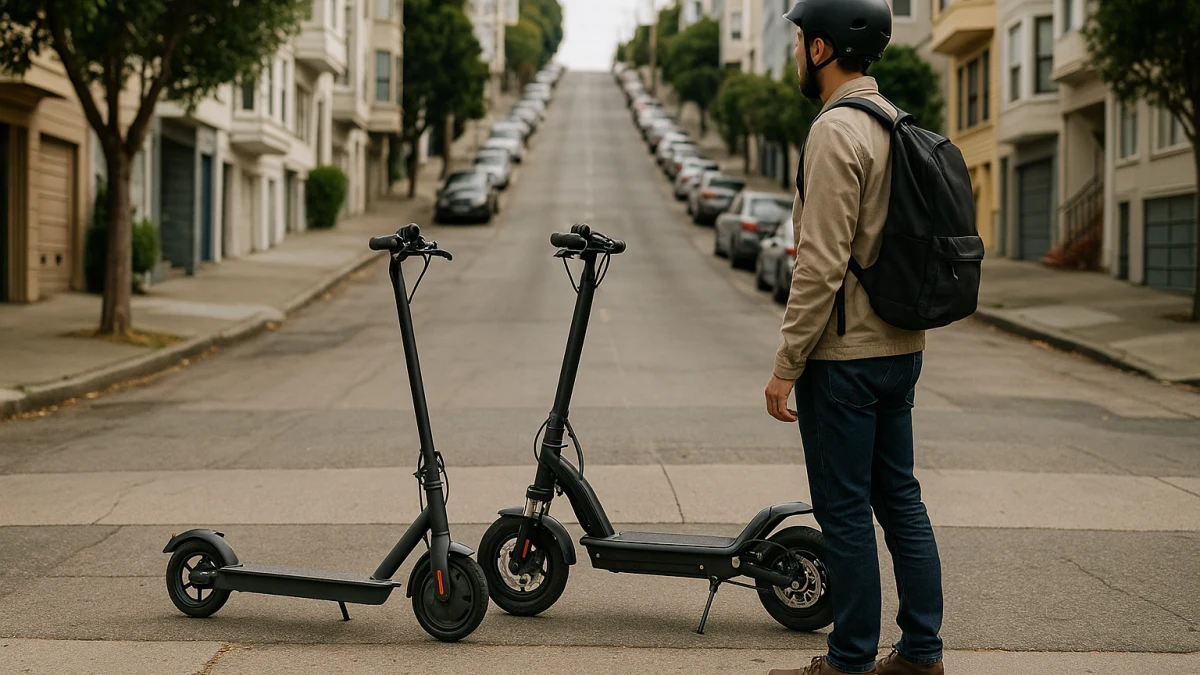
A good hill scooter is not just the fastest scooter on the page. It has to pull rider weight and cargo uphill, then come back down with braking that feels predictable. A normal electric-scooter category page can show motor wattage, range, and speed, but it usually does not separate a practical 500W-class commuter hill scooter from a heavier performance scooter built for repeated steep streets.
Use this collection as a route-fit comparison. Motor output matters, but so do controller limits, battery voltage or capacity, payload headroom, tire size, braking style, portability, and the rules where you ride in the US. The products shown here are shortlists; the guide around them explains what those specs can and cannot prove on paved hills.
Start with the hill you ride most often
| If this describes your route | Better fit | Check before you decide |
|---|---|---|
| Regular paved hills, plus apartment storage, stairs, transit, office parking, or occasional carrying | High-torque commuter electric scooters | Folding design, scooter weight, 8.5- to 10-inch tires, battery capacity, and drum or e-brake setup |
| Repeated steep streets, heavier loads, or uphill starts where acceleration on an incline matters | Dual-motor or performance hill-climbing electric scooters | Higher-output motor layout, 48V or 60V battery system, disc or hydraulic brakes, larger tires, suspension, and payload headroom |
| You are comparing scooters by top speed only | Pause before choosing | Motor output, battery capacity under load, braking setup, tire condition, and grade length matter more than speed claims on hills |
| You need an off-road trail vehicle, moped, motorcycle, gas scooter, electric bike, electric unicycle, kids' scooter, mobility scooter, or seated scooter | Use another category | This page is limited to adult electric scooters for paved streets and commuter hill routes |
The biggest split is not simply low power versus high power. It is short moderate inclines versus repeated steep climbs, and easy daily handling versus stronger uphill and downhill hardware.
Start with grade length, load, and descent—not top speed
Before comparing scooters, define the route that will punish the scooter most. A short paved incline near home is different from a long hill at the end of a commute, and both are different from stop-and-go uphill starts with a backpack or groceries.
Look at these points together:
- Hill severity and repeat frequency: repeated climbs create more heat and battery drain than one short grade.
- Rider plus cargo load: payload ratings such as 265 lb, 286 lb, about 330 lb, or 550 lb help with fit, but they do not by themselves prove strong climbing.
- Motor and battery: 500W or 700W peak output can be useful for moderate commuting; 1000W, 1200W, 2400W, 3200W, or dual 3000W points toward heavier hill use. Battery clues such as 281Wh, 13Ah, 48V 15Ah, 48V systems, and 60V systems should be read against route length.
- Brakes and tires: electronic plus drum brakes or front drum plus rear e-brake setups belong in the moderate-hill conversation. Front and rear disc brakes or hydraulic disc brakes are more relevant when descents are steep.
- Portability penalty: larger motors, batteries, tires, and brake systems can make a scooter harder to lift, store, or bring on mixed-mode commutes.
Hill-scooter mistakes that listings make easy
- Buying by wattage alone. Wattage is a starting point, not a guarantee. Rider weight, cargo, battery charge, hill length, and heat all change real hill behavior.
- Ignoring the ride back down. A scooter that climbs acceptably still needs controlled braking on the descent.
- Treating range as flat-road range. Hill routes drain batteries faster, especially with heavier loads or repeated climbs.
- Overvaluing payload as a hill claim. A high listed load limit helps with fit, but it does not automatically mean quick acceleration or cool operation on a grade.
- Forgetting stairs, storage, and lifting. Performance scooters can be the better hill tool and still be the wrong daily commuter if you have to carry them often.
Paved steep streets only: false friends excluded
This collection is for adult electric scooters used on paved streets and commuter hill routes. It is not an off-road mountain trail guide, a moped or motorcycle comparison, a gas-scooter page, an electric-bike roundup, an electric-unicycle guide, a kids' scooter category, a mobility-scooter page, or a seated-scooter collection.
That boundary matters because searches for hill scooters often mix very different vehicles. A fat-tire trail model, a moped-style scooter, or a seated mobility product may solve a different problem, but it should not be compared as if it were the same portable paved-street scooter.
Commuter Hill Scooters for Moderate Paved Climbs
This is the practical default for riders whose hills are regular but not extreme. In this lane, a 500W motor or a 350W motor with peak output around 700W is a useful starting point for moderate paved inclines, especially when paired with commuter-friendly tires, folding, and manageable storage.
Read the product details as a whole. A 281Wh battery, 13Ah battery, 48V 15Ah battery, 22-mile range claim, 40 km range claim, or 40-50 km range claim should be compared against your actual grade length, rider weight, cargo, and battery charge. Tires in the 8.5- to 10-inch range, electronic plus drum brakes, or front drum plus rear e-brake setups can make sense for moderate hills, but they are not proof that every steep street will feel easy.
Use these products to compare the middle ground: enough motor, battery, tire, brake, load, and folding detail to be plausible for everyday paved hills without jumping straight to a much heavier performance scooter. If your route includes repeated steep climbs, heavier loads, or you want stronger downhill braking confidence than a commuter drum or e-brake setup suggests, use the next section as the better comparison point.
The handoff point from 500W-class commuting to performance power
Move beyond the commuter lane when the hill is not just present, but central to the trip. Warning signs include long grades, repeated climbs in one ride, frequent uphill starts, heavier rider-and-cargo loads, low-battery return trips, or descents where you already know you will want stronger braking hardware.
The handoff is not about buying the most powerful scooter available. It is about deciding when a foldable 500W-class scooter, 700W peak output, 8.5- to 10-inch tires, and drum or e-brake commuter hardware stop being the sensible compromise. At that point, higher-output motors, larger battery systems, disc or hydraulic brakes, larger tires, and suspension become more relevant than easy carrying.
Performance Hill Scooters for Repeated Steep Streets
This lane is for paved routes where climbing and descending matter more than low weight. Look for higher-output details such as 1000W, 1200W, 2400W, 3200W, or dual 3000W motor setups when your commute includes repeated steep streets or heavier loads. Battery systems labeled 48V or 60V are also worth comparing, but they still need to be checked against manufacturer grade information, capacity, payload, and route length.
The braking and stability details are just as important as the motor. Front and rear disc brakes, electric brakes, dual disc brakes, or front and rear hydraulic disc brakes are more relevant for steep downhill control than basic speed claims. Larger 10- to 12-inch tires, dual suspension or double suspension, and payload ratings such as 265 lb, 286 lb, about 330 lb, or 550 lb should be reviewed together because hills stress traction, stability, brakes, motor, controller, and battery at the same time.
Some product pages may mention a 15% uphill climb rating or use language such as hilly areas and climbing slopes. Treat that as a useful prompt to read deeper, not as a universal result for every rider, battery state, temperature, or hill length.
Use these products as the steep-street shortlist. They are better matched to repeated climbs and stronger descent-control needs, but they can also be heavier, faster, harder to carry, and more locally regulated than commuter scooters. If storage, stairs, transit, or frequent lifting are part of your day, the commuter lane may still be the smarter choice.
The downhill bill: heat, brake wear, and battery drain
Hills make several scooter systems work at once. The motor and controller work harder going up, the battery drains faster under load, and the brakes and tires do more work on the way down. That means the right hill scooter is not only about getting to the top; it is also about how often you will need to inspect brakes, tires, fasteners, and battery condition.
For moderate paved hills, pay attention to brake feel, tire pressure or tire condition, and whether the scooter still has enough charge for the return trip. For steeper routes, treat disc or hydraulic brake maintenance as part of ownership, not a one-time feature check. Stronger brakes help only when they are adjusted, maintained, and used conservatively.
Verify grade, payload, brakes, and local rules before riding
Before buying, check the product page and manufacturer documentation for motor rating, peak output if listed, battery voltage and capacity, payload rating, tire size, brake type, and any published incline or grade information. Do not assume that a listed grade rating will apply the same way with a heavier rider, cargo, low battery, cold or hot weather, worn tires, or a long climb.
Also verify where and how the scooter can be used. US rules can vary by state, city, campus, park, road type, and transit system, and high-power scooters may face different restrictions than smaller commuter models. Do not treat a scooter being sold online as proof that it is allowed on your intended public route.
Match the scooter to the steepest hill you actually ride, the load you actually carry, and the braking control you need on the way down. Then use manufacturer specs and local rules as the final checks before choosing.