
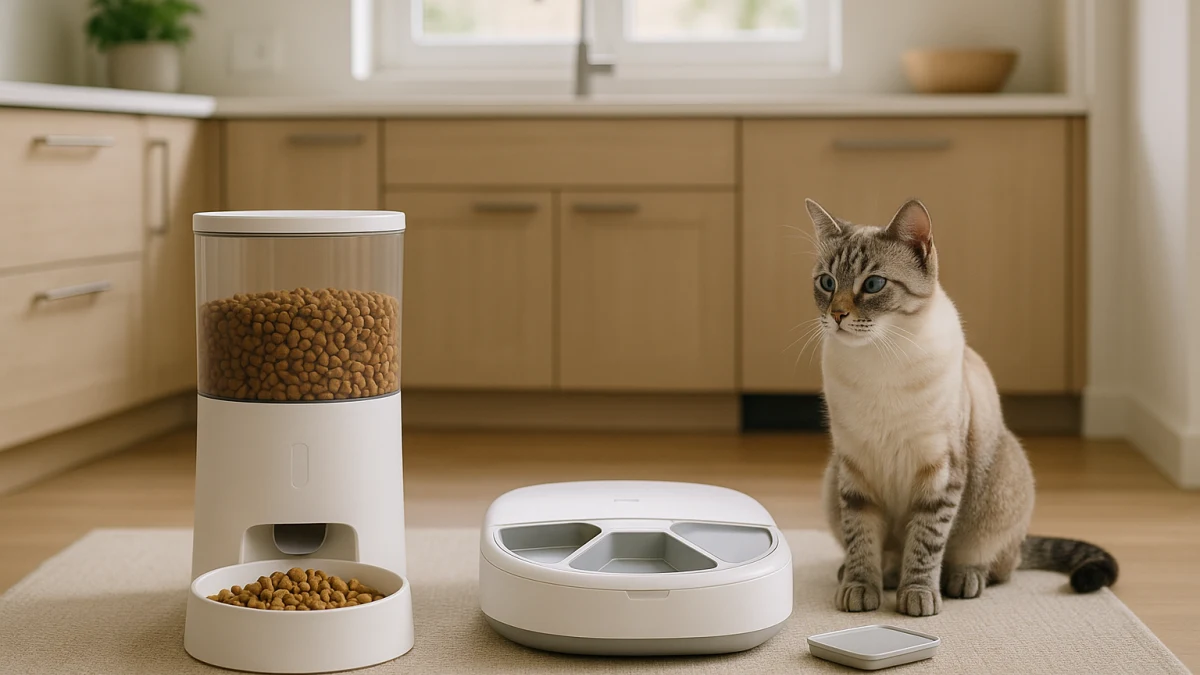
Automatic pet feeders are not interchangeable just because they run on a timer. For this collection, the useful split is the food path: dry kibble moves through a hopper, food tank, and chute, while wet or semi-moist meals need covered compartments, bowls, trays, ice packs, or documented cooling support.
A normal automatic-feeder category can mix hoppers, wet-food trays, camera-heavy feeders, and adjacent products that solve different problems. Use this page to compare the architecture first, then look at portion settings, compartment count, freshness support, power setup, and cleaning details.
Choose by food path before feeder features
| Need | Better fit |
|---|---|
| Repeat timed meals for shelf-stable dry kibble with a stored supply | Dry-kibble hopper automatic feeders |
| Wet, canned, raw, or semi-moist meals that need covered timed compartments | Tray-style wet-food automatic feeders, only when the model lists that food compatibility |
| Both dry meals and wet meals in the same routine | A mixed setup: use a dry-kibble hopper for dry meals and a separate wet-food tray, cooling-aware setup, or human handling for wet meals |
| Large or irregular kibble that might jam a chute | A dry-kibble hopper only after checking the manufacturer’s stated kibble-size limit and portion increment |
| Wet food left for long periods in a feeder | Do not rely on a covered tray, ice pack, or cooling claim without official food-safety guidance and manufacturer instructions |
As you compare, keep six checks in view: food format, dispensing architecture, meal count, freshness or cooling support, cleaning path, and mixed-schedule fit. Hopper listings tend to talk about tank capacity, portions, meals per day, and kibble size. Tray listings tend to talk about 4-, 5-, or 6-meal layouts, covered compartments, ice packs, cooling, removable trays, and capacity per compartment.
Start with the food path, not the app
Camera, voice, and app controls can be useful, but they should not decide the wet-versus-dry question. A dry-food feeder with an app is still a hopper feeder if the meal moves from a food tank through a chute. A timed tray with cooling language is still a tray feeder, even if it also handles some dry snacks.
Use these decision cues before comparing extras:
- Stored supply needed? Look for a hopper or food tank sized for dry kibble, commonly described with 4L to 7L capacities.
- Wet or semi-moist meals? Look for manufacturer-listed wet-food compatibility, covered compartments, trays, bowls, ice packs, ice-crystal boxes, or cooling support.
- Portion precision matters? For dry kibble, compare portion increments, portions per meal, meals per day, and the stated kibble-size limit.
- Freshness support matters? Desiccant storage belongs to some dry hoppers; ice packs or cooling support belong to some wet-food trays. Neither should be generalized across all models.
- Cleaning matters? Check whether the tank, bowl, lid, or tray removes for cleaning, and only rely on dishwasher-safe or material claims when the specific product page lists them.
Keep false friends out of the wet-versus-dry choice
Some products can appear near automatic feeders without solving this decision. Water fountains manage drinking water, not meal timing. Gravity feeders refill a bowl but usually do not provide the same scheduled portion control as an automatic hopper. Puzzle feeders and treat dispensers are enrichment products, not wet-meal storage tools. Microchip or RFID feeders control access for specific pets, but they are a different buying problem from choosing hopper versus tray architecture.
This page also does not treat pet cameras or monitoring products as the main lane. If a feeder includes a camera, evaluate the feeding path first: what food goes in, how it moves, what portion limits apply, and how the food-contact parts are cleaned.
Dry-kibble hoppers for repeat timed portions
Choose this lane when the pet mainly eats shelf-stable dry kibble and you want scheduled portions from a stored supply. The products shown here are useful for comparing food-tank capacity, hopper design, dry-food positioning, portion control, meals-per-day language, bowl setup, desiccant storage, and stated kibble-size or portion limits.
Do not treat all hopper feeders as equal. A 4L tank and a 7L tank support different refill expectations, and portion controls can vary by model. Larger or irregular kibble deserves extra attention because hopper feeders depend on kibble moving through a chute or rotor without exceeding the manufacturer’s food-size guidance.
Read these products through the lens of dry-kibble mechanics. Camera, voice, or app features may be present, but the better comparison is whether the feeder’s tank, chute, portion settings, bowl materials, cleaning design, and backup-power behavior fit your routine. If the food is wet, canned, raw, or semi-moist, move to the tray lane unless the manufacturer clearly documents that compatibility.
The dry-hopper line: no wet food unless documented
A food tank, hopper, or portion chute is not automatically a wet-food system. Wet food can behave very differently from dry kibble: it may smear, stick, dry out, or require handling that a dry-food mechanism was not designed to provide.
If a listing says dry food only, take that boundary seriously. If it does not clearly list wet, canned, raw, or semi-moist compatibility, do not infer it from the word “automatic.” For mixed routines, it is usually better to separate the dry-kibble portion problem from the wet-meal timing and storage problem.
Wet-food trays for covered timed meals
Use this lane when the meal itself is wet, canned, raw, or semi-moist and the product page visibly supports that food type. These feeders usually reveal individual compartments or bowls on a timer rather than dispensing from a large dry-food hopper.
Compare the layout before comparing extras: 4-, 5-, and 6-meal designs solve different scheduling needs, and compartment capacity matters more than total hopper volume. Some models use covered compartments only; others mention ice packs, ice-crystal boxes, or semiconductor cooling. Those features are cooling support, not a blanket guarantee about how long wet food can be left out.
The products shown here help you compare compartment count, covered-meal layout, timer style, power setup, removable tray details, and cooling language. A wet/dry tray can help in a mixed routine, but it should not be confused with a high-capacity dry-kibble hopper for repeated kibble dispensing from a stored tank.
Wet-food time claims need food-safety backing
Be careful with any claim that wet food can sit in a feeder for a long period. A lid, ice pack, ice-crystal box, or cooling feature may be part of the design, but this page does not treat those features as proof of overnight, all-day, or multi-day wet-food safety.
Before buying for wet meals, look for the manufacturer’s instructions on food type, cooling setup, compartment loading, cleaning, and any stated use limits. For food-safety timing, rely on official food-safety guidance and the product’s documentation rather than assuming a tray works like refrigerated storage.
When one automatic feeder is not enough for mixed meals
A household that serves both dry kibble and wet food may need more than one feeding plan. The dry meals may fit a hopper with a food tank, portion control, and kibble-size limits. The wet meals may need a documented tray feeder, cooling-aware setup, or human handling.
Skip the idea of one universal feeder if it forces either food into the wrong architecture. A hopper that handles dry kibble well is not automatically suitable for wet food, and a small covered tray is not the same as a large dry-food reservoir for repeated kibble portions.
Checkout checks for kibble, trays, cooling, and cleaning
Before choosing a feeder, verify the details that are most likely to change by model:
- Food type: dry only, wet compatible, wet/dry tray, canned, raw, or semi-moist support.
- Dry-kibble size: manufacturer’s stated kibble-size limit, especially for large or irregular pieces.
- Portion structure: portions per meal, portion increment, meals per day, and bowl setup for hopper feeders.
- Tray structure: number of compartments, capacity per compartment, lid coverage, and timer style for wet-food feeders.
- Cooling support: whether the model uses ice packs, ice-crystal boxes, semiconductor cooling, or only covered compartments.
- Power setup: battery, plug-in, or backup-power behavior as listed by the product.
- Cleaning path: removable tank, removable tray, removable lid, stainless steel bowl, and any dishwasher-safe claim only if the specific model states it.
- Material claims: BPA-free, food-grade, or other food-contact language only when the product documentation supports it.
Match the next feeder to the food you actually serve: a hopper for dry kibble, a documented wet-food tray for covered timed meals, or separate handling when one device cannot safely cover both.