
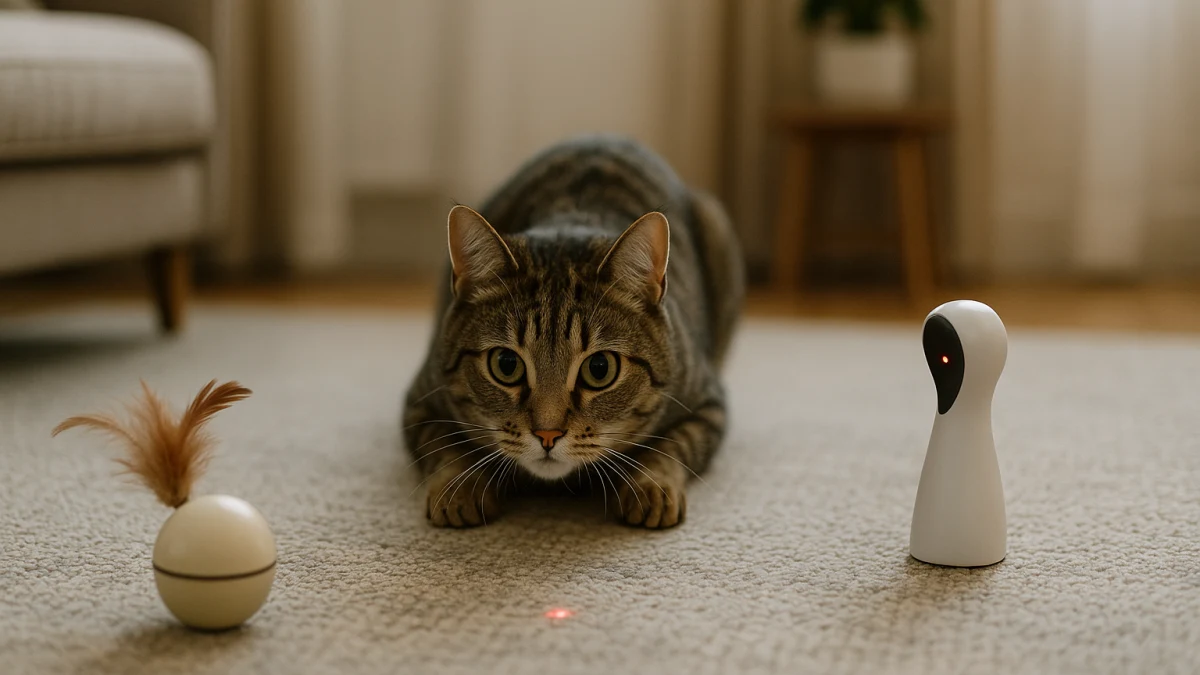
Automatic cat toys are easy to overbuy because the listings can make every moving gadget sound like the same kind of enrichment. The real choice is narrower: does your indoor cat want to catch a physical moving object, or does your cat mainly react to laser-style, LED, light, or pointer-style movement?
This comparison is not an even split between two identical lanes. Physical motion toys are the stronger default when a cat likes to stalk, bat, pounce, chase, or wrestle with something catchable. Laser-style toys can still be useful, but they are more conditional: you need to check the activation method, avoid unsupported safety assumptions, and plan how the play session ends.
Choose by what your cat tries to catch
| Your situation | Better fit |
|---|---|
| Your cat stalks toy mice, bats balls, pounces on moving objects, or wants something physical to wrestle with. | Automatic motion and chase toys |
| Your cat ignores rolling objects but reliably reacts to moving light, laser, LED, or pointer-style movement. | Automatic laser-style toys, with supervision and a catchable finish |
| You want short daytime play bursts instead of a toy that runs continuously. | Either lane only if the product page confirms timer, auto-shutoff, or motion-activated operation |
| Your cat gets frantic when there is nothing to catch at the end of play. | Start with automatic motion and chase toys, or end laser-style sessions with a catchable toy or other satisfying finish |
| You are shopping for a feeder, pet camera, wand toy, cat tree, or scratching post. | Use a different category; those are outside this comparison |
As you compare products shown here, keep seven fit checks in mind: whether the toy offers a catchable object or uncapturable light, what play style triggers your cat, how the toy starts and stops, whether sessions have clear boundaries, how it behaves on your floors, what its power or charging setup requires, and whether durability or replacement details are clear on the product page.
Match the toy to what your cat tries to catch
Start with behavior you have already seen at home. A cat that crouches, stalks, bats at rolling objects, or carries toys away is telling you that physical contact matters. For that cat, toy balls, rolling toys, snake-style toys, turntables, teasers, feather movement, and yo-yo-style chase toys are more natural comparison points.
A cat that watches a ball roll past but instantly locks onto a moving dot is a different shopper. In that case, the laser-style lane may be worth considering, but it should not be treated as a universal upgrade. Light-based play gives motion without a catchable object, so the end of the session matters more.
Also separate automatic from remote-control in your own expectations. Some products may be electronic or motorized but still depend on owner setup, remote operation, mode selection, or placement. Timer, motion-activated, rechargeable, and auto-shutoff language is useful, but it belongs inside each lane as a detail to verify, not as a separate toy type.
Do not let feeders, cameras, wands, or cat trees blur the choice
This page is only comparing automatic cat toys built around physical motion, chase, rolling, pounce, laser-style, light, or pointer-style play. It is not a buying guide for automatic pet feeders, treat dispensers, pet cameras, security monitors, baby monitors, manual wand toys, cat trees, or scratching posts.
Those products can be useful in other contexts, but they solve different problems. A feeder manages food delivery. A camera helps you observe. A wand depends on a person holding it. A cat tree or scratching post gives climbing, resting, or scratching space. None of those should be treated as a substitute for deciding between catchable automatic motion and light-based automatic play.
Automatic motion and chase toys your cat can make contact with
Choose this lane first if your cat likes the satisfaction of touching the target. The products shown here are useful for comparing physical movement formats: intelligent toy balls, remote-control luminous yo-yos, a smart sensing snake-style toy, and motorized rolling ball toys are all examples of toys meant to create something a cat can chase, bat, or pounce on.
The important difference is not just ball versus snake versus teaser. Look at how the toy moves and how much control it may require. A remote-control toy ball or luminous yo-yo-style toy may be fun when you are involved, while another motorized or sensing toy may feel more hands-off. Product text does not automatically prove fully autonomous use, so compare the movement pattern, toy size, battery requirement, and control method before assuming it will fit your routine.
Flooring and noise are real buying factors in this lane. Rolling toys and motorized balls may behave differently on hard floors, rugs, thresholds, or cluttered rooms. Some cats lose interest if the movement is too predictable, too loud, too fast, or constantly gets stuck. If your cat is cautious, the gentler or more varied movement pattern may matter more than the most novel gadget design.
Use the products shown above as a format-comparison window, not as a promise that every model has the same runtime, shutoff behavior, material standard, replacement parts, or durability. If your cat wants something to physically catch, this is usually the better starting lane. If your cat consistently ignores objects but chases light, move to the laser-style lane with the added cautions below.
Pause before treating laser claims as safety proof
Laser-style listings can use terms that sound reassuring, but do not treat words such as laser safe, eye safe, Class 1, or Class 2 as proof unless the product page or manufacturer documentation actually supports them. A shopper-facing listing may describe a feature without providing the standard behind it.
The practical boundary is simple: do not aim laser or pointer-style play at a cat’s eyes, do not assume unlimited unsupervised use, and do not rely on light-based play as if it gives the cat something to catch. If you choose this format, plan short sessions and end with a physical toy, treat, or other satisfying finish.
Automatic laser-style toys when light is the trigger
Consider this narrower lane only if your cat reliably chases moving light, laser, LED, or pointer-style motion. The products shown may include motion-activated rotating light toys with LED or laser features, USB rechargeable power, remote control, multiple modes, or an automatic cat toy robot with a pointer feature. Those details help you understand how sessions start and stop, but they do not prove safe all-day unsupervised use.
Read this widget for activation method, control method, modes, and power source before deciding. Laser-style toys are a better fit for light-motivated cats than for cats that need to bite, bat, or wrestle a target. If your cat becomes agitated when there is nothing to capture, choose a physical motion toy first or make the ending of laser-style play deliberately catchable.
Timer, power, floor, and play-ending checks
Before buying, check the product page for the details that affect day-to-day use:
- Session control: Is the toy automatic, motion-activated, remote controlled, or mode-based? Does the listing clearly describe any timer or auto-shutoff behavior?
- Power setup: Does it use replaceable batteries, USB rechargeable power, or another charging method? Are runtime and charging claims clearly stated by the manufacturer?
- Floor fit: If the toy rolls, spins, or travels, will it work on your mix of hard floor, carpet, rugs, and room clutter?
- Noise and speed: Is the movement likely to startle a cautious cat or become too predictable for a high-energy cat?
- Physical finish: If the toy uses laser, LED, or pointer-style movement, what will your cat get to catch at the end?
- Materials and parts: Are material details, included attachments, and replacement options clear enough for how rough your cat plays?
Why automatic cat toys still get ignored
Many automatic cat toys fail for practical reasons that a normal product grid does not separate. The toy may move, but not in a way your cat wants to chase. It may be physically catchable, but too loud. It may look autonomous, but depend on remote control or frequent owner setup. It may roll well in a listing video, then struggle on the flooring in your home.
Laser-style toys have their own failure mode: the cat may chase intensely but never get a satisfying capture. That does not make every light-based toy wrong, but it does mean the format needs more supervision and a better play ending than a catchable rolling or pouncing toy.
The safest decision path is to return to your cat’s observed play style. Choose physical motion when your cat wants something to catch. Choose laser-style play only when moving light is a reliable trigger and you can manage the session. In both lanes, verify timer, power, floor fit, control method, and safety-related claims on the product page before buying.