
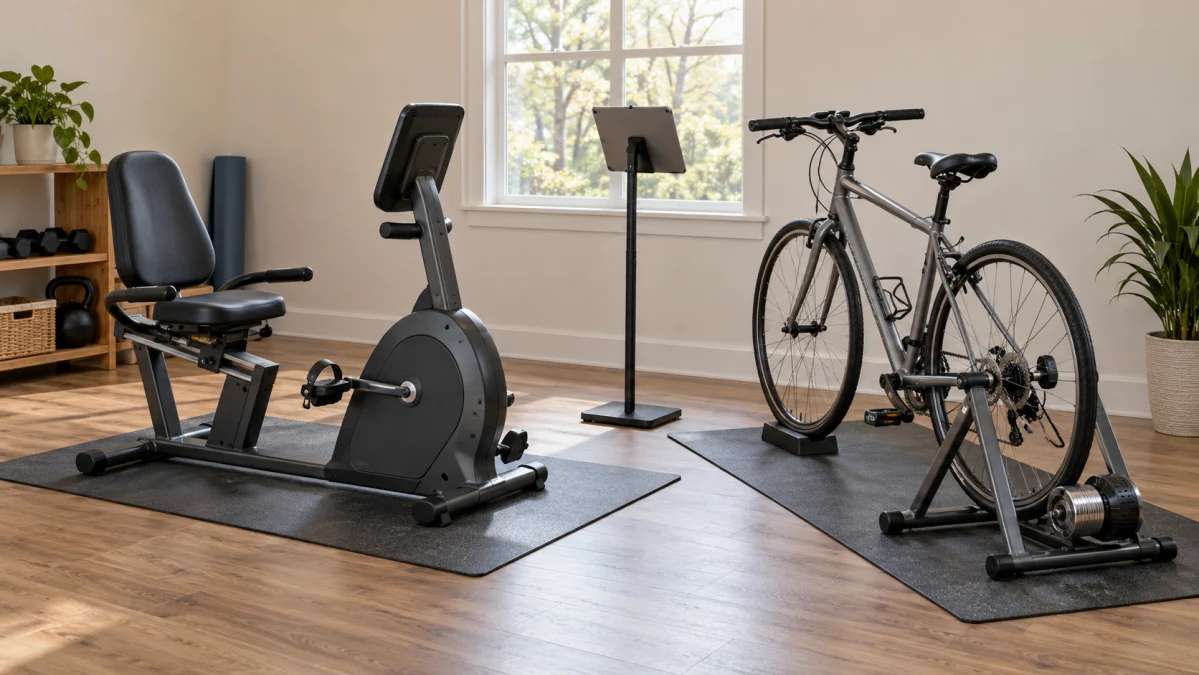
A dedicated exercise bike makes sense when you want an indoor machine that can stay ready while your outdoor bicycle stays available for riding. A trainer is more appealing when using your own bicycle—its saddle, pedals and riding position—is part of the point.
With a recumbent exercise bike, you are also choosing a different way to sit: a seat with a backrest and pedals ahead of you. That physical difference deserves at least as much attention as the app. Watching a class, recording your effort and having resistance change automatically are three separate capabilities.
A recumbent bike for a separate indoor routine
A recumbent bike suits someone who prefers a supported, seated position for indoor exercise. A conventional bicycle mounted on a trainer preserves that bicycle’s riding position, so it will not reproduce the recumbent experience simply because both setups have pedals.
The everyday advantage of a separate machine is independence. Once assembled and adjusted, it does not need your outdoor bicycle to be available. That can matter if you alternate between indoor sessions and outdoor rides, or share the exercise equipment with someone who does not fit your bicycle.
The Recumbent Exercise Bike is advertised with an adjustable seat, moving arm handles and SunnyFit connectivity. The seller’s description also lists eight magnetic resistance levels and places the pulse sensors on the stationary grips beside the seat. Using the moving arm handles and taking a pulse reading from those contact sensors therefore require different hand positions.
Before ordering, get the manufacturer’s model number and manual from the seller. Check the seat-adjustment range and maximum rider weight, how resistance is adjusted, and which measurements reach SunnyFit. The generic product name does not supply those answers.
For a shared machine, the useful question is whether each person can reach the pedals and handles comfortably—and how much adjustment changing riders requires. An adjustable seat is helpful only if its range covers the people who will use it.
A Fluid2 trainer for riding the bicycle you already own
The Fluid2 keeps your bicycle’s rear wheel installed, with the tire running against a resistance roller. You retain your own saddle, pedals, handlebars and gears. If you already like the fit of your bicycle, that familiarity is a substantial reason to choose a trainer. If you dislike its riding position, mounting it indoors does not solve that problem.
The Indoor bike trainer with included speed sensor, model 9907T, packages the trainer with a wireless sensor. Saris’s bundle contents also include a steel quick-release skewer and a front-wheel leveling block.
Its fluid resistance increases as the rear wheel spins faster. As Saris explains progressive resistance, you change the effort through your pedaling and gears. Shifting into a higher gear while maintaining a similar pedaling cadence increases wheel speed and load.
The yellow clutch knob has a separate job: setting the roller’s contact pressure against the tire during setup. It is not an app-controlled resistance adjustment. The Fluid2 setup manual explains how to mount the bicycle and set that contact correctly.
What you will see in the app—and feel at the pedals
SunnyFit: try the classes before buying the hardware
SunnyFit is free to download and use. Sunny also says most workout videos and training programs work without Bluetooth-connected equipment. You can explore the instructors and workout formats before choosing a machine.
A compatible equipment connection matters when you want live workout data. Most challenges and Free Mode require it, and the available measurements depend on the equipment and workout. Sunny recommends checking the exact machine in the app’s Supported Equipment section or its manual in its connection guide.
For the recumbent bike, establish whether the measurements you care about actually appear in SunnyFit. A pulse reading on the console, for example, does not by itself establish that the app receives it. Likewise, a connection for tracking a workout does not establish that the app can adjust resistance.
Fluid2: virtual riding with estimated or separately measured power
ROUVY explicitly lists the Saris/CycleOps Fluid 2 as compatible with its classic-trainer setup.
With the supplied speed sensor, ROUVY estimates watts from wheel speed and the selected trainer’s power curve. The sensor is not measuring the force you put into the pedals. Selecting the correct trainer and wheel size matters because those settings affect the calculation.
There is another detail to get right: the Saris sensor operates in speed or cadence mode, rather than reporting both simultaneously. For speed-based virtual power on the Fluid2, configure it for speed and mount it on the rear hub. Seeing cadence as well requires another cadence source.
Estimated power can still help you follow your own progress. Consistency matters: Wahoo’s explanation of virtual watts identifies tire pressure, roller resistance and the selected power curve as factors in repeatable readings. Treat those numbers as a reference for that setup, rather than assuming they will match another trainer or an outdoor power meter.
If your bicycle already has a compatible power meter, ROUVY can use its measured power instead. That changes where the watts come from; it does not add resistance control. A climb appearing on screen still will not make the Fluid2 automatically harder to pedal. You manage the physical effort yourself.
Check whether the Fluid2 fits your bicycle
A trainer can be compatible with your app and still be incompatible with your bicycle. Match the rear axle, wheel and tire to the 9907T’s current specifications:
- Rear axle: Saris lists quick-release dropout settings of 120, 130 and 135 mm. Compatible 142×12 mm and 148×12 mm thru-axle arrangements require separately sold adapters. Match the adapter to the frame and axle specifications, including thread pitch.
- Wheel and tire: Saris lists 650b and 700c wheels, 27.5-inch tires up to 2 inches wide, and 29-inch tires up to 1.5 inches wide without tread. It excludes 650c, 26-inch wheels, and wider or treaded 29-inch tires.
- Weight: The maximum is 300 lb for the rider and bicycle combined.
These details are especially consequential if you have a mountain bike with wide, knobby tires or a thru-axle frame. Include the necessary changes in the price comparison before deciding that a trainer is the cheaper route.
Account for tire wear, noise and the daily setup
A wheel-on trainer makes your rear tire part of the resistance system. The Saris manual warns that trainer use shortens rear-tire life and that knobby tires create excessive noise and vibration. Tire choice deserves attention if you will ride in a shared room or apartment.
Saris recommends a suitable trainer tire, but its own trainer tire is for indoor use only. If you fit one, taking the bicycle outside again involves changing the tire or using another compatible wheel. That is a meaningful inconvenience when the same bike goes outdoors frequently.
Leaving the bicycle mounted avoids repeated installation. Packing everything away after each session brings that work back: mounting the bike, checking tire pressure and setting roller contact become part of the routine. A separate exercise bike avoids those bicycle-specific tasks, although it still needs assembly, adjustment and space.
Measure the complete riding setup. The Fluid2’s frame folds, but the bicycle needs somewhere to go after you remove it. If you leave it mounted, plan around the full bicycle and trainer footprint. For a recumbent machine, allow room for its seat adjustment and moving handles, as well as getting on and off. Also decide where your phone or tablet will sit during a workout.
Sharing a trainer can add another complication. If two people need different bicycles, each bicycle needs a compatible mounting arrangement, and changing riders means changing bikes. That is a different proposition from moving an exercise bike’s seat.
Compare the cost of the workouts you actually want
For the Fluid2, add any required axle adapter, suitable tire, extra sensors and device receiver to the purchase price. A Bluetooth or ANT+ sensor still needs a phone, tablet or computer that can receive its signal through a supported connection.
Include software costs, too. SunnyFit is free; ROUVY offers a limited free tier and charges for unlimited riding. If virtual routes are the reason you are buying the trainer, budget for the access you expect to use.
Choose a recumbent exercise bike when its supported seating position and a separate indoor setup suit your routine. Choose the Fluid2 when you want to ride your own compatible bicycle and are comfortable managing effort through your gears.
If your main attraction is feeling virtual hills change the resistance automatically, shop for a trainer or exercise bike explicitly supported as controllable by your chosen app. That capability needs to be part of the equipment you buy; a speed sensor cannot add it later.