
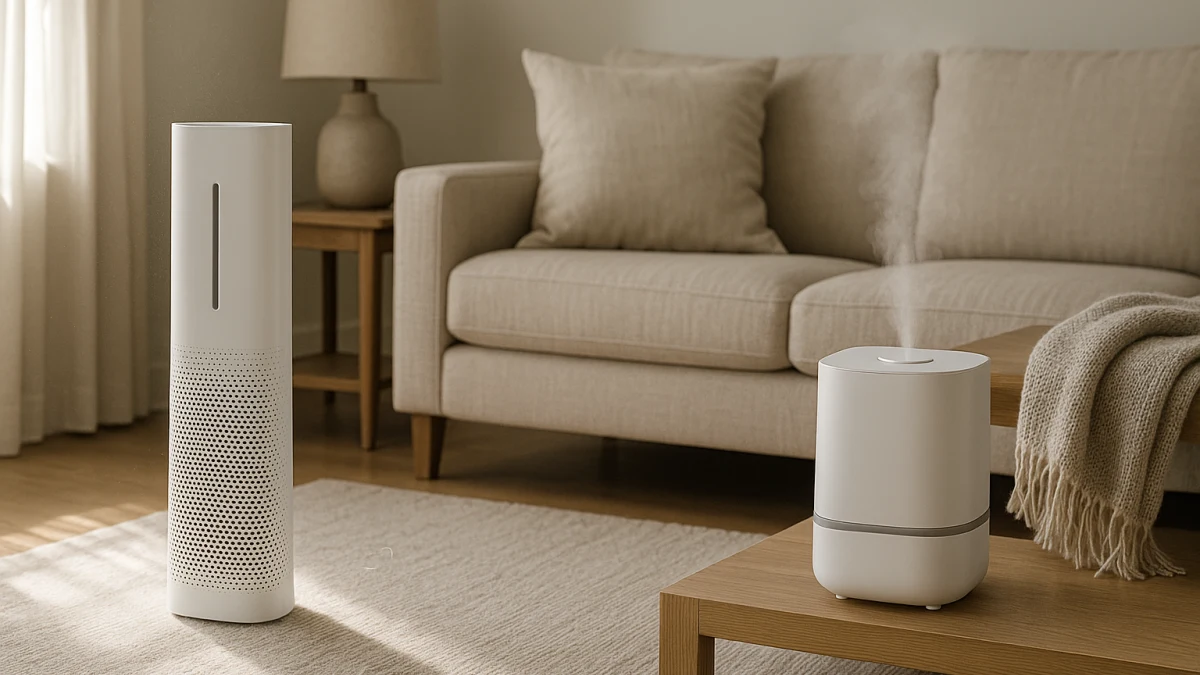
An air purifier and a humidifier can both belong in a bedroom, office, or living room, but they do different jobs. Start with the room clue: dust, smoke, pet dander, pollen, and odors point toward filtering air; static, low indoor humidity, and air that feels too dry point toward adding moisture.
A normal category page can show both product types, but it will not stop the common wrong purchase: buying mist for smoke, or buying filters for dry air. Use the comparison below to separate the problem type, room condition, performance specs, maintenance burden, and bedroom-friendly features before you browse the products shown here.
Start with the room clue: particles, odors, or dry air?
| If the main room clue is... | Better fit |
|---|---|
| Dust, smoke, pet dander, pollen, or lingering odors | Air purifier |
| Static, low indoor humidity, or a room that feels too dry | Humidifier |
| A room that already feels damp, musty, or over-humid | Neither; do not add moisture, and keep damp-room dehumidifier decisions outside this page |
| You are unsure whether particles or humidity are changing | Measure first; an air quality monitor can be a diagnostic add-on, not a purifier or humidifier substitute |
Room clue decoder: floating particles or dry air?
Use the clues you can observe before you compare specs:
- Choose the filtration lane when the complaint is about what is in the air: visible dust, smoke residue, pet dander, seasonal pollen, or odors that linger in a room.
- Choose the moisture lane when the complaint is about air that feels dry: static shocks, low humidity readings, or a room that feels uncomfortable because it lacks moisture.
- Pause before buying either when the room feels damp or musty. Adding mist can be the wrong direction, and this page is not a dehumidifier guide.
- Compare bedroom and office features inside the right lane. Noise, sleep modes, smart controls, and auto operation matter in both lanes, but they do not change the device’s core job.
Do not solve smoke with mist—or dampness with more mist
A humidifier is not a shortcut for smoke, pollen, pet dander, or odor control. Its job is to add moisture, so tank size and runtime do not replace CADR, filter type, or carbon filtration when the issue is airborne particles or smells.
The reverse mistake is just as easy: a purifier can filter air, but it does not add humidity or reduce static caused by dry conditions. If the room already feels damp, do not treat that as a reason to add a humidifier. Essential oil diffusers, whole-home HVAC upgrades, medical treatment questions, and dehumidifier decisions sit outside this comparison.
When a monitor helps but does not become the answer
If you cannot tell whether the room problem is particles or humidity, measuring can help. A monitor may show humidity trends or particle changes, which can make the first purchase less of a guess.
That does not make a monitor a third solution lane. It can help you decide whether to shop for filtration or moisture output, but it does not filter smoke, capture dust, add moisture, or clean a water tank for you.
Air purifiers: when the room needs filtration, not moisture
Use this lane when the room problem is dust, smoke, pet dander, pollen, airborne particles, or odors. The products shown here are dedicated room air purifiers, so compare them by filtration-focused specs rather than by water-tank features.
Look for CADR when listed, room coverage, filter type, filtration stages, HEPA language, activated carbon, washable pre-filters, noise level, sleep modes, app or voice controls, and filter replacement needs. Treat coverage numbers, CADR ratings, HEPA labels, particle-size claims, certification language, and filter life as product-specific details to verify on the product page.
Read this group as the air-cleaning lane. A purifier may be the better fit when you want to compare filters, carbon, CADR, room coverage, and noise for a bedroom or office. It is not the fix for dry air, static, or low indoor humidity, no matter how strong its filtration specs look.
The purifier mistake: expecting filters to fix dry air
Buying a bigger purifier will not turn dry air into comfortable air. Higher CADR, more filtration stages, HEPA language, or activated carbon may help you compare air-cleaning products, but those specs do not add moisture.
If the room clue is static, dry air, or a low humidity reading, move to the humidifier lane instead of upgrading filter specs. If the room clue is smoke or odor, stay with filtration and do not expect mist output to solve it.
Humidifiers: when the air is dry, not dirty
Use this lane when the room feels too dry or humidity is low. Humidifiers add moisture to indoor air; they are not designed to filter dust, smoke, pet dander, pollen, or odors.
Compare tank capacity, runtime, mist type, room coverage, humidistat controls, auto shut-off, refill style, and cleaning requirements. The products shown here may include warm mist, cool mist, evaporative, ultrasonic, top-fill, smart-control, and auto shut-off options. If a model also mentions fragrance or aroma features, treat that as secondary; the reason to buy a humidifier should still be dry air.
Read this group as the moisture lane. A humidifier is the better fit when the important questions are how often you refill it, how long it can run, what type of mist or humidification method it uses, and how easy the tank is to clean. Skip this lane for damp rooms or for particle and odor problems that need filtration.
Upkeep is different: filters to replace, tanks to clean
The ongoing work is not interchangeable.
| Device type | Main upkeep to expect |
|---|---|
| Air purifier | Check filter replacement availability, filter life claims, washable pre-filter care, and whether the product page clearly explains maintenance steps |
| Humidifier | Plan for refilling, tank cleaning, mist-system care, and checking whether any wick, filter, or cleaning feature needs regular attention |
For a purifier, the cost and availability of replacement filters can matter as much as the device price. For a humidifier, the easier model is often the one you will actually clean and refill consistently, especially if it has a large tank or top-fill design.
Spec checks before you add either device to a room
Before buying, confirm the details that match the room and the problem:
- For air purifiers: CADR when available, room coverage, filter type, HEPA or carbon language, filtration stages, noise level, sleep mode, smart controls, and filter replacement requirements.
- For humidifiers: tank capacity, runtime, mist type, room coverage, humidistat or humidity control, auto shut-off, refill design, and cleaning instructions.
- For bedrooms and offices: check the noise information and controls in the context of the device’s job, not just as generic convenience features.
- For any coverage claim: make sure the listed room size and conditions match how you plan to use the product.
Numbers that need proof: humidity, CADR, coverage, and runtime
Be careful with exact numbers and performance language. Recommended humidity ranges, mold-risk warnings, CADR, HEPA, PM2.5, particle-size claims, coverage, runtime, decibel ratings, tank capacity, and filter replacement timing should be backed by official guidance, recognized standards, or the manufacturer’s current product information.
When the product card gives a number, use it as a prompt to check the full product page rather than as a universal guarantee. A purifier’s coverage and CADR do not translate into humidifier performance, and a humidifier’s runtime and tank size do not translate into air-cleaning performance.
Choose the device that matches the room condition first. Then verify the relevant specs: filtration terms and filter upkeep for air purifiers, or moisture output, tank/runtime details, and cleaning burden for humidifiers.