
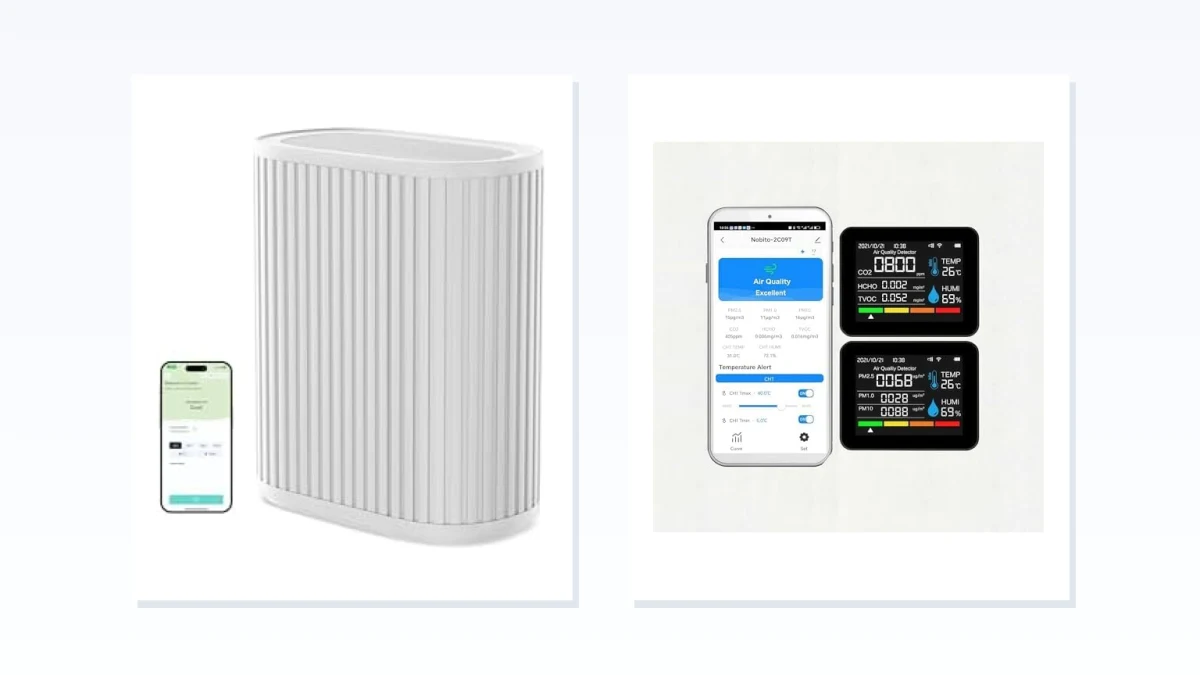
An air purifier and an air quality monitor solve different problems. A purifier changes the air by removing pollutants it is designed to capture. A monitor measures selected pollutants or conditions so you can see when they rise, fall, and respond to changes in your home. If you already know that airborne particles such as dust, pollen, pet dander, or smoke are the problem, a purifier is usually the more useful first purchase. If the problem is unclear—or you specifically want to track PM2.5, CO2, or VOC trends—a monitor can provide information before you choose an intervention.
There is one important exception: neither device should automatically be the first response to every indoor-air problem. A persistent musty odor, visible mold, a combustion concern, or suspected radon calls for finding and addressing the source or using the appropriate dedicated test or safety device. Good indoor air quality depends first on source control, then appropriate ventilation with clean outdoor air, with filtration and monitoring used where they actually help.
Which should you buy first?
| Your Situation | Better First Step |
|---|---|
| You want to reduce known airborne particles such as pollen, pet dander, dust, or smoke | Start with an Air Purifier |
| You want to see whether PM2.5 rises during cooking, smoke events, or other activities | Start with an Air Quality Monitor |
| You want to track CO2 as an indicator of ventilation | Start with a Monitor that actually measures CO2 |
| You are concerned about VOC trends but do not know when or where levels increase | Start with a Monitor that measures VOCs/TVOC |
| You already know you have a particle problem and also want independent data over time | A Purifier + Monitor can make sense |
| You smell persistent mustiness or see mold/moisture damage | Investigate and correct the moisture source first |
| You are concerned about carbon monoxide or radon | Use the appropriate dedicated alarm or test; do not rely on a general IAQ monitor |
The key question is therefore not which device is “better.” It is whether you need measurement first or pollutant reduction first.
Start with an Air Purifier when particles are the known problem
A purifier is the more direct purchase when you already have a particle problem and your goal is to reduce airborne exposure rather than collect more data. Typical examples include pollen, pet dander, fine dust, and smoke particles.
For particle filtration, do not judge a purifier only by the words “HEPA” or by an unusually large advertised coverage number. A HEPA filter is designed to capture at least 99.97% of particles at 0.3 micrometers under its filter test conditions, but the performance of the complete appliance in your room also depends on how much filtered air the fan actually delivers.
For that reason, CADR (Clean Air Delivery Rate) and realistic room sizing are often more useful shopping metrics. Higher CADR means the purifier delivers more cleaned air per unit of time. If an independently verified CADR is available, compare it with the size of the room where the purifier will actually operate rather than assuming that every manufacturer’s maximum-area claim represents the same cleaning rate.
When comparing the purifiers above, focus on these points:
- Particle filtration: Check the stated filter type and the product’s particle-removal performance rather than relying only on marketing labels.
- CADR and room size: A purifier that is too small for the room may clean the air too slowly to be useful. High ceilings and open-plan spaces increase the amount of air that must be treated.
- Noise at useful fan speeds: A high maximum CADR matters less if you will only tolerate the purifier on its lowest setting.
- Replacement filters: Check both replacement cost and the expected replacement interval.
- Activated carbon or other gas media: This can help with some odors and gaseous pollutants, but gas removal depends heavily on the type and amount of sorbent material. A thin carbon layer should not be treated as equivalent to a purifier designed for substantial gas removal.
- Built-in sensors: Some purifiers have particle sensors and automatic fan control. These can be useful for automation, but they do not necessarily measure CO2, VOCs, radon, or other pollutants.
A particle purifier also does not solve every air-quality problem. Standard particle filtration does not remove accumulated carbon dioxide. For VOCs and other gases, source removal and ventilation are often more important, while a purifier requires appropriate gas-phase media to provide meaningful removal. And settled dust still needs cleaning; a purifier only treats air that passes through the device.
Avoid treating ozone generation as an air-cleaning advantage. Ozone is itself a respiratory irritant, and ozone-generating devices are not a substitute for mechanical filtration, source control, or ventilation.
Start with an Air Quality Monitor when you need to understand the pattern first
An air quality monitor is more useful when the main question is what is changing in the room and when. Instead of cleaning the air, it records whichever parameters its sensors are designed to measure.
That distinction matters because “air quality monitor” is not a standardized promise that a device measures everything. One model may measure only PM2.5, temperature, and humidity; another may add CO2; another may report TVOC. A device that lacks the sensor for your pollutant of interest cannot tell you anything about that pollutant.
Common measurements can answer different questions:
- PM2.5 or PM10: Useful for seeing particle spikes from cooking, outdoor smoke, cleaning, candles, or other particle sources.
- CO2: Useful for observing how occupancy and ventilation affect indoor CO2. Rising CO2 can indicate that ventilation is not keeping pace with the people in the room, but CO2 is not a complete measure of indoor air quality.
- VOC/TVOC: Useful mainly for trends and changes after activities such as painting, cleaning, using fragrances, or bringing in new furnishings. Consumer TVOC sensors generally do not identify each individual chemical present.
- Temperature and humidity: Helpful context because indoor comfort, moisture, and sensor readings can all be affected by environmental conditions.
Before choosing a monitor, verify the actual sensor list rather than relying on a generic “multi-function air quality” description. In particular, check whether a CO2 reading comes from a dedicated CO2 sensor or is an estimated value derived from another sensor if that distinction matters for your use case.
Also consider:
- whether historical graphs are available;
- whether data can be viewed without a mandatory cloud service;
- whether alerts can be customized;
- whether the device requires Wi-Fi or an app;
- whether sensor calibration, maintenance, or eventual replacement is documented;
- and whether the display shows the individual measurements you care about rather than only a proprietary color or “air quality score.”
Consumer indoor-air monitors are best treated as measurement and trend tools, not comprehensive diagnostic instruments. Accuracy varies by sensor, pollutant, humidity, placement, calibration, and device design. A monitor can help you see that PM rises every time you cook or that CO2 climbs when a bedroom door is closed overnight; it cannot prove that your home is free of every pollutant it does not measure.
A general-purpose monitor should also not replace certified smoke or carbon-monoxide alarms. Likewise, a standard PM/CO2/VOC monitor cannot rule out radon, asbestos, mold, or other hazards simply because its dashboard looks normal.
Match the pollutant to the action
The biggest mistake in this comparison is assuming that every bad reading points to an air purifier.
If PM2.5 rises, particle filtration may be useful, but first look for the source. Cooking may call for a vented range hood; outdoor smoke may make a properly sized purifier especially valuable.
If CO2 rises, a HEPA purifier will not lower it. The relevant response is usually improved ventilation with suitable outdoor air or changes to occupancy and ventilation practices.
If VOC readings rise, find out what changed. Cleaning products, paint, fragrances, furniture, hobby materials, and other indoor sources may be responsible. Removing or reducing the source and ventilating are usually the first controls. A purifier can supplement those measures only if it contains suitable gas-removal media.
If the concern is persistent dampness or a musty odor, measuring PM or buying a purifier does not fix the underlying moisture problem. Find the leak, condensation, or other moisture source and address contaminated materials as appropriate.
This pollutant-to-action mapping is the strongest reason to buy a monitor first when the problem is genuinely unknown.
When a monitor and purifier work better together
Using both devices can be useful when you want independent measurements as well as active particle filtration. The monitor can show how pollutant levels vary during cooking, cleaning, wildfire-smoke events, ventilation changes, or purifier operation, while the purifier provides the actual particle removal.
A separate monitor can also reveal information that the purifier’s built-in sensor does not measure. For example, a purifier may use a PM sensor for automatic fan control while a separate monitor tracks PM2.5, CO2, humidity, and VOC trends.
Placement matters when you use both. Do not put the monitor directly in the purifier’s clean-air outlet and assume that reading represents the whole room. Follow the monitor manufacturer’s placement instructions and keep it away from locations where a local source, open window, HVAC vent, or purifier outlet would distort the measurement.
You do not need both devices merely because more data sounds better. If the problem is clearly airborne particles and you have no use for trend data, putting the budget into a properly sized purifier and replacement filters may be more useful. If you mainly want to understand ventilation or pollutant patterns, start with the monitor and decide later whether filtration is warranted.
Pre-purchase checklist
- Identify the pollutant or question you are actually trying to address: particles, CO2, VOCs, humidity, odors, or an unknown source.
- For a purifier, compare CADR and realistic room size rather than relying only on maximum-coverage marketing.
- Check the purifier’s filter type and whether meaningful gas-removal media is included if gases or odors matter.
- Check replacement-filter price, availability, expected life, energy use, and noise at the fan speed you expect to use.
- For a monitor, verify every sensor individually; do not assume “air quality” means PM, CO2, and VOC measurement are all included.
- Check whether the monitor provides historical data, alerts, local display, app access, and any calibration or maintenance guidance you need.
- Keep certified smoke and carbon-monoxide alarms in their proper roles; a general IAQ monitor is not a replacement.
- Use a dedicated radon test or monitor when radon is the concern.
- Investigate moisture sources when persistent musty odors, dampness, or visible mold are present instead of expecting either device to solve the cause.
The simplest decision is this: buy the purifier first when you already know you need particle removal; buy the monitor first when measurement will change what you do next. If the monitor reveals high CO2, improve ventilation rather than buying a HEPA unit for that problem. If it repeatedly shows particle spikes, a correctly sized purifier may be the logical next purchase. If it shows a pattern tied to an identifiable indoor source, removing or controlling that source may matter more than either device.