
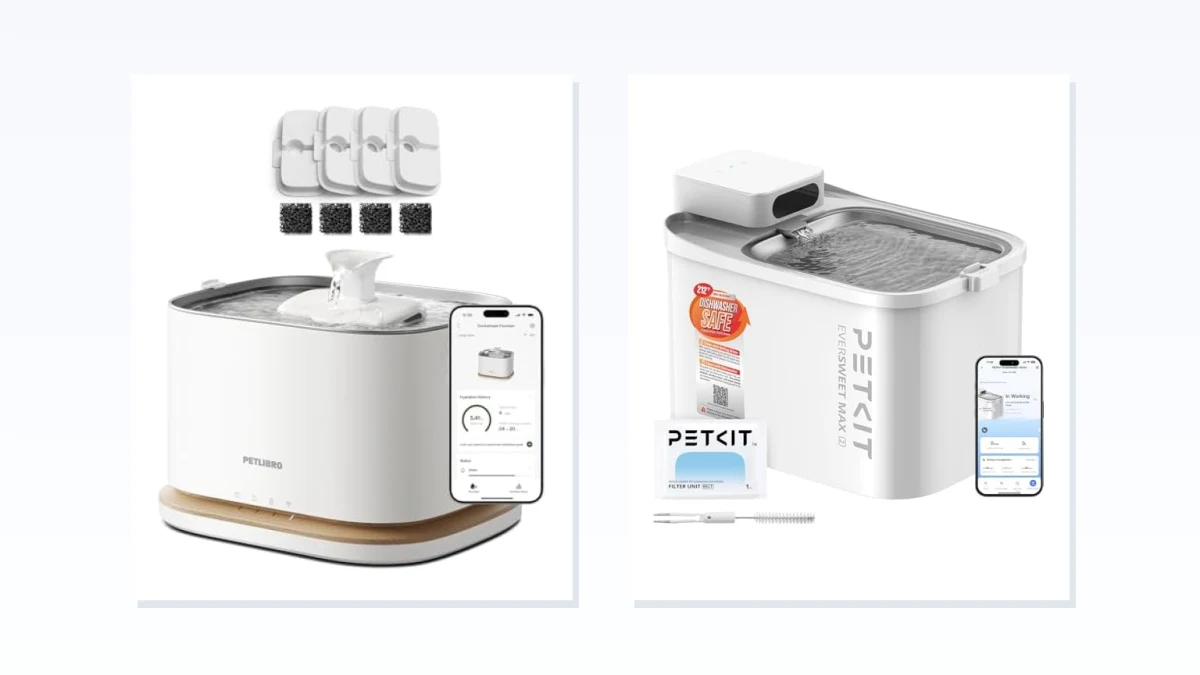
This comparison separates the products shown by fountain material rather than treating every cat water fountain as interchangeable. The current set is uneven: six products describe stainless steel trays or bodies, while only two entries are plastic, and one of those is closer to a filtered automatic water dispenser than a conventional circulating fountain. The smaller plastic section is therefore a limited comparison set, not evidence that the two materials have equal representation.
Material is only one part of the decision. Cleaning instructions, removable parts, filter schedules, pump design, battery operation, app features, and published noise figures all vary by model. One stainless steel product specifies a dishwasher-safe stainless part, while one plastic fountain lists a removable tank and cleaning brush. Noise also crosses the material split: a plastic model lists below 25 dB, while one stainless steel model lists below 30 dB. Use the material as the first filter, then compare the maintenance details that are actually documented for each product.
Stainless steel or plastic: what actually separates the two sets
| If your priority is... | What to look at |
|---|---|
| A fountain with a visibly specified stainless steel tray or body | The stainless steel products shown below |
| A dishwasher-safe component | Verify the exact removable part; one stainless model specifically marks its stainless steel part as dishwasher safe |
| The lowest current purchase price | Compare the live prices of both sections rather than assuming material alone determines price |
| Very low published operating noise | Compare model-level ratings; one plastic model lists below 25 dB and one stainless model lists below 30 dB |
| Cordless or wireless operation | Available features vary by model in both the broader set and the plastic section |
| App-based reminders or drinking data | Check each model individually; some products advertise tracking or maintenance reminders |
| Predictable filter maintenance | Prefer a listing that states the replacement interval and verify replacement-filter availability and cost before buying |
Ceramic fountains are not included in the products currently shown, so this page does not use ceramic as a substitute for missing plastic or stainless steel options.
Start with two questions: material preference or documented maintenance?
First decide whether a stainless steel water-contact surface is itself important to you. If it is, the stainless section provides the much larger selection on this page. One product explicitly identifies 304 stainless steel, and one listing marks the stainless steel component as dishwasher safe. Those are useful model-specific details; they should not be generalized to every stainless fountain.
If material is secondary, compare the practical maintenance information instead. Does the tank come apart? Which pieces can be washed normally or in a dishwasher? How often does the manufacturer say to replace the filter? Is the pump wired, wireless, or battery-powered? Are replacement filters readily available? A plastic model can have stronger documentation for one of these points than a stainless model, so material alone should not settle the purchase.
Ceramic, feeder combos, and health claims: boundaries of this comparison
This page covers products currently shown inside the cat-water-fountain category, including circulating fountains and the filtered dispenser-style entry included in the plastic set. Automatic feeders, feeder-and-water combos from other categories, aquariums, decorative fountains, and water additives are outside the comparison.
Ceramic is also outside the product comparison because no ceramic model is currently shown here.
The page does not claim that one fountain material prevents feline chin acne, prevents bacterial growth, or produces urinary or kidney health benefits. Those are health-related questions that cannot be established from the product specifications used for this comparison. A fountain can be evaluated here for material, filtration, cleaning instructions, noise, power, battery features, and app functions without turning those specifications into a medical claim.
Stainless Steel Cat Water Fountains: the larger material set
Six products in the current selection describe stainless steel trays or bodies. The listings do not all describe the material in the same way, so check whether stainless steel refers to the water tray, drinking surface, reservoir, or a larger part of the body.
One model specifies 304 stainless steel and identifies its stainless component as dishwasher safe. That is a meaningful cleaning feature for that particular removable part, but it does not mean the pump, electronics, base, or every component of the fountain can be placed in a dishwasher. Follow the cleaning instructions for the exact model.
Noise specifications are also inconsistent across the set. One stainless product lists operation below 30 dB, while other listings use non-numeric descriptions such as "quiet" or "whisper-silent." A numeric figure is easier to compare, but even published dB numbers should be treated as model specifications rather than a property of stainless steel itself.
The stainless group also contains some of the more detailed power and app features in the products shown. The selection includes cordless or wireless-pump designs, a model advertising up to 30 days of battery life, and app-connected products that list functions such as drinking or hydration tracking, filter-change reminders, and cleaning reminders.
Filter schedules differ even within this one material group. Visible intervals include approximately every 2 weeks and every 2-4 weeks. That variation is important: the filter schedule belongs to the fountain and filter system, not to stainless steel as a material.
Use the product cards to verify the details that matter for the specific model: which component is stainless steel, whether that component is dishwasher safe, the stated noise figure, battery duration, charging method, app functions, and recommended filter interval. Do not transfer a feature from one stainless product to the entire group.
From stainless steel to plastic: which differences are real?
Changing material does not automatically tell you which fountain will be quieter, which filter will last longer, or which model will require less total maintenance. The listings on this page do not support those blanket conclusions.
The clearest cleaning-related stainless specification is model-specific: one fountain marks its stainless steel component as dishwasher safe. In the plastic set, one cordless fountain instead lists a removable tank and includes a cleaning brush. Those are different approaches to maintenance, and either may matter more than the material label depending on how you prefer to clean the fountain.
Noise provides another useful counterexample to material-based assumptions. One plastic fountain lists below 25 dB, while the visible numeric stainless specification is below 30 dB. Compare those numbers only as specifications of the individual products; they do not establish that plastic fountains are generally quieter.
Filter maintenance is even less suitable for a material-wide conclusion. Several stainless listings provide replacement intervals, while neither plastic entry in the current set provides a visible interval. That means the plastic filter schedule cannot be inferred from the stainless products or from the housing material.
Plastic Cat Water Fountains and Filtered Dispensers
Only two plastic products currently support this side of the comparison, so the range is much narrower than the stainless selection.
The more fully documented plastic fountain is cordless and lists multi-layer filtration, a removable tank, a cleaning brush, app reminders for filter replacement and cleaning, and a published noise level below 25 dB. Those details make it possible to evaluate several maintenance and usability points without assuming that they apply to other plastic fountains.
The second product is an automatic water dispenser with filtration and wireless charging. Its visible specifications are more limited, and its dispenser-style design should not automatically be treated as equivalent to every circulating fountain in the stainless section.
Neither plastic listing in the current set visibly specifies BPA-free construction. Neither provides a visible filter-replacement interval or annual filter cost. Those omissions should remain omissions rather than being filled with assumptions.
If one of these plastic products is attractive because of its current price or features, verify the exact filter model, replacement availability, recommended replacement interval, cleaning instructions, and water-contact materials on the product page before deciding. The small number of plastic entries makes model-level verification especially important.
Filter schedules, noise, and cleaning cannot be inferred from material alone
Three specifications on this page are easy to overgeneralize.
Filter interval: the stainless products with published schedules range from about every 2 weeks to every 2-4 weeks. The plastic products shown do not provide a visible replacement interval. There is therefore no basis here for saying that plastic requires more frequent filter replacement or that stainless filters last longer.
Noise: one plastic fountain lists below 25 dB and one stainless fountain lists below 30 dB. Other products may provide only descriptive wording. Noise depends on the individual pump and fountain design, so compare published specifications product by product.
Cleaning: one stainless model identifies a dishwasher-safe stainless component, while one plastic fountain provides a removable tank and cleaning brush. These are useful documented features, but they do not establish a universal cleaning schedule for either material.
Filter cost is another model-level check. A replacement interval without the price and pack size of compatible filters is not enough to calculate annual maintenance cost.
Two common mistakes when choosing between stainless steel and plastic
The first mistake is choosing stainless steel and then assuming all maintenance questions are solved. A metal drinking surface does not remove the need to clean the reservoir and pump or replace the filter according to the manufacturer's instructions. Even within the stainless products shown here, published filter intervals differ.
The second mistake is rejecting or choosing plastic based on assumptions about the material rather than the actual listing. The better-documented plastic fountain on this page has a removable tank, cleaning brush, app maintenance reminders, and a below-25 dB noise specification. At the same time, its visible listing does not provide a filter interval, so that recurring-maintenance detail still needs verification.
Choose the fountain whose documented maintenance routine fits your household. If stainless steel is an important material preference, the current page offers a substantially broader stainless selection. If price, noise, cordless operation, or app features matter more, compare those specifications across both sections instead of using the housing material as a shortcut. Neither material, by itself, establishes filter life, cleaning frequency, operating noise, or a health outcome.