
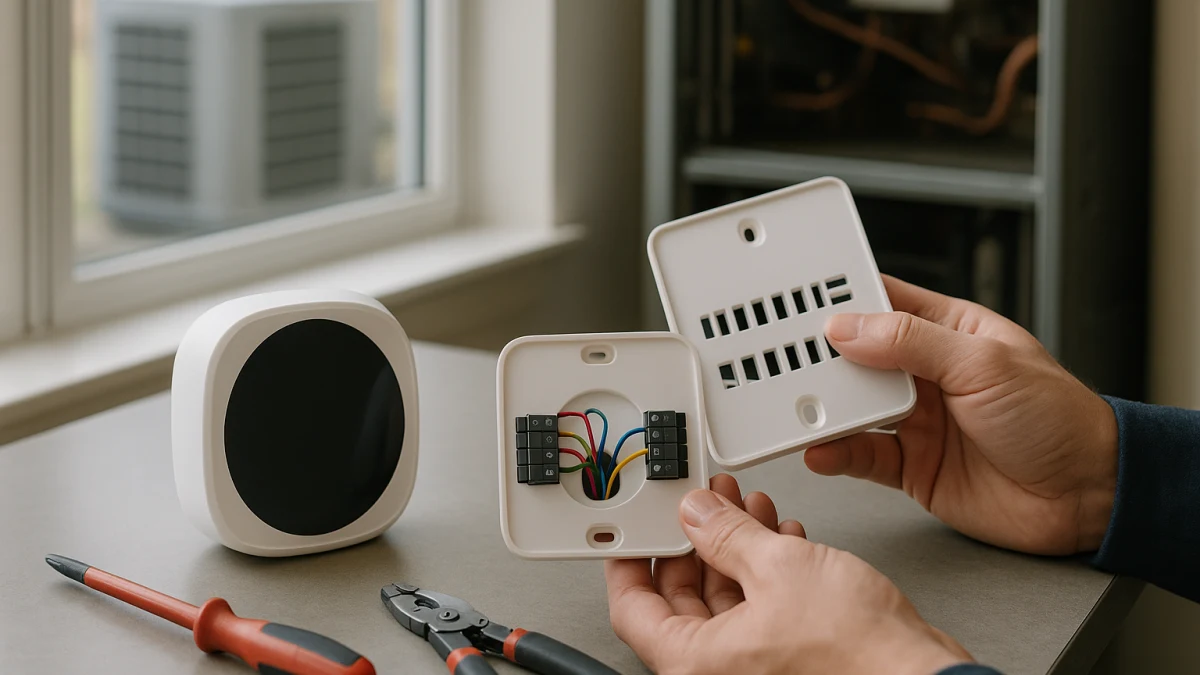
A smart thermostat can have Wi-Fi, app control, Alexa, Google, or familiar smart-home branding and still be the wrong match for a heat pump. Heat pump shoppers have to look past the app badge and read the HVAC compatibility language: heat pump, O/B reversing valve, C-wire or power requirements, voltage, supported system types, stages, and backup heat wording.
This page is intentionally uneven: the first product group is the broader standard heat-pump-compatible shortlist, while the second is a narrower path for systems that mention auxiliary heat, emergency heat, backup heat, electric backup, 3H/2C, or Aux/Emerg. That distinction is the value here; a normal smart thermostat category page does not reliably separate general smart-home compatibility from heat pump control requirements.
Start with the heat pump wording, not the app badge
| If your situation sounds like this | Better fit |
|---|---|
| Your search results mostly mention Wi-Fi, app control, Alexa, Google, or smart-home platforms. | Treat that as insufficient. Look for visible heat pump compatibility, O/B, supported HVAC system types, and manufacturer specifications before choosing either product group. |
| Your system is a heat pump and the listing explicitly names heat pump compatibility, but your setup does not mention backup heat terms. | Heat-pump-compatible smart thermostats. |
| Your setup includes auxiliary heat, emergency heat, backup heat, electric backup, Aux/Emerg, 3H/2C, 3 heat/2 cool, or 2 stages Aux language. | Smart thermostats with auxiliary or emergency heat support. |
| Your equipment is a mini-split, window AC, portable AC, baseboard, floor heating, line-voltage control, proprietary system, or unclear wiring setup. | Do not assume either product group is enough; verify manufacturer compatibility documentation for the exact system before buying. |
Use five checks as you compare: whether heat pump compatibility is actually named, whether O/B and supported HVAC system types are addressed, whether Aux/Emerg or backup heat is mentioned, whether C-wire or 24V power and voltage requirements match your wiring, and whether the product is truly a low-voltage heat pump thermostat rather than a nearby climate-control product.
Read the wiring language before the smart-home features
Before comparing app features, scan the product page for HVAC terms that matter to a heat pump:
- Heat pump compatibility should be explicit, not inferred from smart thermostat or Wi-Fi language.
- O/B matters because heat pumps use a reversing valve, and thermostat support is model-specific.
- C-wire, 24V, voltage, and terminal requirements can decide whether a thermostat is suitable for your wiring.
- Supported HVAC system types should match your actual equipment, not just a broad heating-and-cooling claim.
- Stages and backup heat terms should be checked if your current thermostat or system documentation mentions Aux, Emerg, backup, electric backup, 3H/2C, or similar language.
If those details are missing or unclear, the product may still be worth researching, but it should not be treated as confirmed compatible from smart-home branding alone.
False friends: AC controllers, mini-splits, and line-voltage heating controls
Some products can appear near smart thermostat searches even though they are not interchangeable with a heat pump thermostat. Be careful with listings centered on mini-splits, window AC units, portable AC units, general AC controllers, baseboard heating, floor heating, or line-voltage control.
Those products may control climate equipment, but that does not mean they support the same wiring, voltage, terminals, O/B operation, or staged heat pump behavior as a conventional smart thermostat. Keep them out of your shortlist unless the manufacturer documentation clearly supports your exact wiring type and heat pump system.
Heat pump compatibility checks: O/B, C-wire, voltage, stages, and backup heat
Before buying, check the product page and manufacturer compatibility information for:
- Your current thermostat wires and whether an O/B terminal is required.
- Whether the thermostat needs a C-wire, power adapter, or specific 24V setup.
- The stated voltage and whether the product is meant for your HVAC control type.
- The supported HVAC system types, including heat pump wording.
- The number of supported heat and cool stages, if your system is staged.
- Whether auxiliary heat, emergency heat, backup heat, electric backup, dual fuel, or Aux/Emerg is explicitly supported when your system needs it.
Catalog wording can help you build a shortlist, but it cannot prove compatibility with every heat pump configuration or wiring setup.
Smart thermostats that clearly name heat pump compatibility
Start here if you have a heat pump system and want the main first-pass shortlist. The products shown in this group are smart thermostat listings whose visible information names heat pump compatibility alongside smart thermostat, Wi-Fi, Learning Thermostat, or Nest-type smart thermostat language.
That wording is useful because it separates heat-pump-relevant thermostats from generic connected thermostats. Still, do not let Alexa, Google, app control, or Wi-Fi language do the compatibility work. Open the product details and check C-wire or power requirements, voltage, terminals, O/B support, and the supported HVAC system types before treating any listing as a fit.
Read these products as a heat-pump-compatible shortlist, not as a guarantee for every home. They are most useful for comparing smart thermostats that visibly say they support heat pumps, but they should not be assumed to support auxiliary heat, emergency heat, backup heat, dual-fuel equipment, or higher-stage configurations unless the individual listing or manufacturer specs say so. If your system paperwork or current thermostat mentions Aux/Emerg, backup heat, 3H/2C, 3 heat/2 cool, or 2 stages Aux, continue to the narrower section below.
If you see Aux/Emerg or backup heat, do not stop at generic heat pump support
Generic heat pump compatibility is not the same as backup-heat compatibility. Move to the narrower product group when you see any of these terms in your system documentation, current thermostat wiring, or product requirements:
- Auxiliary heat or Aux
- Emergency heat or Emerg
- Backup heat or electric backup
- 3H/2C or 3 heat/2 cool
- 2 stages Aux or Aux/Emerg stage language
- Dual fuel, but only when the individual thermostat listing or manufacturer documentation explicitly supports it
The point is not that every heat pump shopper needs the second group. The point is that shoppers with backup heat or staged heat pump requirements should not stop at a thermostat that only says heat pump in a broad way.
Backup-heat heat pump thermostats: Aux/Emerg and staged-control listings
Use this smaller, more conditional group only if your heat pump setup requires auxiliary heat, emergency heat, backup heat, electric backup, Aux/Emerg, 3H/2C, 3 heat/2 cool, or 2 stages Aux language. These listings are useful because they visibly combine smart or Wi-Fi thermostat language with heat pump support and some form of backup-heat or staged-control wording.
This is not a universal upgrade over the first group. It is a specialized compatibility subset for systems with backup heat or staged heat pump control needs. For each product, check the exact stage support, C-wire or 24V requirements, terminal labels, and whether the manufacturer states compatibility with your specific heat pump configuration. Do not infer dual-fuel, lockout, or every Aux/Emerg setup from generic multi-stage wording alone.
Manufacturer specs decide heat pump stages and backup heat compatibility
Treat product-card language as a starting point, not the final answer. Claims involving heat pump stages, O/B, 2H/1C, 3H/2C, auxiliary heat, emergency heat, backup heat, electric backup, dual fuel, lockout behavior, or supported terminals need to match manufacturer documentation for the specific model.
That matters because two thermostats can both be smart, Wi-Fi-enabled, and heat-pump-compatible while supporting different wiring arrangements or stage combinations. If a listing does not clearly state the exact backup heat or staged control your system uses, verify before buying rather than assuming compatibility.
When neither thermostat widget is enough
Skip both product groups for now if the real issue is not simply choosing a compatible smart thermostat. Manufacturer or official guidance matters more when:
- Your system is proprietary or uses unusual thermostat wiring.
- You are unsure whether the system is low-voltage, line-voltage, or something else.
- Your setup may be dual fuel, but the thermostat listing does not explicitly say dual fuel support.
- C-wire, 24V power, voltage, or terminal compatibility is unclear.
- Your current system needs HVAC repair, rewiring, or diagnosis before a thermostat can be selected confidently.
- The product you are considering is primarily for mini-splits, window AC, portable AC, baseboard heat, floor heating, or another adjacent control category.
The right smart thermostat is the one whose manufacturer specs match your heat pump’s wiring, voltage, stages, and backup heat requirements—not simply the one with the strongest app or smart-home branding.