
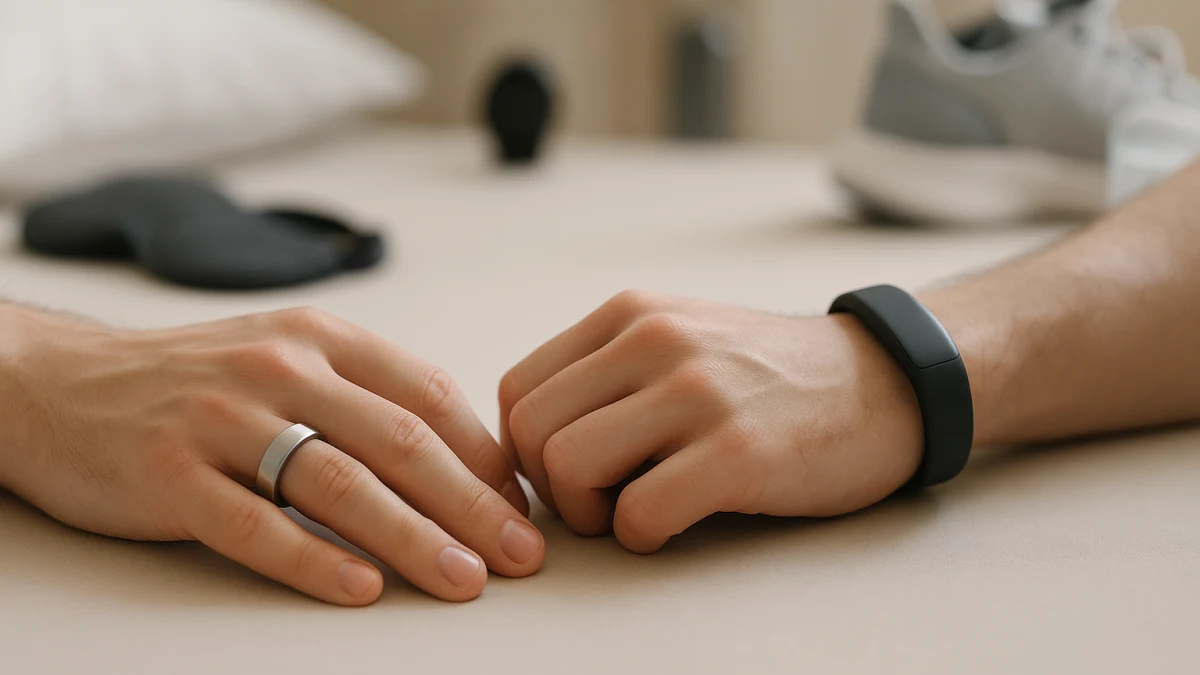
Smart rings and fitness trackers can surface many of the same wellness metrics, but they are built around different interaction styles. A smart ring is typically the more discreet, screen-free option for passive tracking, while a fitness tracker puts activity data, workout controls, and notifications where you can see them on your wrist.
Start with that difference rather than the longest feature list. Then compare sleep comfort, fit, workout interaction, battery claims, water-resistance guidance, phone compatibility, subscriptions, and the exact health metrics supported by each device. If calls, apps, voice assistants, and richer phone controls are the real priority, a smartwatch is usually the more relevant category.
Smart ring vs fitness tracker: which format fits you?
| If this sounds like you | Better fit |
|---|---|
| You want passive sleep, recovery, heart-rate, or activity tracking without a watch-style screen. | Smart ring |
| You want steps, workout modes, heart rate, distance, active minutes, or other stats visible during the day. | Fitness tracker |
| You dislike sleeping with a wrist band and are comfortable checking ring sizing carefully. | Smart ring |
| You want to start workouts, check progress, or read basic notifications directly from the device. | Fitness tracker |
| Calls, apps, voice assistants, richer notifications, or phone controls matter more than discreet tracking. | Smartwatch |
The important tradeoffs are not simply which device lists more sensors. Decide where you want feedback to appear, how you want the wearable to feel during sleep and exercise, and how much interaction you expect without opening your phone.
Choose passive tracking or visible feedback first
A smart ring is usually designed to collect data quietly in the background. Many models focus on sleep, heart rate, heart-rate variability, activity, recovery-style insights, temperature trends, or blood-oxygen-related measurements without putting a conventional display on your finger.
A fitness tracker is more interactive. Its display can show steps, heart rate, workout progress, timers, notifications, and other information while you are walking or exercising.
That difference matters more than overlapping feature labels. A ring can be frustrating if you later discover that you wanted live workout information or on-device controls. A wrist tracker can be unnecessarily distracting if your main goal was passive overnight tracking with fewer screens.
Smart rings: discreet tracking without a watch-style screen
Smart rings make the most sense when the form factor itself solves a problem. They occupy less space than a watch, usually avoid a conventional display, and can be easier to ignore during the day.
Depending on the model, listings may mention:
- sleep tracking;
- heart rate and resting heart rate;
- heart-rate variability (HRV);
- activity and step tracking;
- blood oxygen or SpO2-related measurements;
- temperature trends;
- stress or recovery-style metrics;
- calories or distance estimates;
- NFC or other smart functions.
These features are highly model-dependent. Do not treat "smart ring" as a guarantee that every ring supports the same measurements, and do not assume that similarly named metrics are calculated in the same way across brands.
Use this shortlist to compare ring-specific factors first: supported metrics, app compatibility, sizing method, charging method, battery claim, water-resistance guidance, subscription requirements, and whether the ring provides useful information without requiring constant interaction with an app.
Ring sizing is part of the product decision
Sizing deserves more attention with a ring than with most wrist wearables. A correct nominal ring size does not guarantee that every smart ring will fit the same way because dimensions, sensor placement, width, and internal shape can differ between models.
Before buying, check whether the manufacturer provides a sizing kit or model-specific size chart. If a sizing kit is available, using it before ordering the final ring is usually safer than assuming your jewelry size will transfer directly.
Also consider how your fingers change during normal use. Heat, sleep, exercise, hydration, and time of day can affect finger size. The ring should remain secure enough for its sensors to maintain contact without becoming uncomfortably tight.
Return and size-exchange rules are therefore especially important for this category.
Fitness trackers: better for stats you want to see
A fitness tracker is usually the better fit when you want activity information available without reaching for your phone. Even relatively simple bands can provide a screen for checking steps, heart rate, workout status, alarms, timers, and basic notifications.
Depending on the model, a tracker may offer:
- steps and active minutes;
- heart-rate monitoring;
- sleep tracking;
- workout or sports modes;
- distance and pace;
- calorie estimates;
- blood oxygen or SpO2-related measurements;
- timers and alarms;
- phone notifications;
- music or camera controls.
Display technology also changes the experience. AMOLED, LCD/TFT, touchscreen controls, brightness, always-on-display options, and screen size can matter if you regularly check the device outdoors or during exercise.
If workout tracking is important, inspect the exact model rather than relying on the number of advertised sports modes. Check what the device actually records during those modes and whether route tracking uses built-in GPS, a connected phone, or no GPS at all.
Sleep comfort is not automatically better on one form factor
A ring can feel less watch-like during sleep, but it is not automatically more comfortable for everyone. Some people dislike pressure on a finger, especially when their fingers swell overnight. Others find a wrist band more noticeable because of the case, strap, or display.
The better choice is the device you are likely to keep wearing consistently.
If sleep tracking is your main reason for buying, compare:
- overnight fit;
- charging frequency;
- whether charging interrupts your normal sleep schedule;
- how much useful sleep history the app keeps;
- whether detailed insights require a subscription.
Remember that consumer wearables estimate sleep from sensor data. Sleep stages and related scores should not be treated as equivalent to a clinical sleep study.
Water resistance: read the manufacturer guidance, not just the badge
Water-resistance labels need context. Listings may use ATM ratings, IP ratings, depth-related wording, or broad terms such as "waterproof," but these are not interchangeable promises.
An IP rating and an ATM rating describe different testing conditions. A depth-style water-resistance rating also should not be interpreted as permission to use the device at that literal depth in every real-world situation.
If you plan to swim, shower, train in water, or wear the device continuously, check the manufacturer's instructions for the exact model. Pay attention to restrictions involving swimming, diving, hot water, saunas, high-pressure water, salt water, or damaged seals.
Compare battery claims under the same assumptions
Both rings and wrist trackers are commonly marketed with multi-day battery claims, but advertised runtime can depend heavily on enabled features and test conditions.
For fitness trackers, display brightness, always-on display, frequent notifications, workout tracking, GPS, and sensor settings can change battery life. Rings do not have a large screen to power, but measurement frequency, continuous features, battery size, and ring size can still affect runtime.
Compare the manufacturer's stated typical-use conditions rather than choosing solely by the largest advertised number. Also check charging time and charging hardware: a device that lasts longer is not necessarily more convenient if its charger is proprietary or difficult to replace.
Notifications can change the whole experience
A major advantage of a screen-free ring is that it can keep the wearable itself out of your attention loop. You normally review the data in the companion app rather than receiving a stream of information on the device.
Fitness trackers can sit somewhere between a passive ring and a full smartwatch. Some provide only basic alerts, while others display messages, control music, trigger a phone camera, show weather, or offer additional utilities.
If you are intentionally trying to reduce screen checks, verify that notifications can be disabled or limited. If you want richer interaction, make sure a basic tracker actually supports it before buying.
When a fitness tracker becomes smartwatch-like
The boundary between fitness trackers and smartwatches is not absolute. Some compact trackers now include increasingly watch-like displays and controls.
The practical distinction is what you expect the wearable to do.
If the main job is activity and wellness tracking with quick visible feedback, stay in the fitness tracker category. If you primarily want calls, substantial message interaction, apps, voice-assistant features, richer controls, or a larger interface, compare smartwatches instead.
Smartwatches: the fallback when controls matter more
A smartwatch is not simply a better fitness tracker. It makes a different tradeoff by adding a larger interactive screen and deeper phone-related functionality.
Depending on the platform and model, smartwatch features can include calls, richer notifications, apps, voice assistants, music controls, navigation, timers, weather, contactless payments, and more advanced interaction with a paired phone.
Treat these products as an alternative only if those capabilities are important enough to justify a larger screen and more wrist interaction. For discreet passive tracking, return to smart rings. For visible activity feedback without needing a full app-oriented watch, compare fitness trackers.
Health metrics need device-specific verification
Wearable listings often place many health-related terms next to one another, but the presence of a sensor or metric does not by itself establish medical accuracy or diagnostic capability.
Heart rate, HRV, SpO2, sleep stages, calorie estimates, stress scores, recovery scores, temperature trends, and similar measurements are generally best treated as consumer wellness data unless the exact device has appropriate regulatory authorization for a specific medical function in your region.
Be particularly cautious with claims involving:
- ECG;
- atrial fibrillation or arrhythmia detection;
- blood pressure;
- sleep apnea;
- medical-grade monitoring;
- diagnosis or treatment of a health condition.
If one of those capabilities is central to your purchase, verify the exact model, feature availability in your country, manufacturer documentation, and any applicable regulatory authorization. Do not infer a medical capability from general health-tracking language.
Final checks before choosing a discreet wearable
Before following an offer to a retailer, verify the details that are most likely to change the ownership experience:
- For rings: exact size, sizing-kit process, exchange policy, charging method, and whether the sensors or shape affect fit.
- For trackers: band fit, clasp type, display readability, touch controls, and comfort during sleep.
- For workouts: available sports modes, the data recorded in each mode, and whether GPS is built in or phone-assisted.
- For water exposure: the manufacturer's usage guidance, not just an IP, ATM, or depth label.
- For battery life: the conditions behind the advertised runtime and which features shorten it.
- For phones and apps: Android/iOS requirements, Bluetooth compatibility, notification controls, and regional feature restrictions.
- For subscriptions: whether important history, scores, coaching, or insights require an ongoing paid plan.
- For health features: support for the exact metric you want and the limits the manufacturer places on its use.
Choose a smart ring when discreet, passive tracking and a screen-free form factor matter most. Choose a fitness tracker when visible activity data and workout interaction matter more. Move to a smartwatch only when richer controls and phone integration are part of the actual buying requirement.