
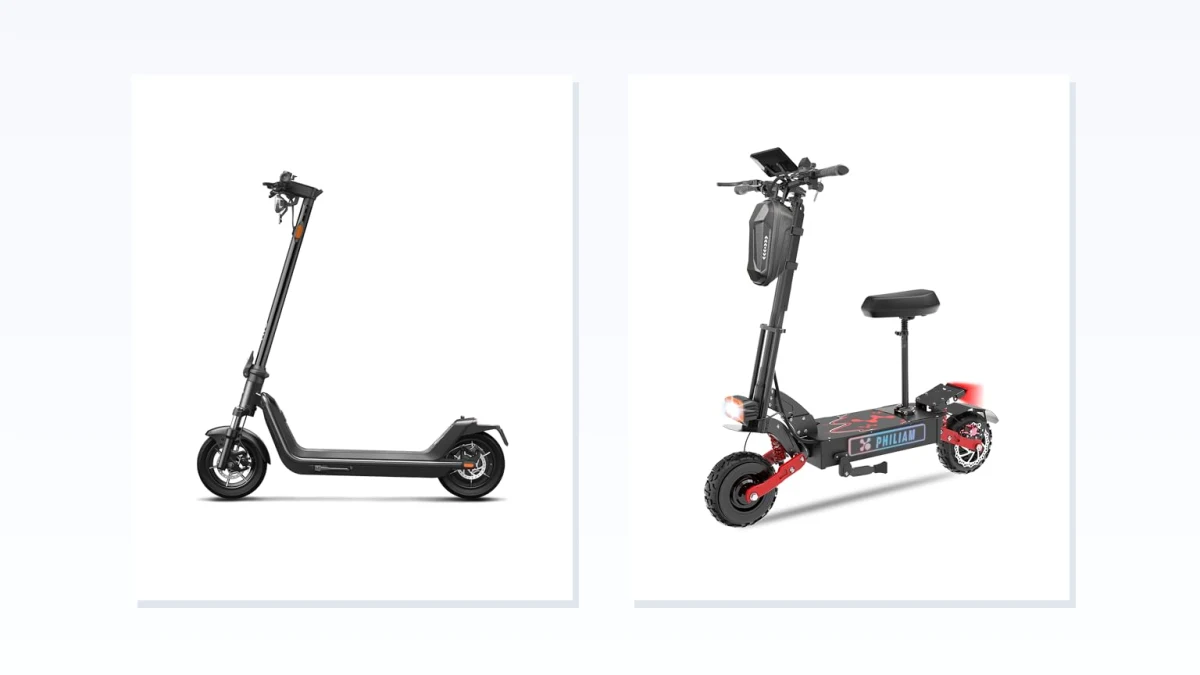
Fast answer: neither riding position is automatically better, and trip length alone should not decide it. Start with a standing scooter if you prefer a conventional kick-scooter deck and are comfortable supporting yourself for the whole ride. Start with a seated model if sitting is a firm comfort or access requirement. Then compare the exact scooter's fit, tires, suspension, brakes, rated range, rider/load limit, weight, and folded size.
A seat removes the need to remain standing continuously, but it does not automatically make a scooter smoother, safer, more stable, or suitable for a heavier rider. A standing position usually puts the rider's eyes higher, but that is not a blanket safety advantage. Those outcomes depend on the complete scooter, the rider, and the route.
The Real Decision: Posture First, Then the Scooter
| If you need... | Better fit | Why |
|---|---|---|
| To sit for most or all of the ride | A factory-seated scooter or a model with a manufacturer-approved seat | Confirm the exact configuration, seat attachment, rider/load limit, foot position, and access to the controls. |
| A conventional stand-up deck with no seat hardware | A standing electric scooter | Check deck space, handlebar height, tire and suspension setup, braking, and whether you can remain comfortable on your actual route. |
| The smallest or easiest scooter to carry | Whichever exact model is lighter and folds smaller | A seat can add bulk, but some standing performance scooters are also heavy. Compare measured weight and folded dimensions rather than posture labels. |
| More comfort on rough pavement | Neither posture by itself | Tire size and type, suspension, deck or saddle ergonomics, speed, and road surface matter more than the presence of a seat alone. |
| A higher rider capacity | Neither posture by itself | Use the scooter's published maximum rider/load limit. If the seat has its own stated limit, check that too. |
| The option to add a seat later | A model with an explicitly listed manufacturer seat or conversion | Verify the exact model and version, required hardware, installation instructions, warranty terms, and any separate seat limit before ordering. |
This is a comparison of adult electric scooters, not medical mobility equipment. Mobility scooters, wheelchairs, kids' rides, tricycles, e-bikes, hoverboards, unicycles, and rideable luggage solve different problems and are outside this guide.
Standing Electric Scooters: Compare the Whole Platform
A standing model is the clearest starting point when you want the familiar kick-scooter layout and do not need a seat. Do not reduce that choice to “short trips only.” A well-fitted standing scooter may work for a longer route, while an uncomfortable one may feel wrong after a few minutes.
Before comparing range or top speed, check whether the scooter fits you: enough deck space for a stable stance, a usable handlebar height, controls you can reach without changing your grip, and a folded weight you can actually lift if stairs or transit are part of the trip. For ride quality, look at the tire construction and suspension rather than assuming standing means harsh or agile. For stopping, compare the actual brake system and learn how that model responds before riding in traffic.
Use the products above as models to investigate, not as proof that every standing scooter behaves the same way. Range changes with rider weight, speed, hills, temperature, and surface. Solid tires can reduce puncture concerns but do not feel the same as pneumatic tires. A folding mechanism helps only if the folded dimensions and total weight work for your storage and carrying routine.
Seated Electric Scooters: Verify What Is Included
A seated scooter is worth considering when sitting is important enough to shape the purchase. That may be because you prefer not to stand continuously, because the seated posture feels better during a test ride, or because a seat and basket suit the way you carry everyday items. None of those reasons requires a universal rule about distance.
The critical question is what the exact product includes. “Seated,” “seat included,” “removable seat,” and “seat-compatible” are different configurations. A complete seated scooter can be ready to ride as sold. An optional manufacturer seat may be a separate purchase. A generic aftermarket kit may not fit the deck, frame, or mounting points at all.
Compare saddle height and adjustment, where your feet rest, access to the throttle and brakes, tire and suspension setup, and whether the seat or basket changes folding. Check the scooter's maximum rider/load limit; only look for a separate seat limit when the manufacturer publishes one. Higher capacity and a smoother ride are model-level characteristics, not benefits guaranteed by the seated category.
Some standing scooters can legitimately appear in a seat-compatible comparison when the manufacturer sells a model-specific accessory. For example, Hiboy's official seat page lists the exact scooter families it fits and states that the scooter itself is not included. That level of model-specific evidence is the standard to look for.
Factory Seat, Official Accessory, or Aftermarket Kit?
Treat these as three different purchase paths:
- Factory-seated or seat-included configuration: verify that the seat is part of the exact SKU, not merely shown as an option in a photo or variation selector.
- Manufacturer-listed accessory: match the scooter model and version to the manufacturer's compatibility list, installation instructions, and warranty terms.
- Third-party aftermarket kit: do not assume compatibility from a similar-looking deck. Get written confirmation from the scooter or seat manufacturer before relying on it.
Also check whether removing the seat leaves exposed mounting hardware, whether the scooter still folds as expected, and whether installing or removing the seat changes the warranty. If the documentation is unclear, treat compatibility as unresolved.
Riding Position Is Not a Safety Shortcut
Standing can allow active body movement and usually creates a higher eye level. Sitting changes how the rider's weight is supported. Neither fact proves that one design is safer, more stable, or better in traffic across all scooters.
The U.S. Consumer Product Safety Commission's electric-scooter safety alert recommends checking the handlebars, brakes, throttle, lights, tires, cables, and frame, testing the brakes, watching for surface hazards, wearing a helmet, and following the manufacturer's rider limits. Those checks apply in both positions. If a product mentions UL 2272, remember that the standard concerns the electrical system and fire risk; it does not establish seat compatibility or superior handling.
Before relying on either posture, confirm that you can start, steer, brake, look around, and dismount comfortably. A test ride on a legal, controlled route is more informative than a posture label when one is available.
Pre-Purchase Checklist
- Identify the exact model, version, and included configuration.
- Check the scooter's published maximum rider/load limit and any separately stated seat limit.
- Compare handlebar height, deck space, saddle adjustment, and foot position for your body.
- Compare tire type and size, suspension, brake setup, and lighting for your route.
- Check scooter weight, folded dimensions, carrying points, and whether the seat must be removed to fold it.
- Treat advertised range as a model claim that varies with conditions, not a guaranteed commute distance.
- For any add-on seat, verify model compatibility, mounting hardware, installation instructions, and warranty coverage with the manufacturer.
- Check local rules for where and how the scooter may be ridden, regardless of posture.
The useful dividing line is simple: if sitting is non-negotiable, begin with a confirmed seat-included scooter or an officially supported seat option. If it is not, begin with standing models and compare their actual fit and hardware. In both cases, the right choice comes from the complete model and your route—not from a rule that short rides require standing or long rides require a seat.