
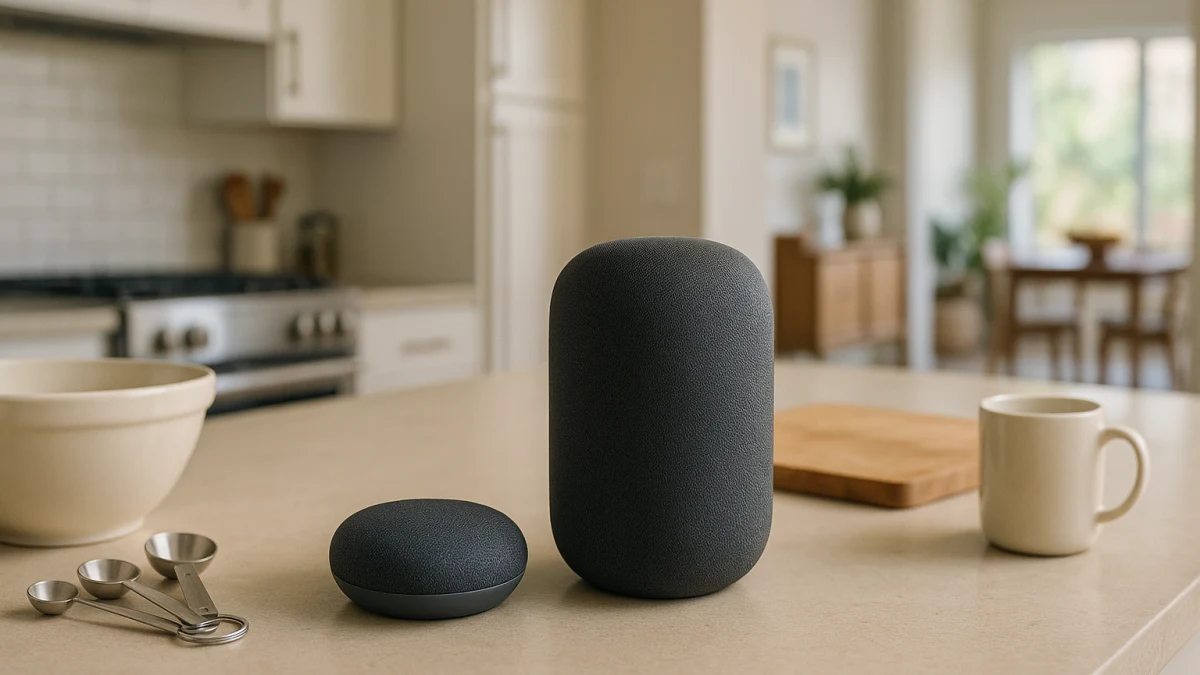
For a kitchen, the useful smart-speaker choice is usually not “which speaker has the most features?” but “how much space and sound does this room need?” A compact screen-free speaker can handle timers, reminders, lists, voice control, and background audio without taking over a prep counter. A larger smart speaker makes more sense when the kitchen opens into a dining or living area and music, podcasts, or radio need to carry farther.
This collection keeps those two use cases separate. It focuses on voice-first smart speakers without displays, then uses kitchen-specific checks such as footprint, power placement, voice-platform compatibility, microphone controls, streaming support, and distance from water and heat.
Compact speaker or fuller sound?
| Kitchen setup | Start with | Check before buying |
|---|---|---|
| Small counter, shelf, breakfast nook, or other tight space | Compact smart speaker | Exact dimensions, cable route, supported voice platform, timer and list behavior, mic controls |
| Kitchen mainly needs timers, reminders, smart-home commands, and quiet background audio | Compact smart speaker | Voice features, account requirements, supported services, listening volume |
| Open kitchen connected to a dining or living room | Larger smart speaker | Speaker size, audio hardware, usable volume, placement, voice pickup |
| Music and podcasts matter as much as voice commands | Larger smart speaker | Woofer/tweeter configuration where specified, streaming services, pairing options |
| You need recipes or controls on a screen | Smart display instead | Displays are intentionally outside this collection |
| You mainly want synchronized music throughout the house | Compare the wider audio ecosystem too | Multi-room compatibility can matter more than kitchen performance alone |
The distinction is about priorities rather than a strict size cutoff. Product names such as “mini,” “pop,” or “compact” can help identify smaller candidates, but always use the published dimensions before assuming a speaker will fit a particular counter or shelf.
Small smart speakers for counters and shelves
Choose the compact lane when voice access matters more than powerful audio. This is the natural starting point for setting timers while cooking, adding something to a shopping list, checking a reminder, controlling compatible lights or plugs, or playing background music without sacrificing much counter space.
When comparing compact models, concentrate on four things.
- Footprint: Check the actual width, depth, and height rather than relying on words such as “mini” or “compact.”
- Voice platform: Confirm which voice service the exact model currently supports and whether the functions you need are available for your account and region.
- Controls: Look for physical volume controls and a clear way to disable the microphones if that matters to you.
- Audio expectations: A small speaker can be enough for spoken responses and casual listening, but compact dimensions alone tell you little about how well audio will carry through a larger room.
Counter placement matters too. Leave enough space for the power cable and avoid positioning the speaker where cookware, bottles, or appliances routinely block it.
When a larger smart speaker makes more sense
A larger speaker becomes more attractive when the kitchen is part of an open-plan room or when music is an important part of the purchase. A speaker positioned several feet from the main listening area may need substantially more acoustic output than one sitting beside a prep space.
Product descriptions can provide useful clues. Look for explicitly stated woofer and tweeter configurations, stereo or spatial-audio features, frequency-related claims, or other details about the speaker hardware. Treat marketing phrases such as “room-filling” or “powerful bass” as starting points rather than measurements.
A bigger speaker still needs to work as a kitchen device. Check whether its footprint leaves usable counter or shelf space, whether the power cable reaches the intended outlet without crossing a work area, and whether the supported voice platform and streaming services match the accounts you actually use.
If the listing is for an imported or region-specific version, verify the supplied power adapter, voltage requirements where relevant, plug type, warranty coverage, and regional availability of voice or streaming features before buying.
Voice recognition matters differently in a kitchen
Kitchens are noisy rooms. Range hoods, dishwashers, blenders, running water, ventilation, and conversation can all compete with a voice command.
Do not assume that a larger speaker automatically has better voice pickup. Microphone design, placement, software, room acoustics, and the direction of nearby noise all matter. If reliable voice control while cooking is important, check the manufacturer's documentation and model-specific reviews rather than inferring microphone performance from speaker size or audio power.
Placement can also help: an unobstructed shelf or counter position away from the loudest appliance may work better than placing the speaker beside a range hood or sink.
Check timers, lists, and services rather than assuming them
“Voice assistant included” does not guarantee that every kitchen workflow behaves the way you expect. Before buying, verify the specific functions that matter to you.
- Timers: Check support for multiple timers, named timers, and timer management if you use them while cooking.
- Reminders and lists: Confirm how reminders and shopping lists are stored, synchronized, and accessed from your phone or household accounts.
- Music and podcasts: Check your preferred services rather than assuming every major platform is available.
- Smart-home control: Make sure your existing plugs, lights, switches, hubs, or other devices work with the speaker's current smart-home platform.
- Household use: If several people will use the speaker, check the available household, profile, or voice-recognition features for the exact ecosystem.
These capabilities can change through software and service updates, so current manufacturer documentation is more reliable than an old feature list copied into a retailer tile.
Multi-room audio is useful, but it is a second decision
Stereo pairing and multi-room playback can be valuable when the kitchen is already part of a larger speaker system. They should not, however, distract from the first question: is this the right speaker for the kitchen itself?
If whole-home playback is a major requirement, check which speakers can actually be grouped together, whether grouping works with your preferred streaming source, and whether older and newer devices remain compatible. Ecosystem compatibility can matter more than choosing the speaker with the longest feature list.
For a single kitchen speaker, prioritize placement, voice functions, and appropriate sound for the room first.
Keep screen-based devices and ordinary Bluetooth speakers separate
This collection is intentionally limited to screen-free smart speakers.
A smart display is a different purchase if you want recipe videos, visual timers, camera feeds, touchscreen smart-home controls, or other information that needs a display. A tablet is another alternative when apps and visual cooking guidance matter more than always-available voice control.
Likewise, an ordinary Bluetooth speaker can be a better value if your only goal is playing audio from a phone. It belongs in a different comparison because Bluetooth playback alone does not provide the built-in voice-assistant functions that define the products on this page.
Kitchen placement: power, water, heat, and microphone controls
Before treating any smart speaker as kitchen-ready, check the installation details as carefully as the feature list.
- Power: Confirm the supplied adapter, plug type, cable length, and outlet position.
- Counter space: Use published dimensions and leave room around frequently used work areas.
- Water: Keep the speaker away from sinks, splashes, and other wet zones unless the manufacturer explicitly provides an appropriate water-resistance rating or installation guidance.
- Heat and steam: Do not place it next to burners, ovens, hot appliance exhausts, or other heat and steam sources outside the manufacturer's operating guidance.
- Microphone controls: Check whether the exact model provides a physical microphone-disable control and how its privacy controls work.
- Regional support: Verify voice features, services, accounts, and power requirements for the country where the speaker will actually be used.
The practical choice is straightforward: start with a compact speaker when counter space and everyday voice tasks are the priority, and move to a larger model when the kitchen is part of a bigger listening area or audio quality matters more. Whichever lane fits, verify the exact dimensions, current voice-platform support, services, power requirements, microphone controls, and placement guidance for the individual model before buying.